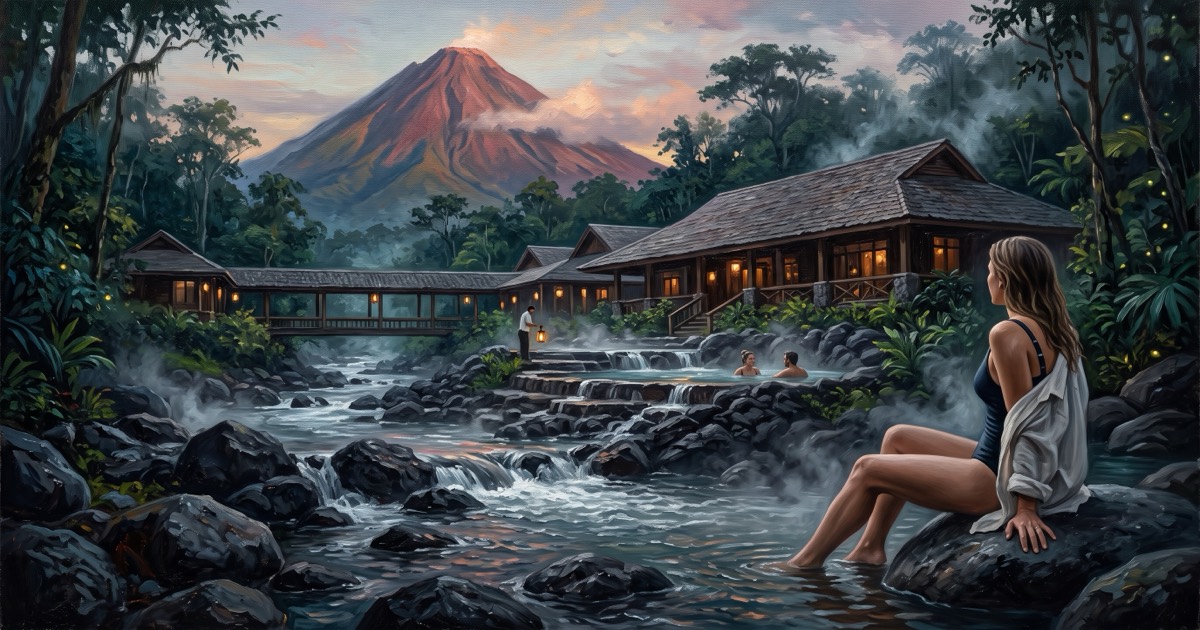
One property here runs structured wellness retreats with assessment and a set programme, and it is also the one offering the regenerative procedures described in the note below; the others are wellness resorts where rainforest, thermal water and the pace of the place do the work.
Find exclusively chosen Pura Vida Costa Rica wellness resorts here! Our team knows what truly matters for your next epic journey to wellness paradise. Saving you to be the best you can become at the most exceptional Costa Rica wellness resorts nestled in this biodiverse country haven. From oceanfront sanctuaries to rainforest retreats, we know the options that deliver exceptional experiences in one of the world's most unique wellness destinations. Ride the waves of this guided journey to your optimal wellbeing choices in Costa Rican luxury here.

Costa Rica's Pura Vida philosophy—literally "pure life"—is not just a greeting but a national ethos of contentment, connection to nature, and well-being that permeates every aspect of the country's wellness offerings. Home to 5% of the world's biodiversity despite covering just 0.03% of its surface, Costa Rica provides an unmatched natural pharmacy of medicinal plants, volcanic hot springs, and pristine ecosystems that serve as living classrooms for ecological wellness. Costa Rican wellness resorts harness this extraordinary biodiversity alongside the country's commitment to sustainability—over 99% of its electricity comes from renewable sources—creating healing environments where rainforest canopy walks, thermal volcanic waters, and organic farm-to-table cuisine converge.
Costa Rica Apex 6 Wellness Resorts 2026 — Comparison at a Glance
| Resort | Location | Type | Stay | Price Range | Best Season | Signature Experience | Wellness Focus |
|---|
| The Well at Hacienda AltaGracia | Pérez Zeledón | All-Inclusive | 3-14 nights | $$$$$ | Dec–Apr | Equestrian wellness & jungle lab | Mountain sanctuary & Auberge |
| Nayara Springs | Arenal | A La Carte | Flexible | $$$$ | Dec–Apr | Private volcanic hot spring villa | Adults-only thermal luxury |
| Tabacon Thermal Resort | Arenal | A La Carte | Flexible | $$$ | Dec–Apr | Natural thermal river under stars | Volcanic hot springs & rainforest |
| Four Seasons Papagayo | Guanacaste | A La Carte | Flexible | $$$$ | Dec–Apr | Peninsula canopy yoga platform | Pacific coast luxury wellness |
| Andaz Papagayo | Guanacaste | A La Carte | Flexible | $$$ | Dec–Apr | Rainforest waterfall meditation | Eco-adventure & beach wellness |
| The Retreat Costa Rica | Atenas | All-Inclusive | 3-10 nights | $$$ | Year-round | Crystal healing & sound baths | Yoga, detox & transformation |
Read This First: Medical Procedures Sold as Wellness
One property on this page offers procedures that are medical rather than spa treatments, several of them regenerative or longevity treatments with limited or contested evidence. They are named plainly for that reason.
- Exosome therapy warrants the clearest warning here. There are no FDA-approved exosome products for any use. In December 2019 the FDA issued a public safety notification after multiple patients in Nebraska suffered serious adverse events, including infections requiring hospitalisation, from products marketed as containing exosomes. Reported harms include severe infection, allergic reaction and tumour formation, and many such products are made without validated sterility procedures.
- NAD+ infusions are heavily marketed for energy, clarity and anti-ageing. Human evidence for those outcomes is limited, and no clinical-outcome trial establishes intravenous NAD+ as an anti-ageing treatment. Infusions are commonly unpleasant, with reported abdominal cramping, nausea, vomiting and diarrhoea, which is why they are given slowly over one to two hours.
- Intravenous nutrient infusions bypass the digestive regulation that normally limits absorption. Risks include site infection, vein inflammation, clotting, fluid overload and vitamin toxicity. Anyone with kidney or heart disease should not receive intravenous fluids except on their own doctor's instruction.
- Hormone results need interpretation in clinical context by a doctor who knows your history. Ask what is being tested and what you would do with the result before agreeing to it.
None of these is an accolade. Discuss any of them with your own doctor before you travel, not on arrival. Crystals, energy work and similar offerings are described here as part of a property's identity; there is no evidence they produce physical or medical effects, and nothing on this page depends on them working.
Frequently Asked Questions — Costa Rica Wellness Resorts
What does Pura Vida mean for wellness in Costa Rica?
Pura Vida — literally “pure life” — is far more than a greeting in Costa Rica. It’s a national philosophy of contentment, gratitude, and living in harmony with nature that permeates the country’s approach to wellness. Costa Rica consistently ranks among the world’s happiest nations, and the Nicoya Peninsula is one of only five identified Blue Zones globally where residents regularly live past 100. This cultural foundation means wellness in Costa Rica isn’t an imported luxury concept — it’s an authentic expression of how Costa Ricans live. The country’s commitment to sustainability (over 99% renewable electricity) and conservation (5% of the world’s biodiversity on 0.03% of its surface) reinforces this ethos at every wellness property.
What makes Arenal’s volcanic hot springs special for wellness?
Arenal Volcano, one of Costa Rica’s most active volcanoes, heats underground water systems that surface as naturally therapeutic hot springs ranging from 37°C to 65°C. These mineral-rich waters contain silica, sulfur, calcium, and magnesium with documented benefits for skin health, joint pain, muscle recovery, and stress reduction. Tabacon Thermal Resort is built directly along a natural thermal river where geothermally heated water cascades through tropical gardens — guests soak in the river itself under a canopy of rainforest. Nayara Springs offers private volcanic hot spring plunge pools in each adults-only villa. These are not artificially heated facilities — they are genuine geothermal resources powered by volcanic activity.
How does Costa Rica’s biodiversity enhance the wellness experience?
Costa Rica’s extraordinary biodiversity — home to over 500,000 species — creates natural healing environments that cannot be replicated artificially. Rainforest canopy walks, waterfall meditation, birdwatching (900+ bird species), and encounters with wildlife like howler monkeys, toucans, and sloths activate what scientists call “biophilia” — the innate human connection to nature that measurably reduces stress hormones. The Well at Hacienda AltaGracia is set within 900 acres of mountain reserve. Four Seasons Papagayo spans a private peninsula with both Pacific dry forest and tropical jungle. The Retreat Costa Rica sits at 2,000 feet elevation in an area with year-round spring-like temperatures. This biodiversity makes outdoor wellness programming in Costa Rica uniquely immersive.
How much do Costa Rica wellness resorts cost per night?
Costa Rica offers a range of price points. Tabacon Thermal Resort provides volcanic hot spring access from approximately $300–$600 per night a la carte. Andaz Papagayo offers rainforest and beach wellness from approximately $350–$700 per night. The Retreat Costa Rica provides all-inclusive yoga and detox programs from approximately $300–$600 per night including meals, treatments, and activities. Nayara Springs ranges from approximately $500–$1,200 per night with private hot spring pools. Four Seasons Papagayo ranges from $600–$1,500+ per night. The Well at Hacienda AltaGracia, an Auberge Resorts Collection property, is the most premium at approximately $1,000–$3,000+ per night all-inclusive with personalized wellness programming.
What is the best time to visit Costa Rica for wellness?
December through April is the dry season and most popular period for wellness travel, with sunny skies and lower humidity across most of the country. The Guanacaste province (Four Seasons Papagayo, Andaz Papagayo) is driest during this period. Arenal-area properties (Nayara Springs, Tabacon) can see rain year-round due to the microclimate around the volcano, but the hot springs are spectacular in light rain. The green season (May–November) brings afternoon showers, dramatically lush landscapes, lower rates, and fewer crowds — many wellness travelers prefer this period for its meditative atmosphere and vibrant natural energy. The Retreat Costa Rica’s highland location enjoys a year-round spring-like climate regardless of season.
BEST COSTA RICA WELLNESS RESORTS TOP 6 CURRENTLY - Equipoise
The verdant paradise of Costa Rica beckons the weary soul with its lush rainforests, volcanic mountains, and pristine coastlines. Within this Eden of natural splendor, a collection of extraordinary wellness resorts Costa Rica is famous for stands ready to transport you into dimensions of healing unknown to the common traveler. These premier Costa Rica wellness resorts merge the wild, untamed beauty of the country with sophisticated luxury and holistic healing traditions. As you explore the finest wellness resorts Costa Rica has to offer, expect to be transported beyond the frantic hum of modern existence into a world where time slows, the senses awaken, and the spirit communes with the primal forces of nature. The wellness resorts Costa Rica presents to discerning travelers represent not merely places to stay, but portals to a heightened state of consciousness and vitality that will leave you forever altered by the transformative power of Costa Rica wellness resorts.
A la carte
Pérez Zeledón, San Isidro de El General, 11901, Costa Rica
Stay options: flexible, from one night
The Well at Hacienda AltaGracia sits on a large estate in the Talamanca foothills in southern Costa Rica, in a partnership with the New York wellness brand The Well. The spa runs across treatment casitas linked by covered walkways through gardens, with thermal pools and meditation spaces. The setting — cloud forest, birdlife, mountain air — is the principal draw, and the property is genuinely remote.
One correction worth making, because it is widely repeated: the Talamanca region is not a Blue Zone. Costa Rica's recognised Blue Zone is the Nicoya Peninsula, on the Pacific coast several hours north. The phrase is used loosely across the travel industry, so treat it with care wherever it is attached to a hotel.
Treatments combine bodywork, Ayurvedic-influenced protocols and energy-based sessions. Ayurveda is a traditional medical system rather than an evidence-based one in the Western sense, and there is no evidence that crystals or energy work detect or correct anything physical — they are offered as experiences, and many guests find them calming.
The Puentes programme connecting guests with local communities is a genuine and unusual offering; where it involves traditional medicinal knowledge, that belongs to the communities concerned rather than to the resort. This is a luxury resort with a serious spa, not a clinic — no resident physician, no diagnostics. Practical: around three hours from San José by road, or a short domestic flight.
The Well at Hacienda AltaGracia Awards
Hacienda AltaGracia Recent Accolades
Editorial selections
- Condé Nast Traveler Gold List, 2025. An editors' selection rather than a judged award
Reader-voted rankings
- Sixth among favourite resorts in Central America, Travel + Leisure World's Best Awards, 2024
- Listed among Central America's leading resorts, Travel + Leisure World's Best Awards, 2026
Design
- Longlisted, leisure and wellness interiors category, Dezeen Awards, 2022. A longlisting, not a win
Hacienda AltaGracia holds no judged wellness or spa award. The recognition above is editorial selection, reader voting and a design longlisting, and is labelled accordingly.
The Well at Hacienda AltaGracia - Wellness Resort InfoHacienda AltaGracia is an all-inclusive Auberge Resorts Collection property of 50 casitas set across 180 acres in the Talamanca Mountains of southern Costa Rica, near Cajón in Pérez Zeledón. Its wellness centre, The Well, runs to more than 20,000 square feet and is built around Casa de Agua, a glassed-in bathhouse with a thermal circuit and a heated marble slab used for clay treatments. Casa de Agua also houses an Estée Lauder Skin Longevity Institute, which is genuinely unusual. Alongside the spa the property has a coffee farm, equine stables, organic gardens and a ropes course.
Unlike Nayara Springs elsewhere on this page, Hacienda AltaGracia is family friendly: children stay free, cots and babysitting are available and there is a children's pool.
Setting:
Mountains rather than coast — 180 acres of forest, coffee terraces and pasture in the Talamanca range, at elevation and noticeably cooler than Costa Rica's beaches. Casitas are spread across the hillsides with long views over the valley. Most guests arrive by light aircraft to the property's own airstrip, about 30 to 35 minutes from San José; the road transfer takes several hours. Wildlife is abundant, with sloths, hummingbirds and a butterfly garden on site.
Signature Spa Treatments:
- The Casa de Agua thermal circuit, centred on a heated marble slab where clay is applied
- Treatments opening with a purifying ritual of herbal exfoliation, local clay and house-made coffee butter
- Skin ritual facial, including consultation, exfoliation, hand-blended masks and lymphatic drainage
- Craniosacral therapy and bodywork
- Skin treatments through the Estée Lauder Skin Longevity Institute at Casa de Agua
Water Facilities:
- Casa de Agua bathhouse with a thermal circuit, glazed to the treetops
- Heated tepidarium, vitality pool and heated jet pool
- Aromatherapy steam room, sauna and recovery areas
- Hydrotherapy tub
- Outdoor and indoor swimming pools, including a children's pool
- Private plunge pool at the casitas
- River bathing on the property
Pools require chemical treatment and monitoring under public bathing regulation. Ozone, copper-silver and salt systems reduce or change how chlorine is delivered but do not eliminate it — a salt pool generates chlorine by electrolysis. No pool here is chemical-free.
Programmes include:
- Itineraries built individually before arrival by the resort's itinerary designers
- Treatment sequences combining the thermal circuit with bodywork and facials
- Movement programmes, from yoga to mindful movement classes outdoors
- Sleep-focused sessions and evening routines
- Nutrition guidance using produce from the property's gardens
Each incorporates:
- A consultation with the wellness team before or on arrival
- Use of the Casa de Agua circuit between treatments
- Time outdoors, on the trails, in the gardens or at the river
- Meals adapted where a guest wants them
These are spa and wellbeing offerings, not medical care: there is no resident physician, no laboratory and no diagnostic programme. The resort describes some experiences in spiritual terms — energy healing with a large quartz crystal, aura cleansing, and treatments said to draw on Blue Zone wisdom. Those are the resort's own framings and are offered as experiences; they are not established therapies, and this guide does not present them as such. Note also that Costa Rica's recognised Blue Zone is the Nicoya Peninsula, some distance from the Talamanca Mountains.
Additional Activities:
- Horse riding from the property's stables, with a resident equestrian programme
- Guided forest hikes, including waterfall walks and night hikes
- A ropes course and a ficus tree climb
- Coffee farm tours on the estate, and visits to local cacao farms
- Birdwatching and the butterfly garden
- Sound bathing, and Reiki offered in a tree net
- Culinary classes
Costa Rican and Latin American cooking across several restaurants, using produce from the property's organic gardens and coffee from its own farm. Because the resort is all-inclusive, dining is part of the rate rather than an add-on.
- Garden produce: Vegetables, greens and herbs grown on the estate
- Estate coffee: Beans from the property's own coffee farm, served at Mercado
- Local sourcing: Produce and proteins from farms in the surrounding region
- Venues: Grano for evening menus, Cienfuegos for fire cooking, Mercado for all-day food and coffee
- Dietary requirements: Accommodated on request; guests consistently note the range of lighter options
Menu highlights:
Menus change with the season and by restaurant, so specific dishes are not published in advance. Expect Costa Rican and Latin American cooking, with fire cooking at Cienfuegos and lighter options across the venues. Rodeo-show dinners are held periodically, tied to the property's equestrian programme. Dietary requirements are accommodated on request.
Accommodations:
- 50 hacienda-style casitas across the estate
- Expansive private terraces with valley and mountain views
- Private plunge pools at the casitas
- Connecting rooms available, and family amenities including cots
- A pillow menu with a choice of fills
Service Approach:
Each guest is assigned a Compa, the resort's term for a personal host who arranges activities and treatments. Itineraries are designed before arrival rather than booked on the day, which suits guests who want a full programme and less so those who prefer to decide as they go. Staff are drawn largely from surrounding communities, and the naturalist and equestrian teams are a genuine strength.
Estimated Pricing & Value:
- Casitas: around $1,100-1,950 per night by category and season
- Three-night stays: roughly $3,300-5,850
- Week-long stays: roughly $7,000-12,000
- Longer wellness stays: from around $15,000
Prices are indicative and change by season. Rates are all-inclusive, which makes direct comparison with the other properties on this page misleading unless you account for meals and activities. Confirm current rates and what is included directly with the resort.
Included:
As an all-inclusive property, rates cover meals, most activities, daily wellness sessions, use of the Casa de Agua circuit and fitness facilities, guided walks and transport within the estate. Spa treatments, the airstrip transfer and some excursions are charged separately — confirm what is included when booking.
FAQ:
What is The Well, and is it unique to this resort?
The Well is a wellness brand that operates in partnership with Auberge across several of its properties, and also runs a standalone club in New York. It is not exclusive to Hacienda AltaGracia, and copy suggesting otherwise — here or elsewhere — is misleading. What is particular to this location is the setting and the facilities: Casa de Agua, the thermal circuit, the marble slab, and the Estée Lauder Skin Longevity Institute housed within it. Treatments open with a standard purifying ritual using local clay and coffee butter from the estate's own farm, which is a real connection to the place rather than a marketing one.
How remote is it, and how do I get there?
Genuinely remote. The property has its own airstrip and most guests fly in from San José in a light aircraft, roughly 30 to 35 minutes. The alternative is a road transfer of several hours through the mountains. The flight is usually charged separately, so factor it in. Once you are there, the estate is large and spread over sloping ground, and transport within it is provided. The remoteness is the point — it is what makes the quiet and the wildlife possible — but it does mean you are committed for the length of your stay.
Does it suit families?
Yes, and this is worth stating clearly because the two best-known wellness properties in this Costa Rica selection differ on exactly this point. Hacienda AltaGracia accepts children, offers cots and babysitting, has a children's pool and connecting rooms, and guests regularly note that it handles families and couples in separate spaces well. Nayara Springs, by contrast, is adults only and will not accept children at all. If you are travelling with a family and want a wellness-led stay in Costa Rica, this is the property on this page to look at first.
A la carte
La Fortuna, Alajuela Province, Costa Rica
Stay options: flexible, from one night
Nayara Springs is an adults-only property near La Fortuna, below Arenal Volcano, where each villa has its own mineral hot spring plunge pool fed from the local thermal source. The villas open to rainforest, and the wildlife is genuinely present — howler monkeys, sloths and birdlife around the property rather than at a distance.
Two corrections. Volcanic mud and mineral-rich clay treatments are pleasant and leave skin feeling smooth; there is no evidence that trace elements draw toxins from skin tissue — skin does not work that way, and the liver and kidneys handle detoxification continuously. And the claim that this or any rainforest produces twenty percent of the world's oxygen is a persistent myth: most atmospheric oxygen comes from marine phytoplankton, and mature forests consume nearly as much oxygen as they release. Rainforest matters enormously for biodiversity and carbon storage — which is a better reason to protect it than an invented statistic.
What this property reliably offers is thermal bathing in a spectacular setting, privacy, and rainforest immediately outside. It is a luxury resort rather than a wellness programme — no medical team, no assessment. Practical: around three hours from San José, and the green season from May to November brings heavy afternoon rain and lower rates.
Nayara Springs Awards
Nayara Springs Recent Accolades
Wins
- Three MICHELIN Keys, MICHELIN Guide, 2025. The first hotel in Costa Rica to receive three Keys, from a global selection of more than seven thousand properties reviewed
- Costa Rica's Leading Hotel, World Travel Awards, 2023 and 2024
- Costa Rica's Best Wellness Retreat, World Spa Awards, 2023
- Four Leaves, Costa Rican Certification for Sustainable Tourism
Memberships
Rankings and nominations
- Sixth among resorts in Central America, Travel + Leisure World's Best Awards, 2026. A reader-voted ranking
- Nominee for World's Best Wellness Retreat, World Spa Awards, 2024
- Listed in the Condé Nast Traveler Readers' Choice Awards, 2023
- Ranked in The Luxury Spa Edit Awards, 2024
Nayara Resorts operates three separate properties in the Arenal area: Nayara Springs, which is adults only; Nayara Gardens, which is family friendly; and Nayara Tented Camp. Their awards are not interchangeable. The first place in Travel + Leisure's Central America resort ranking is held by Nayara Tented Camp, not by Nayara Springs, and only accolades awarded to Nayara Springs itself are listed above.
Nayara Springs - Wellness Resort InfoNayara Springs is an adults-only villa resort in rainforest near Arenal Volcano, and in 2025 became the first hotel in Costa Rica to receive three MICHELIN Keys — the guide's highest hotel rating, from a global review of more than seven thousand properties. Each villa has its own plunge pool fed by geothermally heated spring water, and the property is a member of Relais & Châteaux. It is a luxury hotel built around hot springs and rainforest rather than a clinical wellness destination: there is no medical team and no diagnostic programme.
Nayara Resorts runs three separate properties in the Arenal area. Nayara Springs is adults only. Nayara Gardens is family friendly, and Nayara Tented Camp is a third, distinct property. Their facilities, prices and awards differ.
Setting:
Rainforest at the base of Arenal Volcano, near La Fortuna. Villas are set among mature trees along stone paths and bridges, spaced for privacy and reached by electric buggy. The forest is genuinely working habitat: sloths, howler and capuchin monkeys, toucans and hummingbirds are seen regularly rather than occasionally. Arenal ended its eruptive phase in 2010, so the volcano is a view rather than a display of lava.
Signature Spa Treatments:
- Volcanic mud massage, the signature treatment, using local mineral clay
- Coffee exfoliation using Costa Rican beans
- Aromatherapy massage using oils from native plants
- Couples' treatments in open-air pavilions
Treatment rooms are cantilevered over the rainforest and open to it, which is much of the appeal and also means insects, humidity and birdsong. That suits most guests and not all.
Water Facilities:
- A private plunge pool at every villa, fed by geothermally heated spring water
- Spring-fed pools arranged across three levels in the rainforest, from cool to hot
- The warmest of these sits at around 38°C, a comfortable long-soak temperature
- Waiter service to the water's edge at the main pools
- Open-air showers in the villa gardens
The spring water is geothermally heated by Arenal, which is genuine and unusual. Built and recirculating pools still require treatment and monitoring under public bathing regulation; descriptions of pool water as chemical-free are not accurate, and salt systems generate chlorine by electrolysis rather than avoiding it.
Programmes include:
- Thermal soaking sequences using the pools across the three levels
- Treatment packages combining massage, mud and exfoliation
- Rest-focused stays built around unhurried use of the springs
- Botanical treatments using local plants
- Couples' packages
Each incorporates:
- A consultation with the spa team on preferences and any skin sensitivities
- Treatments arranged across a stay rather than in one day
- Time in the pools and the rainforest between treatments
- Menu options adapted on request
These are spa treatments, not medical or detoxification programmes. Warm mineral bathing is comfortable and helps many people relax and sleep. Claims that mineral content in spring water treats conditions, or that soaking detoxifies the body, are not supported by evidence — the liver and kidneys do that continuously. Anyone pregnant or with a cardiovascular condition should speak to a doctor before long hot soaks and stay in the cooler pools.
Additional Activities:
- Yoga in open-air pavilions facing Arenal
- Guided meditation in the rainforest
- Birdwatching with naturalist guides
- Rainforest walks to waterfalls
- Sloth-spotting walks on the property
- Arenal Volcano National Park, a short drive away
Costa Rican and Latin American cooking using local produce, across several restaurants including Mis Amores, Asia Luna and Amor Loco. Dietary requirements are accommodated on request; menus are not built around a wellness protocol.
- Garden produce: Leaves, herbs and edible flowers grown on the property
- Local sourcing: Root vegetables and produce from farms in the region
- Proteins: Local fish, free-range poultry, beans and grains
- Tropical fruit: Passion fruit, guanabana and cas, used across the menus
- Range: Several restaurants including an Asian kitchen, unusual for a property of this size
Menu highlights:
Menus change with the season and by restaurant, so specific dishes are not published in advance. Expect Costa Rican and Latin American cooking — ceviche, hearts of palm, plantain, local fish — alongside the Asian menu at Asia Luna, with vegetarian options throughout. Dietary requirements are accommodated on request.
Accommodations:
- Villas only, each free-standing and set among the trees for privacy
- A private plunge pool at every villa, fed by the springs
- Indoor-outdoor living space and an open-air shower in the garden
- Adults only — the property does not accept children
- A pillow menu with a choice of fills
Service Approach:
Costa Rican hospitality: warm and informal rather than formal, with a personal host arranging dining, treatments and excursions. Buggies run on call between the villas and the public areas, which matters because the property is spread through forest on sloping ground. Naturalist guides on staff are a genuine strength and worth using rather than walking the trails alone.
Estimated Pricing & Value:
- Villas: around $750-1,500 per night by category and season, with reports of about $1,000 as a typical rate
- Three-night stays: roughly $2,250-4,500
- Week-long stays: roughly $4,900-9,800
- Spa treatments charged separately
Prices are indicative and change by season. Confirm current rates directly with the resort.
Included:
Breakfast, yoga classes, guided birdwatching walks, use of the thermal pools and fitness facilities, and shuttle service to Arenal Volcano National Park. Spa treatments and excursions are charged separately.
FAQ:
What do three MICHELIN Keys mean?
MICHELIN extended its guide to hotels with the Keys system, reviewing more than seven thousand properties worldwide and awarding Keys to around 2,450 of them. Keys are judged on architecture, design, service, value and connection to local character, with three Keys the highest level. Nayara Springs received three Keys in 2025 and was the first hotel in Costa Rica to do so. Unlike the reader-voted rankings that dominate this industry, MICHELIN Keys are assessed by inspectors, which makes this the strongest single credential of any property in this Costa Rica selection.
What are the hot springs actually like?
Every villa has its own plunge pool fed by geothermally heated spring water, which is the reason most guests choose the property — you can soak privately at any hour without walking to a public area. Beyond the villas, pools are arranged across three levels in the rainforest, ranging from a cool plunge to a warm dip to a long soak, the warmest at around 38°C, with waiter service at the water's edge. The heat is genuinely geothermal rather than a boiler. What it offers is warmth, buoyancy and quiet; the mineral content is not a treatment and should not be judged as one.
Which Nayara property should I book?
This matters more than it sounds, because the three Arenal properties share a name and differ substantially. Nayara Springs is adults only, villa-based, and the one with three MICHELIN Keys and a private spring-fed pool per villa. Nayara Gardens is family friendly, so it is the one to book if you are travelling with children — Springs will not accept them. Nayara Tented Camp is a third property, safari-style tents above the forest, and it is the one that has topped Travel + Leisure's Central America resort ranking. Awards reported for one are frequently attributed to another; check which property a given accolade belongs to before it influences your booking.
A la carte
Km 21, Carretera La Fortuna-San Ramón, Alajuela Province, Costa Rica
Stay options: flexible, from one night; day passes available
Tabacón sits at the base of Arenal Volcano, where geothermally heated water runs through the property as a natural river system rather than a constructed circuit — pools, cascades and channels at varying temperatures through tropical gardens. It predates Costa Rica's wellness tourism boom by decades, and the thermal river remains the most impressive of its kind in the country.
On the water: bathing in warm mineral water is comfortable, relaxing and genuinely useful for musculoskeletal discomfort — warmth, buoyancy and enforced rest are real effects. Claims that specific mineral concentrations deliver documented therapeutic benefits are traditional rather than established, and this guide does not repeat them. The setting does the work.
The spa offers treatments alongside the thermal circuit, and day passes make it accessible without staying. This is a thermal resort rather than a clinic — no medical team, no programme.
Practical and worth knowing: Arenal is an active volcano and the area is monitored; follow any guidance from staff or authorities. The thermal water is hot, so limit sessions and hydrate, particularly in humid conditions. Around three hours from San José.
Tabacon Thermal Resort & Spa Awards
Tabacon Thermal Resort & Spa Recent Accolades
Wins
- World's Leading Green Resort, World Travel Awards, 2023 and 2024
- Mexico and Central America's Leading Green Hotel, World Travel Awards, 2023 and 2024
Rankings
- Ranked Best Spa Retreat, North and Central America, The Luxury Spa Edit Awards, 2024. A public vote
The two World Travel Awards titles are genuine wins in the sustainability categories, held in consecutive years. Note they recognise the resort's environmental practice rather than its spa.
Tabacon Thermal Resort & Spa - Wellness Resort InfoTabacon sits at the base of Arenal Volcano near La Fortuna, on a property of more than 900 acres of private rainforest reserve. Its distinguishing feature is genuine: a naturally flowing thermal river, heated by the volcano's magma, running through the gardens and forming pools and waterfalls rather than being pumped into constructed basins. Three springs surface on the property at around 50°C, producing roughly 80 litres per second, and this water is blended and cooled as it flows to give bathing pools across a comfortable range. A member of Small Luxury Hotels, the resort has around 100 rooms plus a spa in open-air bungalows.
Setting:
More than 900 acres of rainforest reserve at the foot of Arenal, about 13 km from La Fortuna. The thermal river follows its own course through the gardens, forming waterfalls, shallow shelves and deeper soaking pools, with the forest closing over much of it. Wildlife is genuinely present rather than decorative. Arenal stopped its eruptive phase in 2010, so the volcano is a backdrop rather than a spectacle — worth knowing if you have seen older photographs of glowing lava.
Signature Spa Treatments:
- Volcanic mud wraps using local mineral clay
- Kapi Kapi massage, the resort's signature treatment, using local botanicals
- Temazcal, a ceremonial steam bath drawing on Mesoamerican tradition
- Treatments in open-air bungalows set within the thermal gardens
Water Facilities:
- A naturally flowing thermal river forming more than twenty pools of differing size, depth and temperature
- Five main pools in the central bathing area, with a swim-up bar and a thermal water slide
- Cold-water pools set among the hot ones, for contrast
- Cascading thermal waterfalls, including sections used for shoulder and back massage
- Shangri-La Gardens, an adults-only area (18 and over) with quieter pools
- Two pools reserved for Grand Spa guests
Temperatures. The springs emerge at around 50°C (122°F), which is far too hot to enter — water at that temperature scalds. What guests bathe in is the river after cooling and blending: roughly 22-38°C (72-100°F) according to the resort, with some sources citing up to 40°C (105°F) in the hottest sections. Each pool is signposted with its own temperature; read the sign before getting in. Sulfur content is low, so there is none of the smell associated with many thermal springs.
Programmes include:
- Thermal circuit sequences moving between warmer and cooler pools
- Treatment packages combining soaking with massage and bodywork
- Stress and rest programmes built around unhurried use of the river
- Volcanic mud and clay rituals
- Spa days for guests not staying overnight
Each incorporates:
- An orientation to the thermal circuit and pool temperatures
- Soaking sequences paced across the day rather than in one session
- Treatments in the open-air bungalows
- Time in the gardens and on the forest trails
Warm mineral bathing is comfortable, eases muscle tension and helps many people sleep — that much is a reasonable expectation of warm water. Claims that thermal water neutralises acidity in the body, that its lithium content lifts mood, that silica promotes collagen, or that soaking eliminates toxins are not supported by evidence. Heat and pregnancy, heat and cardiovascular conditions, and heat and alcohol are all genuine risks: limit time in the hottest pools, hydrate, and check with a doctor first if you are pregnant or have a heart condition.
Additional Activities:
- Morning yoga beside the thermal river
- Guided meditation in the garden pavilions
- Forest walks within the private reserve
- Birdwatching with naturalist guides — toucans, sloths and howler monkeys are commonly seen
- Arenal Volcano National Park, a short drive away
- Evening soaking, when the gardens are lit and quieter
Costa Rican cooking using regional produce, across two main restaurants plus the swim-up bar. Menus can be adapted for dietary requirements; they are not built around a wellness protocol.
- Local produce: Vegetables, roots and greens grown in the volcanic soils of the region
- Root vegetables: Yuca, camote and malanga, prepared to traditional Costa Rican recipes
- Proteins: Freshwater fish, poultry from nearby farms, beans and grains
- Regional ingredients: Local honey, herbs and native fruit
- Dietary requirements: Accommodated on request across the restaurants
Menu highlights:
Menus change with the season and with what is available locally, so specific dishes are not published in advance. Expect Costa Rican cooking — casados, ceviche, plantain, rice and beans done properly — alongside international dishes, with vegetarian options throughout. The swim-up bar in the main thermal area serves drinks and light food without leaving the water.
Accommodations:
- Around 100 rooms and suites with volcano or rainforest views
- Design using local materials and construction techniques
- Private balconies facing the forest or the volcano
- Some suites with private jacuzzi or thermal plunge pool
- A pillow menu with a choice of fills, including hypoallergenic options
Service Approach:
Warm and informal, in the Costa Rican manner rather than the formal European one. Staff give an orientation to the thermal circuit on arrival, which is genuinely useful given the number of pools and the range of temperatures. Many staff come from La Fortuna and the surrounding communities and know the area well, which shows in the guiding and the naturalist walks.
Estimated Pricing & Value:
- Rooms: $350-750 per night by category and season
- Day passes for the thermal springs: $85-120
- Three-night packages: roughly $1,050-2,250
- Week-long stays: roughly $2,100-4,900
- Spa treatments charged separately
Prices are indicative and change by season. Confirm current rates directly with the resort.
Included:
Unlimited access to the thermal river and pools during your stay, breakfast, entry to the adults-only Shangri-La Gardens, morning yoga, a thermal circuit orientation, and shuttle service to La Fortuna.
FAQ:
How hot is the water, and is it safe?
The springs surface at about 50°C (122°F). That is a source temperature, not a bathing temperature — water at 50°C causes burns, and nobody gets into it. By the time the river reaches the bathing areas it has cooled and blended to roughly 22-38°C (72-100°F), with some sources citing up to 40°C (105°F) in the hottest sections. Every pool is signposted with its temperature. Sensible practice is the same as any hot spring: start in a cooler pool, limit time in the hottest to fifteen or twenty minutes, alternate with the cold pools, drink water, and do not combine long hot soaks with alcohol. If you are pregnant or have a cardiovascular condition, speak to your doctor before soaking and stay in the cooler pools.
What makes Tabacon different from other Arenal hot springs?
Most thermal resorts pump spring water into built pools. At Tabacon the thermal river runs its own course through the property and the pools are formed along it, continuously fed and renewed rather than filtered and recirculated. Three springs surface here at around 50°C, producing about 80 litres per second — a large flow, which is what makes the free-flowing approach possible. The water is roughly 97 per cent rainwater that has percolated underground and been heated by magma, with only a small magmatic fraction, and its sulfur content is low. That combination of volume, temperature and low sulfur is genuinely unusual and is the honest reason to choose Tabacon over its neighbours — not any therapeutic property of the minerals themselves.
How should I plan the thermal circuit?
Take the orientation on arrival; with more than twenty pools it saves wandering. Begin in a cooler pool to acclimatise, then move up in temperature, keeping the hottest sections short and alternating with the cold pools. Several shorter visits across a stay work better than one long session, mainly because prolonged heat leaves most people flat rather than rested. Mornings are quietest; evenings are atmospheric with the gardens lit. Note that Shangri-La Gardens is adults-only at 18 and over, so families should plan around the main bathing areas.
A la carte
Península Papagayo, Guanacaste Province, 50101, Costa Rica
Stay options: flexible, from one night, with multi-day wellness packages
Four Seasons Peninsula Papagayo occupies a narrow neck of land in Guanacaste with the Pacific on one side and Culebra Bay on the other — two beaches, two aspects, and tropical dry forest through the property. The architecture uses organic curved forms; the setting and the wildlife are the draw.
The spa offers treatments using local ingredients — volcanic mud, tropical fruit, highland coffee — alongside a fitness and performance offering. On the optimisation framing: exercise programming, sleep, nutrition and recovery are well-evidenced and genuinely worth doing. Claims about enhancing cellular function or unlocking full potential are marketing language rather than measurable outcomes, and this guide does not repeat them.
On sound sessions described as shamanic: these draw on imagery from Indigenous traditions of the Americas. A resort spa running a sound session is not practising a shamanic tradition, and no partnership with an Indigenous community is published here. They are pleasant and often calming, which is a reasonable expectation.
This is a large luxury resort with an excellent spa and strong family facilities rather than a wellness programme — no medical team, no assessment. Practical: around 30 minutes from Liberia airport, which makes it among the most accessible properties on this page, and the dry season from December to April is the busiest.
Four Seasons Resort Costa Rica Awards
Four Seasons Resort Costa Rica Recent Accolades
Ratings
- Five Stars, Forbes Travel Guide, awarded in consecutive years including 2023, 2024 and 2025. Forbes ratings are assessed by anonymous inspectors rather than voted
Reader-voted rankings
- First among resorts in Central America, Condé Nast Traveler Readers' Choice Awards, 2024
- Included in the Travel + Leisure It List, 2024
Nominations
- Nominated for Costa Rica's Leading Resort, World Travel Awards, 2023 and 2024
- Nominated for Costa Rica's Best Incentive Hotel, World MICE Awards, 2024
- Nominated across several World Travel Awards categories, 2025
Correction: this block previously listed Costa Rica's Leading Resort as a win. World Travel Awards records Fiesta Resort as the 2024 winner of that title, so the entries are shown here as nominations. The Forbes Five-Star rating is the property's strongest credential, being inspected rather than voted.
Four Seasons Resort Costa Rica at Peninsula Papagayo - Wellness Resort InfoFour Seasons Resort Costa Rica sits on the Peninsula Papagayo in Guanacaste, on a narrow isthmus with a beach on either side — Playa Virador facing the Pacific and Playa Blanca on the sheltered Culebra Bay. It is a full-service luxury resort with a spa, an Arnold Palmer-designed golf course, tennis, watersports and a children's programme, rather than a wellness clinic: there is no medical team, no diagnostics and no supervised programme. Its strengths are the setting, the range of activities and Four Seasons' operational consistency.
Setting:
Peninsula Papagayo is a private peninsula in northwestern Guanacaste, and the resort occupies its narrowest point, which is what allows a beach on each side within a short walk. The two differ usefully: the Pacific side has surf, the bay side is calm and better for swimming and paddleboarding. The surrounding habitat is tropical dry forest, a distinct and comparatively rare ecosystem in Costa Rica that is markedly drier than the rainforest most visitors picture, with a pronounced dry season from around December to April.
Signature Spa Treatments:
- Cacao-based body treatments using Costa Rican chocolate
- Clay body wraps
- Bamboo massage, worked with warmed canes
- Four-hands massage with two therapists
- Facials and standard spa bodywork
Water Facilities:
- Infinity pools overlooking the ocean
- An adults-only quiet pool
- A children's pool and splash area
- Hydrotherapy facilities within the spa
- Private plunge pools with selected suites and residences
- Swimming from both beaches, with the bay side calmer
Pools require chemical treatment and monitoring under public bathing regulation. Saline, UV, ozone and copper-silver systems change how sanitiser is delivered but do not remove the need for it — a saline pool generates chlorine by electrolysis. No pool here is chemical-free.
Programmes include:
- Treatment sequences arranged across a stay rather than booked singly
- Fitness programmes with the resort's trainers
- Rest and stress-focused sequences combining massage with quiet time
- Sports and post-exercise recovery treatments
- Couples' treatments
Each incorporates:
- A consultation with the spa team on preferences and any sensitivities
- Treatments ordered to build across the stay
- Use of the pools, beaches and fitness facilities between treatments
- Menu options adapted on request
These are spa treatments, not clinical programmes. There is no medical assessment, no diagnostics and no published outcome data, and claims sometimes made in this category — anti-ageing, burnout recovery as a treatable protocol — should be read as marketing rather than medicine. Anyone managing a health condition should speak to their own doctor before booking.
Additional Activities:
- Surfing lessons on the Pacific-facing beach
- Paddleboarding and paddleboard yoga in Culebra Bay
- Guided nature walks with the resort naturalist
- Golf on the Arnold Palmer-designed course
- Tennis with coaching available
- Non-motorised watersports, included in the rate
- A supervised children's programme
Costa Rican and international cooking across several venues, using local produce and fish landed nearby. Menus are adapted for dietary requirements on request; they are not built around a wellness protocol.
- Seafood: Fish landed locally on the Guanacaste coast
- Produce: Vegetables, fruit and herbs from Costa Rican growers
- Proteins: Meat from regional ranches, alongside plant-based options
- Lighter options: Available across the venues for guests who want them
- Families: Children's menus alongside the main offering
Menu highlights:
Menus change with the season and by venue, so specific dishes are not published in advance. Expect Costa Rican coastal cooking — ceviche, local fish, plantain, rice and beans — alongside international dishes, with vegetarian options throughout. Dietary requirements are accommodated on request.
Accommodations:
- Rooms, suites and multi-bedroom private residences with ocean or forest views
- Indoor-outdoor living spaces oriented to the sea breeze
- Private terraces, and plunge pools with premium categories
- Connecting rooms and family configurations available
- A pillow menu with a choice of fills, including hypoallergenic options
Service Approach:
Standard Four Seasons service delivered by Costa Rican staff: consistent, attentive and reliable, with the brand's usual strength in handling families and special requests without fuss. The naturalist guiding is a genuine asset given the dry forest habitat, which rewards knowing what to look for. This is a resort that does a lot of things well rather than one thing exceptionally, which suits guests wanting variety over immersion.
Estimated Pricing & Value:
- Rooms: around $850-3,500 per night by category and season
- Three-night stays: roughly $2,550-10,500
- Week-long stays: roughly $5,500-21,000
- Private residences: around $4,500-12,000 per night
- Spa treatments charged separately
Prices are indicative and vary sharply between the dry and green seasons. Confirm current rates directly with the resort.
Included:
Non-motorised watersports, fitness centre access, guided morning walks, selected fitness classes, the children's programme and Wi-Fi. Meals, spa treatments and golf are charged separately.
FAQ:
What is actually distinctive about the location?
The resort sits on the narrowest part of the peninsula, so there is a beach on each side within a few minutes' walk — the Pacific side with surf, the Culebra Bay side calm enough for swimming and paddleboarding at almost any time. That is genuinely useful rather than a marketing line: it means the conditions you want are usually available on one side or the other. The surrounding habitat is tropical dry forest, which is drier and more seasonal than the rainforest most visitors expect, and looks strikingly different between the dry and green seasons.
Is this a wellness destination or a resort with a spa?
A resort with a spa, and a very good one, but not a wellness destination in the sense used elsewhere in this guide. There is no medical team, no assessment and no structured multi-day protocol of the kind at Chenot or Clinique La Prairie. What it offers is breadth: golf, tennis, surfing, watersports, a children's programme and a spa, all run to Four Seasons standards. If you want a family holiday with excellent spa access, this is a strong choice on this page. If you want a supervised wellness programme, look at the more clinical properties instead.
When should I go?
Guanacaste has a pronounced dry season from roughly December to April, which is the peak period: reliable sun, brown-gold landscape, highest rates. The green season from May to November brings afternoon rain, a far greener and more alive landscape, better wildlife activity and materially lower prices, with September and October the wettest. For a beach-focused stay the dry season is the safer choice; for value and for seeing the dry forest at its most vivid, the shoulder months either side are worth considering.
A la carte
Península Papagayo, Guanacaste Province, Costa Rica
Stay options: flexible, from one night
Andaz Costa Rica Resort at Península Papagayo sits on the same peninsula in Guanacaste, on Culebra Bay, in buildings using curved organic forms that step down the hillside to the beach. It is more relaxed and less formal than the Four Seasons on the same peninsula, and its terraced layout gives most rooms a bay view.
The offering combines activity — kayaking, paddleboarding, hiking and mountain biking in the surrounding tropical dry forest — with a spa using local botanical ingredients. The bay itself is calm and good for swimming, which is not true of every Pacific beach in Guanacaste.
One correction worth making, since it is often repeated in the region: Guanacaste is not itself a Blue Zone, though it is the nearest province to one. Costa Rica's recognised Blue Zone is the Nicoya Peninsula, to the south — reachable as a long day trip but a separate place. Programmes drawing on Blue Zone ideas are borrowing a framework rather than operating within one, and the phrase is used loosely across the travel industry. The underlying lifestyle elements — daily movement, plant-led diet, social connection, purpose — are sensible regardless of setting.
This is a resort with a good spa rather than a wellness programme: no medical team, no diagnostics. Practical: around 30 minutes from Liberia airport.
Andaz Costa Rica Resort Awards
Andaz Costa Rica Resort Recent Accolades
Wins
- Latin America's Best Incentive Hotel, World MICE Awards, 2023
Nominations
- Nominated for Costa Rica's Leading Resort, World Travel Awards, 2023 and 2024
- Nominated for Costa Rica's Best Incentive Hotel and Latin America's Best Incentive Hotel, World MICE Awards, 2024
- Nominated across several World Travel Awards categories, 2025
Correction: this block previously listed Costa Rica's Leading Resort 2024 as a win. World Travel Awards records Fiesta Resort as that year's winner, so the entry is shown as a nomination.
Andaz Peninsula Papagayo Resort - Wellness Resort InfoAndaz Costa Rica sits on a hillside above Culebra Bay on the Peninsula Papagayo, in Guanacaste. It is Hyatt's design-led brand rather than a wellness operator: the property's distinguishing feature is its architecture, by the Costa Rican architect Ronald Zürcher, whose forms draw on local wildlife and shell shapes. There is a spa, tiered pools, a beach and an active programme, but no medical team, no assessment and no clinical wellness offering. It is also the most affordable property in this Costa Rica selection by a clear margin.
Setting:
A wooded hillside on the Peninsula Papagayo, looking down over the sheltered water of Culebra Bay, in tropical dry forest — drier and more seasonal than the rainforest most visitors expect, and visibly different between the dry and green seasons. The buildings step down the slope, which means views from most rooms and a certain amount of walking or shuttling between them. Ronald Zürcher's architecture is the reason many guests choose the property over its neighbours.
Signature Spa Treatments:
- Body scrubs using Costa Rican ingredients including purple corn and honey
- Body treatments using local botanicals and clay
- Massage worked with wooden tools
- Coffee-based body wraps using Costa Rican beans
- Standard massage and facial treatments
Water Facilities:
- Tiered infinity pools stepping down the hillside toward the bay
- An adults-only quiet pool
- A family splash area
- Hydrotherapy facilities in the spa
- Private plunge pools with selected suites
- Swimming from the beach on Culebra Bay, which is sheltered and calm
Pools require chemical treatment and monitoring under public bathing regulation. Bromine, salt chlorination, copper-silver ionisation and peroxide systems change how sanitiser is delivered rather than removing the need for it — a salt pool generates chlorine by electrolysis, and bromine is itself a chemical sanitiser. No pool here is chemical-free.
Programmes include:
- Treatment sequences arranged across a stay
- Fitness programmes with the resort's trainers
- Rest and stress-focused sequences
- Cultural activities and workshops with local practitioners
- Couples' treatments
Each incorporates:
- A consultation with the spa team on preferences and sensitivities
- Movement, food and rest considered together rather than treatments alone
- Use of the pools, beach and fitness facilities between treatments
- Menu options adapted on request
These are spa and resort offerings, not clinical programmes: there is no medical assessment, no diagnostics and no published outcome data. Coffee wraps and similar treatments are pleasant and exfoliating; they do not detoxify the body, which the liver and kidneys do continuously.
Additional Activities:
- Sunrise yoga above Culebra Bay
- Paddleboarding in the sheltered bay
- Trail running and walking in the dry forest
- Beach fitness sessions
- Cooking classes using Costa Rican ingredients
- Craft workshops with local artisans
- Access to the wider Peninsula Papagayo, including golf, by shuttle
Costa Rican cooking using local produce and fish landed nearby, across several venues. Dietary requirements are accommodated on request; menus are not built around a wellness protocol.
- Seafood: Fish landed on the Guanacaste coast
- Produce: Vegetables, fruit and herbs from Costa Rican growers
- Proteins: Regional poultry and meat, alongside bean and grain dishes
- Local ingredients: Tropical fruit, herbs and Costa Rican coffee
- Lighter options: Available across the venues for guests who want them
Menu highlights:
Menus change with the season and by venue, so specific dishes are not published in advance. Expect Costa Rican coastal cooking — ceviche, hearts of palm, local fish, plantain, rice and beans — alongside international dishes, with vegetarian options throughout. Dietary requirements are accommodated on request.
Accommodations:
- Contemporary rooms and suites with floor-to-ceiling glazing to the bay or forest
- Private balconies, most with a hammock
- Interiors and architecture drawing on local wildlife and shell forms
- Plunge pools with selected suites
- A pillow menu with a choice of fills
Service Approach:
Andaz uses a host model rather than a conventional front desk, so arrival and requests are handled by a member of staff who stays with you rather than at a counter. The style is informal and younger in feel than the Four Seasons on the same peninsula, which suits some travellers and not others. Staff include guides and cultural hosts who run the workshops and walks.
Estimated Pricing & Value:
- Rooms: around $450-1,200 per night by category and season
- Three-night stays: roughly $1,350-3,600
- Week-long stays: roughly $2,800-7,200
- Day passes for non-guests: around $150-250, subject to availability
- Spa treatments charged separately
Prices are indicative and vary sharply between the dry and green seasons. This is the most affordable of the Costa Rica properties in this guide; confirm current rates directly.
Included:
Morning yoga, non-alcoholic minibar items, selected cultural activities, use of the fitness centre, pool and beach access, and shuttle service within Peninsula Papagayo. Meals and spa treatments are charged separately.
FAQ:
How does this compare with the Four Seasons on the same peninsula?
They sit on the same peninsula and differ in register and price. The Four Seasons occupies the isthmus with a beach on each side, has the Arnold Palmer golf course and a broader activity programme, and costs roughly twice as much. Andaz is on a hillside above Culebra Bay, is informal and design-led, and is the better value of the two by a wide margin. Neither is a wellness clinic. Choose the Four Seasons for breadth and families, Andaz for architecture, atmosphere and price.
What does Andaz's design actually amount to?
More than most resort architecture. Ronald Zürcher is a well-known Costa Rican architect and the buildings genuinely respond to the site, stepping down the hillside with forms drawn from local wildlife and shells, using timber and stone rather than imported resort vernacular. Whether that matters to you is personal, but it is the property's real distinction and the honest reason to choose it — rather than any wellness claim. Note the practical consequence: a hillside site means steps and slopes, and getting around involves more walking or shuttle use than a flat beachfront property.
When should I go?
Guanacaste's dry season runs roughly December to April: reliable sun, a brown-gold landscape, peak rates. The green season from May to November brings afternoon rain, a much greener setting, better wildlife activity and materially lower prices, with September and October the wettest. Mornings are usually clear even in the green season, so outdoor activity is generally possible; the shoulder months of May, June and November offer the best balance of weather and value.
A la carte
Barrio Jesús de Atenas, Alajuela Province, Costa Rica
Stay options: flexible nightly stays, plus structured wellness programmes of roughly three to ten nights.
The Retreat Costa Rica is an adults-only property of 25 rooms in the hills above Atenas, about thirty minutes from San José airport, with long views west toward the Gulf of Nicoya. It was founded by Diana Stobo, a wellness author and chef, and its programme is built around Ayurvedic treatment, plant-based anti-inflammatory food from the property's own gardens, twice-daily yoga and an 8,000 square foot spa. The setting is genuinely good: highland elevation gives it a mild, dry climate that is markedly more comfortable than Costa Rica's coast.
The property is built on quartz-bearing ground, and crystals are central to how it presents itself — in treatments, in the rooms, and in the founder's own description of the place. Those are the resort's beliefs about its site, offered as part of the experience. This guide reports them as such and does not present crystal energy as having physical or medical effects, because there is no evidence that it does.
The Retreat Costa Rica Recent Accolades
Reader-voted rankings
- Sixth among Destination Spas and Resorts worldwide, Condé Nast Traveler Readers' Choice Awards, 2024
- Ninth among Destination Spas worldwide, Condé Nast Traveller UK Readers' Choice Awards, 2023
- Best Spa Retreat, South America, The Luxury Spa Edit Awards, 2024 and 2025. A public vote
Judged awards
- Excellence Award for its Ayurveda programme, Spa & Wellness MexiCaribe Awards, 2023
Memberships and certifications
- Small Luxury Hotels of the World, member
- Healing Hotels of the World, certified member
Publication listings
- Listed in the Sunday Times World's 50 Best Spas
- Featured in Forbes and in Condé Nast Traveler's rooms-with-a-view selection
Most of the recognition above is reader-voted or editorial listing rather than inspected assessment. That is normal in this sector, but it is a different thing from a judged award and is labelled accordingly.
The Retreat Costa Rica - Wellness Resort Info - At A Glance
An adults-only, 25-room Ayurvedic and plant-based retreat in the highlands above Atenas
The Retreat Costa Rica is a small adults-only property of 25 rooms set in highlands above Atenas, roughly thirty minutes from San José's airport. Its centre is the Vida Mia spa, around 8,000 square feet, with a resident Ayurvedic practitioner trained in Kerala and a programme of Panchakarma and related treatments. Food is entirely plant-forward, dairy-free, gluten-free and without refined sugar, with a large share grown on site. A Santosha wellness club adds a lap pool, yoga shala and further accommodation. Programmes run three to ten nights alongside ordinary room bookings.
Some offerings here are medical procedures rather than spa treatments — intravenous infusions, NAD+, exosomes, PRP and hormone therapy. These require proper medical assessment, carry real risks, and have varying and in several cases limited evidence behind them. They should be discussed with your own doctor before you travel, not decided on arrival.
Setting:
Highland ridge above Atenas in Alajuela province, at elevation, with views down toward the Gulf of Nicoya and the Pacific beyond. The Atenas microclimate is well known in Costa Rica for being mild and dry — warm days, cool nights, low humidity and comparatively few insects — which makes it far more comfortable for a week of treatments than the humid coast. The property sits on quartz-bearing ground and guests can collect small specimens on walks. It is thirty minutes from the airport, which is unusually convenient for a retreat of this kind.
Signature Spa Treatments:
- Shirodhara, the Ayurvedic warm-oil stream to the forehead
- Pizhichil, warm-oil immersion in the Kerala tradition
- Panchakarma protocols with the resident Ayurvedic practitioner
- Signature massage using the spa's own oil blends
- Deep tissue and remedial massage
- Body scrubs and wraps, including crystal-themed rituals
- Outdoor clay bath in the forest
- Vichy shower hydrotherapy
Water Facilities:
- Two saltwater infinity pools with views west toward the Pacific
- A quiet saltwater pool at the Vida Mia spa
- The Santosha lap pool, a single 50-foot lane
- Vichy shower room with overhead jets
- Cold plunge at the spa
- Chromotherapy steam room and infrared sauna
Pools require chemical treatment and monitoring under public bathing regulation. A saltwater pool is not chlorine-free: it generates chlorine from dissolved salt by electrolysis. UV systems reduce the chlorine needed but do not replace it. Descriptions of these pools as chemical-free are not accurate.
Programmes include:
- Authentic Ayurveda: a seven-night Panchakarma programme with the resident Kerala-trained practitioner. The property's strongest and most coherent offering
- Detox and cleanse: a seven to ten-night programme combining plant-based food, treatments, infrared sauna and cooking classes
- Rest and burnout: a five-night programme built around sleep, quiet and nervous-system recovery
- Menopause support: a seven-night programme; note that the hormone element is medical treatment, not a spa service
- Emotional wellbeing: a five-night programme combining bodywork, meditation and talking support
- Fitness and weight management: a seven-night programme with training, nutrition and treatments
Each incorporates:
- An initial consultation with the wellness team
- Plant-based meals from the property's gardens
- Twice-daily yoga and meditation
- A treatment plan across the stay
- Guidance for continuing at home
Read this before booking a programme. Weight-loss figures are sometimes quoted for detox programmes at properties of this kind. Rapid loss over a week or ten days is mostly water and glycogen and returns quickly; a specific promised amount is not a reasonable expectation and is not repeated here. Anyone with a history of disordered eating should approach cleanse and weight programmes with particular care and speak to their own clinician first. “Adrenal fatigue” is not a recognised medical diagnosis — persistent exhaustion warrants proper investigation. Programmes addressing trauma, anxiety or menopause are not a substitute for psychological or medical care, and anyone under treatment should continue it and tell their own doctor about anything they plan to undertake here.
Additional Activities:
- Twice-daily yoga, morning and late afternoon, in the mountaintop shala
- Guided meditation and yoga nidra
- Sound sessions with singing bowls, and cacao ceremonies
- Cooking classes several times a week, covering raw food, juicing and plant-based technique
- Guided walks through coffee plantation, forest and river trails
- Quartz collecting on the property
- Optional medical treatments including intravenous infusions and regenerative procedures
The optional medical treatments are administered by a doctor and charged separately. They are elective procedures with real risks and, for several of them, limited or contested evidence. Discuss them with your own physician before travelling rather than deciding on site.
All food is plant-forward, dairy-free, gluten-free and free of refined sugar, with a large proportion grown in the property's own organic gardens. This is one of the more genuinely committed kitchens of its kind: the restriction is the concept rather than an option, so it suits guests who want that and will frustrate those who do not.
- Garden produce: Vegetables, greens, herbs and tropical fruit grown on the property
- Estate coffee: Grown and roasted on site
- Proteins: Local fish and poultry alongside beans, pulses and plant proteins
- Approach: Anti-inflammatory in intent, prepared without refined sugar, dairy or gluten
- Venues: Several, including the Sol terrace and the Mystique rooftop
Menu highlights:
Menus change with the season and with what the gardens are producing, so specific dishes are not published in advance. Expect vegetable-led cooking, pressed juices, chia and fruit at breakfast, estate coffee, and multi-course dinners at the terrace and rooftop restaurants. The kitchen accommodates further dietary requirements on request, though note the whole menu is already dairy-free, gluten-free and refined-sugar-free.
Accommodations:
- 25 rooms across several categories, adults only
- No televisions or telephones in the rooms, by design
- Santosha lofts, the newest category, with freestanding soaking tubs and Pacific views
- Original lofts named after plants on the property, with high ceilings and balcony swing chairs
- Premium and deluxe rooms with valley or ocean views and private terraces
- A three-bedroom villa for groups
- A pillow menu with a choice of fills
Service Approach:
Small scale and informal, with long-serving staff and a founder still closely involved. Resident practitioners include the Kerala-trained Ayurvedic therapist and a doctor overseeing the medical treatments; yoga teachers rotate. With 25 rooms the attention is genuinely personal, and returning guests are remembered. The style is warm and unhurried rather than polished-corporate, which is the point of the place.
Estimated Pricing & Value:
- Rooms: around $400-665 per night by category and season
- Santosha lofts: around $545-665 per night, with breakfast and yoga
- Three-night introductory programmes: roughly $1,200-2,000
- Week-long programmes: roughly $4,500-7,500 including accommodation, meals and treatments
- Seven-night Ayurveda programme: from around $8,000
- Three-bedroom villa: from around $3,330 per night
Prices are indicative and change by season. Medical treatments are charged separately and can add substantially. Confirm current rates and what a programme includes directly.
Included:
Breakfast, twice-daily yoga, use of the pools and fitness facilities, guided walks, drinking water and Wi-Fi. Airport transfer is included on wellness programmes of five nights or more. Treatments outside a programme, and all medical procedures, are charged separately.
FAQ:
What about the crystals?
The property is built on quartz-bearing ground, crystals appear in the rooms and treatments, and the founder describes the site's energy as central to what the place is. That is a sincere and consistent part of its identity, and guests who find it meaningful report it adds to the stay. It is worth being straightforward, though: there is no evidence that proximity to quartz, or crystal-infused water, produces any physical or medical effect. Nothing here depends on it working. What does reliably do you good — a week of plant-based food, twice-daily yoga, real sleep, no screens and skilled bodywork at a comfortable altitude — is entirely independent of the geology.
How serious is the Ayurveda?
More serious than most. There is a resident practitioner trained in Kerala, where the tradition is strongest, and the seven-night Panchakarma programme follows recognisable protocols rather than offering Ayurvedic-styled spa treatments. That is unusual outside India and is the property's most substantial credential. Ayurveda is a traditional system rather than an evidence-based medical one, and should be approached as such: it can be a valuable, structured week, and it is not a treatment for a diagnosed condition.
Who does this suit, and who should think twice?
It suits adults wanting a small, quiet, structured week with genuinely committed plant-based food, daily yoga and Ayurvedic treatment, close to the airport and in a comfortable climate. It suits less well anyone wanting resort facilities, a beach, or flexibility about food — the kitchen is entirely dairy-free, gluten-free and sugar-free, and that is not adjustable. Think twice, and speak to your own doctor first, if you are considering the medical treatments, if you have a history of disordered eating and are drawn to the cleanse programmes, or if you are hoping a retreat will substitute for medical or psychological care that you need.