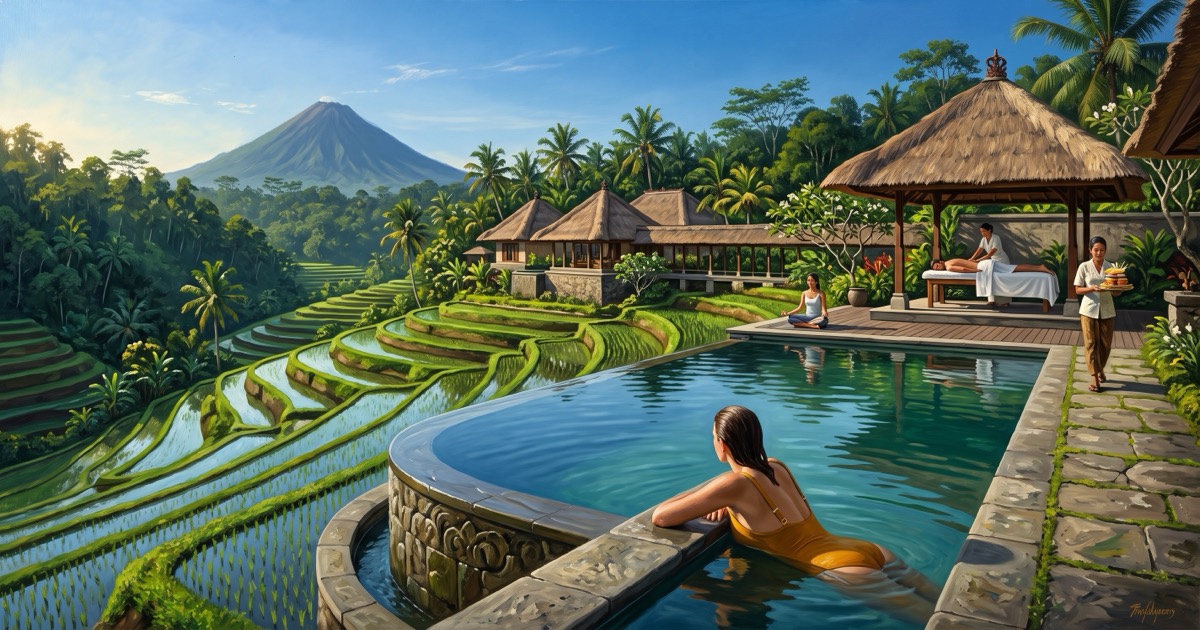
Independently researched rankings of the best wellness resorts and wellness retreats in Bali, from Ubud jungle sanctuaries above the Ayung gorge to clifftop retreats on the Bukit peninsula.

Bali Wellness Resorts: Your Gateway to Holistic Revitalization! Experience serenity in Bali, the "Island of Gods," where distinguished wellness resorts offer unparalleled sanctuaries for those seeking profound rejuvenation amid breathtaking natural settings that range from mist-shrouded highland estates to dramatic oceanfront compounds. Our meticulously evaluated selection of Bali wellness resorts delivers metamorphic experiences that harmoniously blend indigenous Balinese healing traditions with innovative therapeutic approaches, allowing guests to immerse themselves in this volcanic paradise where ancient temples neighbor emerald rice terraces and prismatic coral reefs fringe spectacular coastlines, all while masterful practitioners implement personalized wellness protocols designed to elevate physical vitality, mental clarity, and spiritual connection in some of Earth's most extraordinary environments.
Bali's wellness culture is inseparable from its Hindu-Balinese spiritual traditions, where healing is considered sacred and practitioners known as Balian have passed down their craft through generations. The island's Tri Hita Karana philosophy, harmony with God, nature and fellow humans, shapes much of what is offered, from melukat water purification ceremonies in holy springs to offerings-laden spa rituals. Set among rice terraces, volcanic peaks and temples, Bali's wellness resorts combine that living religious practice with international standards of treatment, which is a genuinely unusual pairing and the reason the island draws the volume it does.
| Resort | Location | Type | Stay | Price Range | Best Season | Signature Experience | Wellness Focus |
|---|---|---|---|---|---|---|---|
| COMO Shambhala Estate | Ubud | A La Carte | Flexible | $$$$ | Apr to Oct | Balinese healer consultations | Ayurveda & nature immersion |
| Fivelements Sanctuary | Ubud | All-Inclusive | 3-7 nights | $$$ | Apr to Oct | Sacred Balinese rituals | Plant-based cuisine & sacred arts |
| Mulia Resort & Villas | Nusa Dua | A La Carte | Flexible | $$$$ | Apr to Oct | Mulia Spa ice room circuit | Luxury beachfront wellness |
| Sukhavati Ayurvedic | Tabanan | All-Inclusive | 5-14 nights | $$$ | Year-round | Panchakarma with Indian doctors | Authentic Ayurveda & Panchakarma programmes |
| Ayana Resort Bali | Jimbaran | A La Carte | Flexible | $$$ | Apr to Oct | Spa on the Rocks ocean treatment | Aquatonic seawater therapy |
| REVĪVŌ | Nusa Dua | All-Inclusive | 3-14 nights | $$$ | Year-round | Revival longevity assessment | Longevity programmes & spa therapies |
Bali Wellness Resorts: Extraordinary Sanctuaries for Holistic Renewal
Bali has become one of Asia's principal wellness destinations, and the six properties below span the full range of what that now means on the island. They include physician-led Ayurveda practised in its classical Kerala form, Balinese healing delivered in a bamboo sanctuary on the Ayung river, a thalassotherapy complex among the largest in Asia, and beachfront resorts where wellness is one pleasure among many. Ubud and the hills hold the retreats built for structure and quiet; the southern coast holds the resorts built for comfort and scale. Each profile below sets out which is which.
From misty jungle compounds with mineral-rich thermal springs to elevated coastal retreats perched above azure waters, these exceptional Bali wellness resorts seamlessly integrate authentic Balinese healing traditions with pioneering wellness methodologies. Guests discover sacred spaces where ancient rituals and evidence-based treatments coexist in perfect harmony, creating personalized experiences that address every dimension of human wellness.
Whether you seek intensive purification protocols, inner spiritual awakening, or simply an elegant sojourn infused with health-enhancing elements, these carefully selected wellness sanctuaries deliver profound renewal through the expertise of master practitioners working within environments meticulously designed to nurture optimal vitality. Each distinctive property illuminates Bali's extraordinary capacity to facilitate deep restoration through its combination of mystical natural settings, nutrient-dense cuisine crafted from island-grown ingredients, and comprehensive wellness programs that honor timeless practices while embracing advanced approaches to physiological flourishing.
For the discerning wellness traveler exploring Bali's top wellness destinations, these sanctuaries represent the absolute pinnacle of what the island offers: nourishing experiences that resonate long after departure, creating lasting shifts in wellbeing that extend far beyond the tropical paradise where they first took root.
COMO Shambhala Estate occupies a 22-acre private sanctuary of riverine forest above the Ayung River near Ubud, roughly fifteen minutes from the town and ninety from Denpasar airport, on land the Balinese hold sacred for its spring, The Source, and its alignment with four temples. Opened as Begawan Giri and reborn under COMO, it calls itself a retreat for change: around 30 suites, residences and villas on the forested hillside, most with private pools and butlers, and a three-night minimum. Resident experts, an Ayurvedic doctor, a Chinese medicine practitioner, yoga and Pilates masters, nutritionists and activity guides, sit behind the programme, which begins with a body-composition scan and consultation before it is built. Signature all-inclusive Wellness Paths run from three to ten nights on goals such as detox, fitness and rebalancing, while bespoke retreats and a simple a la carte stay are equally possible, with hydrotherapy, a vitality pool, a climbing wall and jungle trekking alongside COMO Shambhala Cuisine. Among Indonesia wellness resorts it is the most complete: a serious wellness retreat that still functions as a beautiful hotel. Children under sixteen are welcome only when a villa or residence is booked entirely.
Fivelements Retreat Bali opened in late 2010 at Mambal, twenty minutes south of Ubud, on the banks of the sacred Ayung River, and remains one of the most purposeful wellness retreats in Indonesia. It is small, around twenty bamboo and timber riverfront and pool suites built in the shape of a spiral, with volcanic stone bathtubs and open Balinese bathrooms, and it is organised entirely around healing rather than leisure. Treatments are delivered by Balinese healers working within direct generational lineages, following the Sekala-Niskala principle of the seen and the unseen, and the framework draws on Tri Hita Karana and Panca Mahabhuta, the five elements that give the retreat its name. Programmes typically run from three to fourteen nights and combine purification rituals, Watsu water therapy, yoga, meditation, energy work and sacred-arts journeys to cave temples and rainforest with local healers. The Sakti Dining Room, a bamboo pavilion over the river, serves award-winning plant-based and living-foods cuisine treated as part of the therapy. Choose it when the healing work is the point of the trip; it is not a beach holiday, and there is no medical supervision.
The Mulia, Mulia Resort and Mulia Villas sit together on Geger Beach at Nusa Dua, on the southern peninsula about twenty minutes from Denpasar airport, and represent the grand end of Indonesia wellness resorts: a beachfront estate of monumental scale, with hundreds of rooms and villas, a long private stretch of sand and one of the largest resort spas on the island. Mulia Spa is the reason it belongs on this page. Its hydrotherapy circuit is unusually serious for a beach resort, with ice fountains, a Roman-style bath, plunge pools, steam and sauna, and treatment rooms and couples' villas that run to Balinese, Thai and European traditions, alongside daily yoga and a large fitness centre. Wellness here is entirely a la carte: guests book the resort and take treatments, circuits and classes as they choose, with no programme, no minimum stay and no medical supervision. That, plus the beach, the pools and a spread of restaurants, makes it the choice for families and for couples where only one of the pair wants a wellness retreat; a guest seeking quiet, structure or transformation should look to Ubud or the hills.
Sukhavati Ayurvedic Retreat and Spa is a small Ayurvedic centre in the village of Mengwi, inland in the Tabanan direction about forty minutes from Denpasar airport, set among rice paddies above the Penet River with the mountains behind. It is an Indonesia wellness retreat in the Indian sense rather than the Balinese one: eight villas only, one and two bedrooms, several with private pools, and a programme built on panchakarma, the traditional Ayurvedic purification sequence, prescribed by an Ayurvedic doctor after consultation and supported by vegetarian cuisine cooked to each guest's constitution. Stays are all-inclusive and sold by length: three to six nights as an introduction focused on rest and treatment, seven to fourteen for a genuine panchakarma, and up to twenty-one days for deeper work on burnout, autoimmune conditions, arthritis, weight or insomnia. Days follow a set rhythm of morning yoga and pranayama, daily oil treatments such as abhyanga and shirodhara at the riverside spa pavilions, seminars and village walks. It is the most authentic Ayurveda on this page and the right choice for someone treating something specific; it is not a place for couples wanting a resort, and there is no beach.
AYANA Resort Bali is the flagship of a 90-hectare clifftop estate above Jimbaran Bay, about ten kilometres from Denpasar airport, and Bali's only fully integrated resort: four hotels sharing fourteen pools, a private white-sand beach reached by cliff lift, twenty-six dining venues including the cliffside Rock Bar, and an 18-hole putting course. Its wellness credentials rest on Thermes Marins Bali, a two-storey spa with 53 treatment rooms and villas, including Spa on the Rocks, two treatment villas set on a rock outcrop in the sea, and the centrepiece: one of the world's largest Aquatonic seawater therapy pools, fed directly from the Indian Ocean and warmed, with twelve hydromassage stations and more than sixty jets for thalassotherapy. Wellness is taken a la carte, with no programme, minimum stay or medical supervision, and the resort welcomes families with a full kids' club. Among Indonesia wellness resorts it is the one for a guest who wants a proper Bali holiday, sunsets, beach, restaurants, with a world-class thalasso spa inside it; anyone wanting a structured wellness retreat will be better served at COMO Shambhala or REVIVO.
REVIVO Wellness Resort opened in April 2018 in the quiet hills of Nusa Dua in southern Bali, twenty minutes from the airport, spread across three hectares of teak forest with the Indian Ocean beyond. Its name means I live again, and the scale is deliberately intimate: around 22 Balinese-style suites and villas, a gourmet restaurant, a 50-metre lap pool, a yoga barn, Pilates and fitness studios, an aerial yoga deck, a hydrotherapy spa with hot and cold plunge pools, infrared saunas, steam rooms and a salt-water floating pool, and a vitality centre for advanced longevity and beauty therapies. Stays follow five named pillars, sleep, stress, nutrition, movement and vitality, and are sold as personalised programmes on goals such as detox, weight, sleep enhancement, de-stress and emotional balance, with up to three fitness classes a day, daily treatments and a nutrition plan written for each guest; a la carte journeys are also possible. It is the most programme-driven of the Indonesia wellness resorts on this page and the right choice for a guest who wants measurable structure in a small, quiet setting; there is no beach on site, though a shuttle runs down to one.
A 22-acre riverine forest above the Ayung gorge outside Ubud, arranged around a spring the Balinese consider holy
COMO Shambhala EstateOf all Bali's wellness properties, COMO Shambhala Estate is the one built around a specific piece of ground rather than dropped onto it. A 22-acre riverine forest on the hillside above the Ayung River outside Ubud, organised around The Source, a natural spring locals regard as holy and which still supplies the estate. Five residential houses hold the rooms and villas, connected by paths under old banyan trees. The wellness offering runs on individually built Paths combining Balinese practice, Ayurveda and Chinese medicine with contemporary nutrition.
Setting:
A 22-acre riverine forest on the hillside above the Ayung River, roughly twenty minutes north of central Ubud and considerably further in feel. Banyan trees and dense planting separate the residences, and the buildings step down the slope rather than levelling it, so nothing on the estate is entirely flat. The river is audible almost everywhere. Guests should know the site involves genuine stairs and inclines, which is either a feature or a consideration depending on the guest.
Signature Spa Treatments:
Ayurveda and Traditional Chinese Medicine are traditional medical systems with their own training and lineages rather than evidence-based ones in the Western sense. Treatments here are skilled and pleasant; they are not a substitute for medical care.
Water & Wellness Facilities:
Constructed pools require chemical treatment and monitoring under bathing regulation, whatever their water source.
Advanced wellness programs include:
Each program incorporates:
These are wellness programmes rather than medical care: there is no resident physician and no diagnostics. Detox and cleanse describe programme categories rather than a physiological process: the liver and kidneys handle that continuously. What a lighter diet, daily movement, skilled bodywork and proper rest reliably deliver is feeling considerably better after several days, which is a sufficient reason to come. Anyone under medical treatment should discuss a programme with their own doctor first.
Additional Wellness Activities:
Melukat is a living Balinese Hindu purification rite rather than a spa treatment. Guests are welcome to take part; dress modestly and follow the guidance given.
COMO Shambhala Cuisine has been copied widely enough across Asian wellness properties that it is easy to forget it started here. The principle is nutritional balance without loss of pleasure, built on organic local ingredients and minimal processing. The estate has two restaurants: glow, the all-day home of COMO Shambhala Kitchen, which has been nominated at the World Culinary Awards on its own account, and Kudus House, which serves Indonesian breakfasts and dinners in a residence about 150 years old.
Menu Highlights:
Black cod arrives in a golden coconut and turmeric broth threaded with ginger flower, the fish barely holding together, the broth doing most of the work. A vegetable mosaic follows, local heirloom varieties cut precisely over beetroot purée, each element cooked to its own point rather than uniformly. This is food that would hold up in a restaurant with no wellness claim attached, which remains the hardest thing for this category to achieve.
Accommodations:
Service Approach:
A personal assistant is assigned to each guest for the stay, coordinating the programme, dining and activities, which on a hillside estate with treatments spread across several levels is genuinely useful rather than ceremonial. The team combines internationally trained wellness practitioners with local healers from the surrounding villages, and that mix is the estate's real distinction: the Balinese practice here is delivered by Balinese practitioners rather than imported and imitated.
Estimated Pricing & Value:
Pricing is indicative and varies by season; confirm current rates directly with the estate. Note that programme prices exclude accommodation, so the real cost of a week is both figures combined.
Included:
Daily breakfast, the scheduled wellness activity programme, use of the hydrotherapy facilities, guided morning walks, and access to The Source. Wellness programmes add consultations, treatments and individual nutritional guidance.
FAQ:
How does this compare with Bali's other wellness properties?
Bali has no shortage of wellness resorts, and most were built as resorts first. COMO Shambhala was conceived as a healing estate from the outset, which shows in how the site is organised: around the spring, along the contours, with treatment spaces distributed rather than concentrated in a spa building. The wellness team spans internationally trained practitioners and local healers, and the Balinese element is delivered by Balinese people. For guests choosing between Ubud properties, the practical distinction is that here the programme drives the stay rather than decorating it.
What is The Source?
A natural spring on the estate, regarded locally as holy, which supplies water across the property and is the site of melukat water blessing ceremonies conducted in the Balinese tradition. Its presence determined where the estate was built and how it was laid out. Guests can attend blessings there, and the spring water is used in treatments and throughout the property. It is worth understanding melukat as a living Hindu religious practice rather than a wellness treatment; the estate treats it accordingly, and guests are asked to as well.
How individual are the programmes?
Genuinely so. Every guest is assessed on arrival to establish health profile, preferences and objectives, and both the treatment schedule and the kitchen work from that. Meal plans are built with the culinary team rather than selected from a spa menu, and programmes are adjusted through the stay rather than fixed at the start. Guests with specific health conditions or dietary requirements are accommodated as a matter of routine, though anyone under medical treatment should discuss their programme with their own doctor beforehand, particularly for the cleanse protocols. Note also that the estate is built on a steep hillside with substantial stairs, which is worth weighing if mobility is a consideration.
Inspected ratings
Within Indonesia
Across Asia
Global rankings
This is a long record, and almost all of it is reader votes and rankings rather than inspection; the Forbes Four-Star rating and the MICHELIN Key are the exceptions. The Condé Nast Readers' Choice placings are decided by reader ballot, and the World Spa Awards entries are nominations decided by industry and public voting.
Sustained high placing in reader votes is still meaningful: appearing in the world top ten of destination spas in consecutive years, and taking “Forever Icon”, reflects a property that guests return to and recommend over a long period. Read it as durable reputation rather than assessed quality.
Also featured in: Neck Pain
A bamboo retreat on the Ayung at Mambal, built around Balinese healing practice and plant-based cuisine
Fivelements Retreat BaliFivelements is the most culturally specific property on this list, built on Balinese healing philosophy rather than borrowing from it. Nine bamboo suites sit along the Ayung River at Mambal, and programmes combine work with traditional Balinese healers, plant-based cuisine and sacred arts practice. The architecture is bamboo throughout, which is both an ecological position and the reason the place looks like nowhere else in Bali. Small, deliberate, and considerably less expensive than the island's better-known wellness names.
Setting:
The retreat sits along the Ayung River at Mambal, south of Ubud and away from its traffic. Bamboo structures rise directly from the riverbank, built with minimal foundations and no attempt to level the ground. Treatment rooms and meditation spaces are open-sided, so the river and the birds are constant. The scale is small enough that the whole property can be walked in a few minutes, which is unusual in a category that tends toward sprawl.
Signature Spa Treatments:
Balinese healing is a traditional practice with its own lineage rather than an evidence-based medical system. Treatments here are skilled and culturally grounded; they are not a substitute for medical care.
Water & Wellness Facilities:
Constructed pools require chemical treatment and monitoring under bathing regulation, whatever their water source.
Advanced wellness programs include:
Each program incorporates:
These are wellness and cultural programmes rather than medical care: no physician, no diagnostics. Detox describes a programme category rather than a physiological process; the liver and kidneys handle that continuously. A few days of plant-based food, daily movement, bodywork and rest reliably leaves people feeling considerably better, which is reason enough. Anyone under medical treatment should speak to their own doctor first.
Additional Wellness Activities:
Melukat and the fire blessings are living Balinese Hindu religious practices rather than spa treatments. Guests are welcome to take part; dress modestly and follow the guidance given. On the plant walks: identification is educational; do not gather or consume wild plants on the strength of a guided walk.
The Sakti Dining Room has a reputation well beyond the retreat, and deservedly: this is plant-based cooking treated as a serious cuisine rather than a restriction. Much of the menu is raw or prepared at low temperature, a technique that preserves texture, colour and volatile aromatics which conventional cooking destroys. The results are genuinely inventive, and the reason a number of guests book for the food and discover the rest afterwards.
Menu Highlights:
A morning lotus bowl arrives as dragonfruit cream under tropical fruit set in a mandala, with sprouted quinoa for texture. The tasting menu runs through a sequence of small plates, each drawn from a different Balinese microclimate, opening with an earthy note from local heirloom mushrooms. Nothing on the menu contains animal products and almost nothing announces the fact, which is the highest compliment available to a plant-based kitchen.
Accommodations:
Open-sided bamboo buildings in a river valley mean insects, humidity and ambient noise are part of the experience. That suits most guests here and will not suit everyone.
Service Approach:
Fivelements works from Tri Hita Karana, the Balinese principle of harmony between people, nature and the divine, and staffs accordingly. Team members are chosen for their connection to Balinese healing practice as much as for hospitality skill, and a number come from families of traditional healers. The effect is that the cultural content of a stay here is delivered by people for whom it is not content at all.
Estimated Pricing & Value:
Pricing is indicative and varies by season; confirm current rates directly with the retreat. Note that programme prices here include accommodation, which is not the case at every property in this guide; it makes Fivelements markedly better value than the comparison suggests.
Included:
Retreat programmes include accommodation, all meals, daily rituals, sacred arts sessions, wellness consultations and the treatments matched to the programme. A journal and supporting material are provided for continuing the practices afterwards.
FAQ:
Is the food genuinely good, or good for plant-based?
Genuinely good, and the Sakti Dining Room's reputation extends well past the retreat's guests. The kitchen works largely raw or at low temperature, which preserves texture, colour and aromatics that heat would destroy, and uses fermentation, dehydration and sprouting to build flavour and complexity. Ingredients come from the retreat's permaculture gardens. The claim worth being careful about is the one made across raw food generally, that low-temperature preparation preserves enzymes the body then uses; digestion breaks those down regardless, so that is not where the benefit lies. The better argument is simpler: the food tastes exceptional and is built almost entirely from vegetables, fruit, nuts and seeds.
How authentic are the Balinese healing traditions here?
This is the property on the page where the cultural element is most clearly genuine rather than borrowed. Fivelements works directly with Balian, traditional Balinese healers from lineages that have carried these practices across generations, and melukat ceremonies are conducted by priests rather than staff. The healing spaces follow Balinese design principles rather than spa convention. For guests, that means an experience which can feel unfamiliar rather than comfortable, which is rather the point. Worth understanding clearly: these are living religious and cultural practices, not therapies with measurable outcomes, and they should be approached with that respect rather than as treatments being purchased.
How substantial is the sustainability commitment?
It is structural rather than added on, and visible on the ground, which is the right standard for any sustainability claim. The buildings are bamboo, a fast-renewing material grown locally, designed to sit on the riverbank with minimal intervention. The kitchen is entirely plant-based, which carries a materially lighter footprint than a resort kitchen serving meat. Staff are local and purchasing supports Balinese farmers. The retreat also contributes to Ayung watershed protection and village initiatives, which matters in an area where tourism pressure on water is considerable.
Nominations
Public votes
Distinctions
Two TripExpert awards and a KAYAK Travel Awards ranking are aggregator scores derived from reviews and booking data rather than awards. Entries from Haute Grandeur Global Excellence Awards (two), LUXE Global Awards and Luxury Lifestyle Awards come from entrant-nominated programmes rather than independent assessment.
What remains contains no judged wins (only nominations and one public vote), and that is worth knowing rather than inferring from a long list.
It is also beside the point here. Fivelements' real distinction is what it does: it is among the very few properties in Bali where the Balinese healing element is delivered by Balian from genuine lineages and melukat is led by priests, rather than performed by staff trained into it. That is a harder thing to achieve than any award on this page, and no awarding body measures it.
Note also that the property renamed from Fivelements Sanctuary to Fivelements Retreat; older award listings may appear under the former name.
Forbes Five-Star luxury on Nusa Dua beach, with a spa that holds its own separate rating
Mulia Resort & Villas Nusa DuaThe Mulia occupies a secluded stretch of Nusa Dua beach on Bali's southern peninsula, and approaches wellness from the direction of luxury hotel-keeping rather than clinical retreat. It holds Forbes Five-Star for the resort and a separate Forbes Four-Star for Mulia Spa, both inspector-assessed rather than voted, which is rare and tells you the spa is a serious operation rather than an amenity. The hydrotherapy circuit is the centrepiece, built on European contrast bathing traditions, and the property is unapologetic about pairing all of it with nine restaurants and considerable grandeur.
Setting:
A quiet section of Nusa Dua's white sand beach on the southern peninsula, facing the Indian Ocean. The grounds are formal rather than jungly: landscaped gardens, reflecting pools and monumental statuary, on a scale that is the opposite of the Ubud properties. The wellness facilities sit within that, moving between interior and exterior spaces. Guests choosing between Bali's wellness options should note this is beach and grandeur rather than jungle and simplicity.
Signature Spa Treatments:
Marine algae and mineral wraps are pleasant and leave skin feeling smooth; there is no evidence they draw out toxins or deliver minerals through the skin.
Water & Wellness Facilities:
Contrast bathing (alternating hot and cold) is enjoyable and there is some evidence it helps perceived recovery after exercise. Chromotherapy, or coloured light, is pleasant with no established physiological effect. Pools require chemical treatment and monitoring under bathing regulation.
Wellness programmes include:
Each program incorporates:
These are spa and fitness offerings rather than medical care: no physician, no diagnostics, no outcome data. Anti-ageing describes a treatment category rather than an effect: no topical treatment reverses ageing. Anyone with a history of disordered eating should approach weight-management packages with care and speak to their own clinician first.
Additional Wellness Activities:
Nine restaurants and bars, and no pretence that all of them are wellness venues. A dedicated wellness menu runs alongside the rest, offering nutritionally considered dishes prepared to the same standard as everything else. The kitchens are taken seriously in their own right, and the property does not pretend otherwise.
Menu Highlights:
Menus change with the season and by venue, so specific dishes are not published in advance. Expect contemporary international cooking with Asian influence across the nine venues, alongside a separately maintained wellness menu. The honest position here is that the kitchen is not trying to be a wellness kitchen: both offerings exist, and both are done properly.
Accommodations:
Service Approach:
Asian warmth held to European precision, and the Forbes Five-Star rating is external verification that the standard is genuinely met rather than claimed; Forbes assess by inspection rather than reader vote, which is why it carries more weight than most hotel accolades. Service is attentive without hovering. In the spa, therapists carry international certification alongside traditional training, which is what allows the Balinese treatments and the European hydrotherapy circuit to sit under one roof without either feeling like a compromise.
Estimated Pricing & Value:
Pricing is indicative and varies by season; confirm current rates directly with the resort. Note that programme prices exclude accommodation, so the real cost of a wellness stay is both figures combined.
Included:
Rates include daily breakfast, use of the fitness centre and swimming pools, and selected wellness activities. Villa stays add butler service, private airport transfers and afternoon tea. Wellness packages cover the specified treatments, facility access and selected tailored meals.
FAQ:
How does this compare with Bali's dedicated wellness retreats?
It is a different proposition and should be understood as one. COMO Shambhala and Fivelements are wellness properties that provide accommodation; The Mulia is a luxury resort with a wellness operation serious enough to hold its own Forbes rating. Guests wanting a structured programme with assessment, prescribed treatments and controlled nutrition will be better served elsewhere on this list. Guests wanting an excellent hydrotherapy circuit, capable therapists and the option of a very good dinner afterwards will find this suits them considerably better. Both are legitimate; the mismatch only occurs when someone books expecting the other.
Can wellness and indulgence coexist here?
That is the property's explicit position, and it is a defensible one. Guests can take the hydrotherapy circuit in the morning and a full dinner in the evening without anyone implying they have failed. The culinary programme runs both wellness-focused and indulgent options at the same standard, and treatments range from therapeutic to frankly pampering. The underlying argument is that restriction is not the only route to wellbeing, and that for a great many people a week of genuine pleasure and rest does more good than a week of discipline they will abandon on returning home.
What makes the hydrotherapy circuit worth the visit?
It follows European spa tradition properly, which is rarer in Southeast Asia than it should be: hot and cold experiences arranged in a deliberate sequence rather than assembled as a collection of features. Chromotherapy, aromatherapy and acoustic elements run through the journey. The construction in Italian marble and natural stone holds temperature the way tile does not, which matters more to the experience than it sounds. Both guided sessions with a therapist and self-directed use are available. What it reliably delivers is warmth, cold, buoyancy and an hour of enforced stillness, which is a sufficient reason to book it without needing a physiological claim attached.
Inspected ratings
Judged awards
Reader-voted rankings
Nominations
Listings
Distinctions
Entries are grouped by type above, since inspected ratings, judged awards, reader votes and nominations measure very different things.
The Forbes Five-Star rating, held in consecutive years and assessed by inspectors, is the strongest credential here. Note also that Mulia Spa holds its own Forbes Four-Star rating separately from the resort: a spa inspected in its own right, which on a wellness page is the entry that matters most. Only Rosewood Mayakoba and Grand Velas in this guide hold a separately rated spa at the five-star level.
The property is also a substantial conference venue, which several entries above reflect. That is worth knowing when weighing it as a wellness stay.
Classical Kerala Ayurveda practised properly, in a Balinese river valley away from the tourist coast
Sukhavati Ayurvedic Retreat & Spa BaliSukhavati is the most doctrinally strict property on this list: classical Ayurveda as practised in Kerala, established with the guidance of Indian Ayurvedic physicians and following traditional protocol rather than a spa adaptation of it. Seven villas sit on two hectares in the Penet River valley at Bebengan, well away from the tourist coast. Programmes run from three days to a full twenty-one-day Panchakarma, and the longer ones are demanding rather than restful. This is a retreat for people who want the tradition applied seriously.
Setting:
Two hectares in the Penet River valley at Bebengan, with terraced gardens dropping toward the water. Banyan trees and planted medicinal beds fill the grounds. Treatment pavilions and meditation spaces follow Vastu Shastra, the Indian architectural tradition, rather than Balinese convention, which is consistent with everything else here. The village setting, away from the tourist areas, means the retreat is genuinely quiet.
Signature Spa Treatments:
Water & Wellness Facilities:
Advanced wellness programs include:
Each program incorporates:
Additional Wellness Activities:
Meals follow classical Ayurvedic nutritional principle, matched to each guest's constitution and to the stage of their programme. Ingredients are fresh and largely from the retreat's own gardens, and food combining and timing are treated as seriously as content, which in this tradition they are.
Menu Highlights:
Golden kitchari brings split mung beans and aged basmati under turmeric and cumin ground that morning, the dish this tradition returns to for good reason: it is easy to digest and complete. A rasayana bowl follows with cultured coconut yoghurt, amla powder and forest honey over soaked nuts. The food is deliberately gentle, since the point of the programme is to reduce digestive load rather than impress.
Accommodations:
Service Approach:
Ayurvedic doctors and therapists trained in Kerala institutions are on site throughout a guest's stay, and the same practitioners follow each guest from start to finish. That continuity matters on a protocol where the treatment changes daily according to how the previous day went. Staff are chosen for their grounding in the tradition as much as for technique, and many come from Ayurvedic backgrounds in India or Bali.
Estimated Pricing & Value:
Pricing is indicative and varies by season; confirm current rates directly with the retreat.
Included:
Programmes include villa accommodation, dosha-specific meals, herbal teas and prescribed formulations, daily Ayurvedic treatments, yoga and meditation, consultations, nutritional guidance and airport transfers. Longer programmes add follow-up support and home care recommendations.
FAQ:
How authentic is the Ayurveda here?
Unusually so for a property outside India. Sukhavati was established with guidance from Ayurvedic doctors in Kerala and follows classical protocol rather than the abbreviated spa versions common elsewhere. Herbs and oils are sourced from certified suppliers in India, therapists are trained at recognised Ayurvedic institutions, and treatment rooms are built to traditional specification. Assessment covers prakriti, the individual constitution, and vikriti, current imbalance, and the whole programme follows from that. Guests expecting a spa experience with Ayurvedic branding should look elsewhere; this is the tradition applied as it is practised in Kerala.
What does Panchakarma actually involve?
Panchakarma proceeds in three phases: Purvakarma, the preparatory stage; Pradhankarma, the main elimination procedures; and Paschatkarma, the rejuvenation that follows. In Ayurvedic terms the sequence loosens and clears ama, the accumulated residue the tradition holds responsible for imbalance, before rebuilding. Protocols are individual rather than standard, and internal herbal preparations run alongside the external treatments. Worth knowing before booking: a genuine Panchakarma is demanding, involves procedures that can be uncomfortable, and is not a relaxing holiday. Guests should discuss suitability with the retreat and with their own doctor beforehand, particularly if managing a medical condition or taking prescribed medication.
What should I realistically expect?
Guests most commonly report better digestion, improved sleep, lower stress and clearer energy, alongside a changed relationship with food and a more attentive sense of what their body is asking for. Those are the effects the tradition aims at and the ones guests describe most consistently. What Ayurveda should not be presented as is a treatment for diagnosed medical conditions: it works alongside conventional medicine rather than replacing it, and anyone under treatment should continue with their own physician and discuss the programme with them first. The retreat is clear that the lasting value lies in dinacharya, the daily routines guests take home, rather than in the fortnight itself.
Entrant-nominated programmes
Distinctions
Every entry above comes from an entrant-nominated programme rather than an independently judged award. World Luxury Hotel Awards, LUXlife Magazine, Luxury Lifestyle Awards and Luxury Travel Guide all operate on models where properties enter or are invited, and outcomes are not assessed by inspection. They are grouped together here because presenting them as wins alongside judged awards would misrepresent what they measure.
Sukhavati's genuine distinction is what it does rather than what it has been given: it is one of the few properties in Bali running authentic Ayurvedic medicine with resident doctors, and Panchakarma over the durations the classical protocols actually assume rather than compressed into a spa week. Judge it on that.
Ayurveda is a traditional medical system with its own training and practitioners rather than evidence-based medicine in the Western sense, and a programme here is not treatment for a diagnosed condition.
Ninety hectares of clifftop above Jimbaran Bay, built around one of Asia's largest thalassotherapy pools
Ayana Resort BaliAYANA occupies ninety hectares of limestone clifftop above Jimbaran Bay, and its wellness proposition rests on Thermes Marins Bali, a thalassotherapy complex built around an Aquatonic seawater pool that ranks among the largest in Asia. Traditional Balinese practice runs alongside the French thalassotherapy tradition. Twelve pools and nineteen restaurants and bars across the estate make this the largest property on this list by a considerable margin, and the one that most comfortably combines a wellness stay with a family holiday.
Setting:
Limestone cliffs above Jimbaran Bay, on ninety hectares that hold gardens, private beaches and natural grottos alongside several distinct resort areas. The scale means the estate reads as a small district rather than a hotel, and guests can find quiet corners despite the size. Spa villas and relaxation areas sit along the cliff edge, so treatments happen with the Indian Ocean directly below.
Signature Spa Treatments:
Chakra-based treatments and chromotherapy are pleasant and often calming; there is no evidence they detect or correct anything physical. Melukat is a living Balinese Hindu religious rite rather than a spa treatment; guests are welcome to take part, and should approach it as such.
Water & Wellness Facilities:
Seawater drawn for treatment is filtered and heated, which is standard practice and necessary for safety; pools require chemical treatment and monitoring under bathing regulation.
Wellness programmes include:
Each program incorporates:
These are spa offerings rather than medical care: no physician, no diagnostics, no outcome data. The consultation is a preferences and suitability conversation rather than a clinical assessment. Anyone managing a health condition should continue under their own doctor's care.
Additional Wellness Activities:
Nineteen restaurants and bars across the estate cover everything from destination dining to spa cuisine, and the range is the point: this is a property where a wellness guest and a guest on holiday can eat well in the same place without either compromising. Health-conscious menus run alongside the rest rather than replacing them.
Menu Highlights:
Menus change with the season and by venue, so specific dishes are not published in advance. Expect Jimbaran-style grilled seafood at the beachside venues (the local speciality, and worth seeking out) alongside Indonesian, Japanese and Mediterranean kitchens across the estate, with a separately maintained spa menu. Dietary requirements are accommodated on request.
Accommodations:
Service Approach:
Service follows the Balinese register of genuine attentiveness, and the ratio is high enough that scale does not dilute it. Spa therapists train in both Balinese practice and international technique, which is what allows the thalassotherapy and the Balinese treatments to coexist credibly. Villa guests have butler service; everyone else gets the warmth that has made Bali's hospitality reputation, which at ninety hectares is a real operational achievement.
Estimated Pricing & Value:
Pricing is indicative and varies by season; confirm current rates directly with the resort. Note that programme prices exclude accommodation, so the real cost of a wellness stay is both figures combined.
Included:
Stays include daily breakfast, fitness centre access and selected wellness activities. Villa stays add butler service and priority reservations. Wellness packages cover the specified treatments, unlimited access to the Aquatonic pool and thermal facilities, and the wellness consultation.
FAQ:
What is thalassotherapy, and why does it matter here?
Thalassotherapy is the French tradition of treatment using heated seawater, developed in the nineteenth century, and AYANA's Aquatonic pool is among the largest facilities of its kind in Asia. Seawater is drawn from the Indian Ocean and warmed, and sixty jet stations work different muscle groups as guests move through the circuit. What warm seawater reliably offers is buoyancy that unloads joints, warmth that eases muscle tension, directed pressure from the jets, and enforced rest, genuinely useful, particularly for musculoskeletal discomfort, and the mechanism is straightforward physics. Two claims commonly made for thalassotherapy are not supported: that seawater matches the mineral composition of human blood plasma, and that marine treatments detoxify the body. The liver and kidneys handle detoxification continuously. Judge it on the rest and the relief of tension, which are real.
Can a resort this large deliver a personal wellness experience?
Better than expected, because the estate is arranged as several distinct environments rather than one large hotel. Guests can locate genuinely secluded areas within ninety hectares, and the spa uses private treatment villas rather than a corridor of rooms. AYANA Villas functions as a quieter property within the property for guests wanting more separation. That said, honesty is due: this is not COMO Shambhala or Sukhavati, where the entire operation is organised around a wellness programme. AYANA is a large luxury resort with an exceptional spa, which suits guests travelling with family or with a partner who has no interest in a wellness programme at all.
How long should a wellness stay be?
At least five nights to get real value from the wellness offering. That allows an initial consultation, three treatment sequences with rest days between them, and enough time to use the hydrotherapy facilities properly, which on a circuit this size takes longer than people expect. Longer seven to ten-day stays follow a clearer arc, opening with rest, moving to targeted treatment, and closing with practices intended to travel home. Shorter stays still work, particularly for the Aquatonic pool, but are better understood as a very good spa break than a programme.
Wins and inspected ratings
Reader-voted rankings
Nominations
Distinctions
Note that the World Travel Awards and World Spa Awards entries are nominations across consecutive years rather than wins: repeated nomination reflects annual re-entry rather than accumulating recognition. The Travel + Leisure Best Hotel Spa win and the Forbes Five-Star rating are the substantive entries here, and the Forbes rating is the only inspected one.
Note the recipient on the Forbes rating: it was awarded to AYANA Villas Bali, one part of the estate, rather than to the whole resort. AYANA also operates further properties including AYANA Komodo, which hold their own awards separately from the Bali estate.
Eighteen villas in teak forest, and Bali's first dedicated longevity clinic
REVĪVŌREVĪVŌ combines Balinese healing with longevity science on a scale small enough to make both credible: eighteen villas, never more than twenty guests, three hectares of teak forest above Nusa Dua. The VITALITY Centre, opened in 2024, was Bali's first dedicated longevity clinic and offers diagnostics including VO2 max testing, metabolic rate analysis and blood panels, which then shape the programme. Five pillars structure each retreat. The 2024 World Spa Awards double win, followed by a MICHELIN Key, place it at the front of the island's wellness offering.
Setting:
Three hectares of protected teak forest in the hills above Nusa Dua, high enough to catch the breeze and far enough from the coast road to be genuinely quiet, with the Indian Ocean visible beyond. Aswin Soengkono's architecture works traditional Balinese design into contemporary wellness spaces. Geger Beach is five minutes away by complimentary shuttle and the airport around thirty. The forest setting is the property's quietest asset: the temperature drops noticeably under the canopy, and the nights are dark and silent, which matters on a programme built around sleep.
Signature Spa & Vitality Treatments:
Water & Wellness Facilities:
Pools require chemical treatment and monitoring under bathing regulation. Chromotherapy (coloured light in baths and pods) is pleasant and has no established physiological effect.
Signature Wellness Retreats:
Each programme includes:
Read before booking. Several treatments here are medical procedures rather than spa treatments. Intravenous infusions carry real risks and should follow assessment rather than preference. Colon hydrotherapy carries real risks, including bowel perforation and electrolyte disturbance, and has no demonstrated detoxification benefit; the body's detoxification is carried out continuously by the liver and kidneys. Discuss both with your own doctor before booking a programme that includes them. Anyone with a history of disordered eating should approach the weight and body composition programmes with care.
Additional Wellness Activities:
The Balinese blessing ceremonies are part of living Hindu practice on the island rather than a performance. Guests are welcome to observe or take part; dress modestly and follow the staff's guidance on temple etiquette.
NŪTRIŌ treats nutrition as part of the protocol rather than alongside it, with meals composed against each guest's programme and pre-selected to remove the daily decision. Executive Chef Joshua Purwo Caroko works organic and local, and the results are good enough that guests regularly ask how food this restricted can taste like this. The permaculture garden supplies herbs and vegetables daily.
Dining atmosphere:
Nu Restaurant serves the NŪTRIŌ menu open-air above the teak canopy. Menus are set by programme rather than chosen, so specific dishes are not published in advance; expect vegetable-led cooking with local proteins and fermented preparations. The kitchen's real achievement is that the food does not read as restricted, which on a programme where the menu is chosen for you is what determines whether guests finish the week willingly.
Accommodations:
Service & Wellness Team:
A maximum of twenty guests on the property at any time is the fact everything else follows from: staff know every guest by name within a day, and the wellness team maintains continuity from the pre-arrival questionnaire through to departure. A pattern worth noting is that guests frequently book one retreat focus and find during consultation that a different one suits them better, and the programme is changed accordingly. The VITALITY Centre team covers the diagnostics and therapeutic technologies.
Estimated Pricing & Value:
Pricing is indicative and varies by season; confirm current rates and programme inclusions directly with the resort.
Included in Retreat Packages:
Villa accommodation, full-board NŪTRIŌ cuisine with snacks and beverages, daily wellness activities across yoga, meditation and fitness, spa facility access covering pools, saunas, steam rooms, hammam and jacuzzis, the NOCTURNŌ evening rituals, wellness consultations, the treatments specified for that programme, a wellness journal and the beach shuttle. VITALITY Centre diagnostics and the advanced therapies are available as programme inclusions or added separately. Airport transfers are included on longer stays.
FAQ:
What is the VITALITY Centre?
Bali's first dedicated longevity clinic, opened in 2024, and the thing that separates REVĪVŌ from the island's other wellness properties. Diagnostics include VO2 max cardiovascular testing, resting metabolic rate analysis and blood panel assessment, and those results shape the protocol rather than sitting in a report. Therapies available include intermittent hypoxia-hyperoxia training, photobiomodulation, intravenous nutrient infusions, PEMF, infrared sauna and compression boots. The genuine advance is the sequence: measure, prescribe, measure again, which most wellness resorts cannot do. Be clear that several of these are medical procedures with real contraindications, and that the evidence base varies considerably between them: VO2 max testing and blood panels are well established, while several of the therapies are not. Discuss anything clinical with your own physician first.
How do the five pillars work together?
The argument is that wellness fails when addressed one dimension at a time. REMISSIŌ covers healing therapies drawing on Balinese tradition, Chinese medicine and Ayurveda. NŪTRIŌ makes nutrition serve the protocol. MOVEŌ handles movement. NOCTURNŌ addresses sleep, which is the foundation most wellness programmes neglect, through evening rituals, blackout rooms and circadian work. VITAŌ adds the diagnostic layer. Guests commonly report that improvements in sleep were what made the rest possible, which is both plausible and consistent with what is known about sleep. Whether effects persist depends on what happens after departure, which is why the take-home guidance is part of every programme.
Who is REVĪVŌ for?
Guests who want measurement rather than atmosphere: professionals dealing with burnout who want a baseline and a plan, people prepared to engage with diagnostics, and those drawn to the technologies. What distinguishes it is scale against capability: twenty guests with access to a genuine diagnostic clinic, which is unusual anywhere. Guests seeking a traditional Balinese spa experience or a relaxed beach holiday will find the register more clinical than they expect, and should consider the island's other options on this page.
Inspected ratings
Wins
Nominations
Distinctions
The 2024 double win and the MICHELIN Key are the substantive credentials here, and of those, only the Key is assessed by inspection. The World Spa Awards are decided by industry and public voting.
A note on longevity. The VITALITY Centre is described as Bali's first dedicated longevity clinic, and that may well be accurate as a first. It is worth separating the claim from the category: no programme has been shown to extend human lifespan, and longevity in this sector names a type of offering rather than a demonstrated outcome. What the underlying work consists of (assessment, nutrition, exercise, sleep and stress reduction) is well evidenced for health in later life and needs no stronger claim.
The scale is the genuine distinction: eighteen villas and a maximum of twenty guests, which is the smallest operating capacity of any property in this guide.

Also featured in: Longevity & Cellular Regeneration