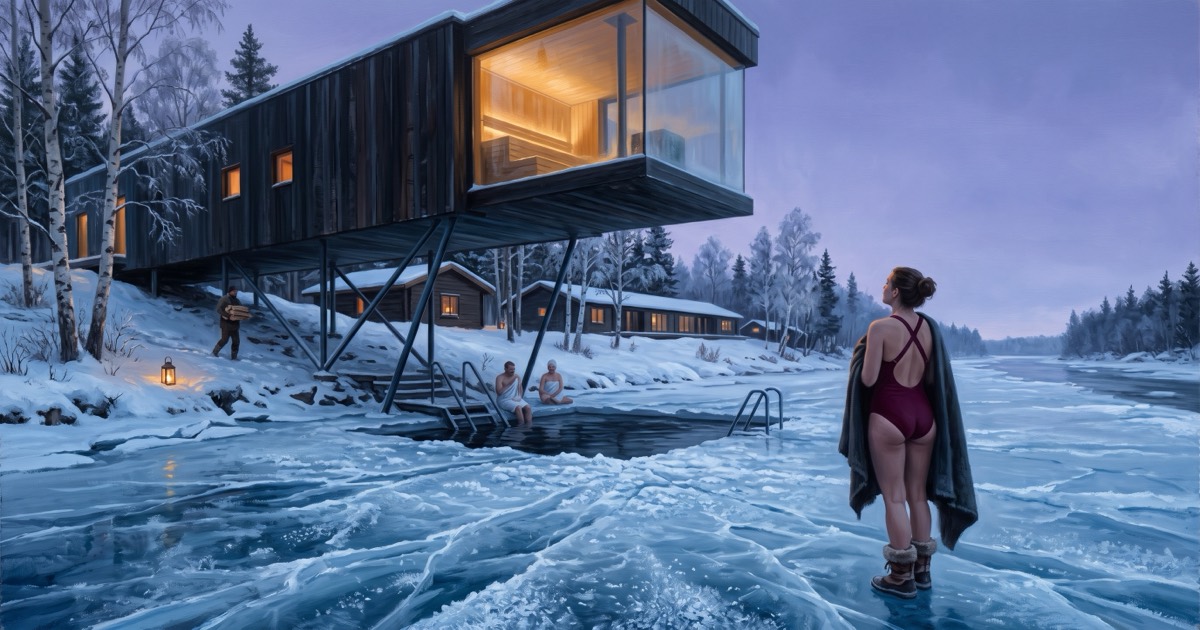
Sweden's contribution to wellness is architectural. A circular floating bath house on the Lule River built to resemble a timber jam, individual rooms suspended in pine forest each by a different Scandinavian architect, a Japanese-influenced bath house on a cliff twenty minutes from Stockholm. These are buildings that make you use them differently, and cold-water immersion is central to several of them. That is where the risk lies, and it is stated before any property is described. One claim commonly attached to cold plunging has been removed from this page entirely, because it is not supported. None of these runs a fixed residential programme, so Sweden's wellness retreats are architectural rather than clinical: you come for the building, the sauna and the cold water, and the structure of the days is entirely your own.
| Resort | Location | Type | Stay | Price Range | Best Season | Signature Experience | Wellness Focus |
|---|---|---|---|---|---|---|---|
| Arctic Bath | Harads, Norrbotten | A La Carte | Flexible | $$$$$ | Sep-Mar | A floating bath house shaped like a timber jam | Arctic cold bathing & sauna |
| Yasuragi | Nacka, Stockholm | A La Carte | Flexible | $$$$ | Year-round | Japanese bath house twenty minutes from the city | Onsen-style bathing |
| Treehotel | Harads, Norrbotten | A La Carte | Flexible | $$$$$ | Sep-Mar | Rooms suspended in pines by different architects | Design, forest & sauna |
| Copperhill Mountain Lodge | Åre, Jämtland | A La Carte | Flexible | $$$$ | Dec-Apr | A Bohlin-designed lodge above the mountains | Mountain spa & skiing |
| Åstad Vingård | Tvååker, Varberg | A La Carte | Flexible | $$$ | May-Sep | A working vineyard with a lake sauna | Farm kitchen & gentle spa |
| Stenungsbaden Yacht Club | Stenungsund, Bohuslän | A La Carte | Flexible | $$$ | Jun-Aug | A sociable spa among the granite islands | Coastal spa, family-friendly |
Sudden cold-water entry causes an involuntary gasp, hyperventilation, and a sharp rise in heart rate and blood pressure, the cold shock response. It is a leading cause of sudden death in cold water and can affect people with no known heart condition.
Done sensibly it is fine for most healthy people:
Enhanced immune response is not supported and has been removed from this page. The mood lift afterwards is real and sufficient.
Arctic Bath opened in January 2020 on the Lule river at Harads in Swedish Lapland, about fifty kilometres south of the Arctic Circle and an hour and a quarter from Lulea airport, and is the clearest expression of Nordic cold-bath culture anywhere on this site. The circular main building, designed by Bertil Harstrom and Johan Kauppi to resemble a jam of drifting timber after the river's logging history, floats through the summer and freezes into the ice in winter. At its centre is an open plunge pool cut straight through the deck into the river, ringed by saunas, hot baths and a treatment room; the ritual is heat, then cold water, then rest, repeated. There are twelve rooms, six on the water and six elevated on land, and the kitchen works with reindeer, moose, wild fish, herbs and berries. Northern lights in winter, midnight sun in summer. Among Sweden wellness resorts it is the most striking and the most demanding; the cold is genuine, not decorative.
Yasuragi stands on the water at Hasseludden in Nacka, about twenty-five minutes from central Stockholm, and is the most complete Japanese bathing house in Europe outside Japan. The building opened in the 1970s as a conference centre designed by the Japanese-influenced architect Yoji Kasajima and was converted into an onsen-style hotel, and the Japanese framework is followed properly rather than decoratively: guests change into yukata on arrival and wear it throughout, wash thoroughly before entering the water, and bathe in indoor and outdoor hot baths overlooking the Baltic inlet, with separate nude bathing areas alongside mixed pools in swimwear. Around the baths sit saunas, steam rooms, cold plunges, shiatsu and Japanese treatment rooms, a large daily schedule of yoga, meditation, qigong and bathing rituals, and Japanese food. Day visits and overnight stays are both offered. Among Sweden wellness resorts it is the most accessible from a city and the most ritualised; the etiquette is part of the experience.
Treehotel occupies a pine forest at Harads in Swedish Lapland, the same village as Arctic Bath and by the same founders, Britta and Kent Lindvall, whose idea in 2010 was to suspend architect-designed rooms among the trees. The result is a collection of individual treerooms by leading Nordic practices, among them Tham and Videgard's Mirrorcube, clad in mirrored glass so it nearly disappears, Snohetta, Sami Rintala and Bertil Harstrom's Bird's Nest, each reached by walkway or stair several metres above the ground. Wellness here is not a spa programme but the setting and the sauna: a treetop sauna and relaxation space, forest bathing in the literal sense, silence, and the aurora overhead in winter or the midnight sun in summer, with snowshoeing, dog sledding, ice fishing and river trips arranged. Meals are taken in the old guesthouse below. Among Sweden wellness resorts it is the design and nature choice; guests wanting treatments or structure should pair it with Arctic Bath nearby.
Copperhill Mountain Lodge stands on Forberget above Are in Jamtland, the mountain region of western Sweden near the Norwegian border, and was designed by the American architect Peter Bohlin, better known for Apple's glass stores and private houses, which makes it the most architecturally considered mountain hotel in the country. The building sits low along the ridge in timber, stone and copper with long glazed walls facing the Are valley and Lake Are below, so the view is the constant. Its wellness offering is a substantial spa with an indoor pool, outdoor heated pool and hot tubs looking over the valley, saunas, steam and treatment rooms using Nordic ingredients, alongside a gym and yoga. Around it is the reason most guests come: Are is Sweden's principal ski resort in winter, and in summer the same slopes give hiking, biking and trail running. Among Sweden wellness resorts it is the active mountain choice, where the spa is the recovery rather than the purpose.
Astad Vingard lies in the Halland countryside of south-west Sweden, inland from Varberg and about an hour south of Gothenburg, on a farm that has been in the same family for generations and which now runs one of Sweden's northernmost commercial vineyards alongside its hotel. That combination is the point: the estate grows and makes its own wine at a latitude few would attempt, keeps cattle and gardens, and serves the results in a restaurant that has become a destination in its own right. The spa is small and deliberate rather than large, built around a series of pools, saunas and a wood-fired hot tub set in the landscape, with treatments using estate and Nordic ingredients, and guests are encouraged to walk the vineyard and the surrounding forest and lakes between sessions. Among Sweden wellness resorts it is the gastronomic and rural choice, best suited to a couple who want food, wine and quiet countryside rather than facilities or a programme.
Stenungsbaden Yacht Club sits on the water at Stenungsund in Bohuslan, on the west coast about forty-five minutes north of Gothenburg, looking across to the island of Tjorn and its bridge, and is the most conventional and most family-capable property on this page. It is a large seafront hotel with its own marina, and its wellness offering is scaled accordingly: a spa with indoor and outdoor pools, several saunas including a seafront sauna, steam and cold plunge, treatment rooms offering massage, facials and body work, and a gym, with spa day packages and overnight spa breaks sold as the main product. The Bohuslan coast around it, granite islands, fishing villages, seafood and kayaking, is among the most attractive in Sweden and is easily reached. Among Sweden wellness resorts it is the accessible and affordable choice, well suited to families or a group weekend; there is no programme, no medical supervision and nothing austere about it.
A circular floating structure on the Lule River, built to resemble a timber jam. The logs once floated down this river to the coast, and that is where the form comes from, which makes it a genuine piece of regional architecture rather than a shape chosen for photographs.
The open cold bath sits at the centre of the ring, with saunas around it. In winter the structure freezes into the river ice.
Setting:
A circular floating structure on the Lule River at Harads, in Swedish Lapland, built to resemble a timber jam. The logs once floated down this river to the coast, and that is where the form comes from, which makes it a genuine piece of regional architecture rather than a shape chosen for photographs.
Bathing and facilities:
The cold bath is the point, and it is genuinely cold: river water in Lapland, not a chilled plunge pool. The Nordic sequence here runs hot sauna, open sky, then river.
Cold-water immersion at these temperatures is a real physiological event, not a bracing extra. It causes an immediate gasp reflex and a sharp rise in blood pressure, and the risk of cold shock is highest in the first minute. Enter slowly and never alone, never after alcohol, and take medical advice first if you have any cardiovascular condition. Staff supervise, and their guidance on duration is not a formality.
Claims that cold immersion detoxifies the body or boosts immunity are not supported by evidence. What it reliably delivers is alertness, a strong mood lift for most people, and better sleep.
Norrbotten ingredients treated seriously: Arctic char, reindeer, cloudberries and forest mushrooms.
Twelve cabins in total, six floating on the Lule River reached by walkways and six raised on pillars among the birch, small in number and designed throughout, in pine and oak with wood stoves and wide windows for the aurora or the midnight sun. The floating cabins and the circular main building are by the architects Bertil Harström and Johan Kauppi, the land cabins by AnnKathrin Lundqvist, and the logjam form refers to the timber-floating era when felled trees were moved down this river. It opened in 2020. The centre of the main building is an open-air cold plunge: this is not a geothermal spring, and in winter the river freezes around the structure so the pool becomes a hole cut in the ice. Around it sit saunas, a steam room, hot baths and a treatment room, and stays include breakfast and a guided spa ritual. Harads is a village of about 500 people, roughly 50 kilometres south of the Arctic Circle and an hour and a quarter from Luleå airport; Treehotel is the sister property nearby. Among the most expensive properties in this guide, and the architecture and the remoteness are what the price buys.
Estimated pricing
Why the timber jam shape?
Because logs were once floated down the Lule River to the coast, and jams of timber were part of the river's working life. The building references that directly. It is regional history expressed as architecture rather than a form chosen because it photographs well, which is what makes it worth the journey.
Winter or summer?
Winter, for most people. The structure freezes into the river ice, the contrast between sauna and cold bath is at its sharpest, and the aurora season runs September to March. Summer brings near-permanent daylight and a flowing river, which is pleasant but less extraordinary.
Inspected ratings
About the property
The MICHELIN Key is a genuine inspected distinction. It recognises architecture, design, service and sense of place, not the spa's effects.
The design story is documented rather than invented. The logjam form refers to the practice of floating felled timber down the Lule when logging was Harads's main industry, and the architects also designed the nearby Treehotel. Arctic Bath began as a floating sauna intended for Treehotel guests.
The sustainability claims are unusually concrete and checkable: cabins built from locally sourced timber with no trees felled for the development, land cabins elevated to avoid ground damage, and pollutant-free swimsuits issued to guests to protect the river.
The cold plunge is the point and needs respect. Immersion in near-freezing water triggers a gasp reflex and sharp cardiovascular response. Entry is supervised for that reason. Anyone with a cardiovascular condition should take medical advice first, and the wellness menu's "detox" and "cleansing" treatments name categories rather than physiological processes.
A Japanese-influenced bath house on a cliff above the water, twenty minutes from central Stockholm, and the most committed dedicated wellness property in Sweden.
Guests change into a yukata on arrival and wear it throughout, which sounds like a gimmick and functions as the opposite: it removes the ordinary signals of status and hurry.
Setting:
A Japanese-influenced bath house on a cliff above the water at Nacka, twenty minutes from central Stockholm, and the most committed dedicated wellness property in Sweden.
Bathing and facilities:
The yukata sounds like a gimmick and functions as the opposite. It removes the visual signals of status and occupation (everyone in the building is dressed identically) and the effect on the atmosphere is immediate and real. It is the single most effective design decision on this page.
Note the bathing etiquette is genuinely Japanese: you wash thoroughly before entering the water, and the baths are for soaking rather than swimming. Some areas are nude and gender-separated; others are mixed and require swimwear. Check which is which before you arrive, as the distinction catches out most first-time visitors.
On heat and cold: the alternation is restful and helps most people sleep. Cold plunging causes a gasp reflex and a sharp blood-pressure rise; enter slowly, never after alcohol, take medical advice first with a cardiovascular condition. Claims that bathing detoxifies the body are not supported by evidence.
Japanese-influenced cooking using Swedish ingredients, eaten in the yukata like everything else here.
One hundred and ninety-one rooms in the Japanese manner, spare and quiet, all facing Höggarnsfjärden at the entrance to the Stockholm archipelago, some with an ofuro bath in the room, and dog-friendly rooms available. The building predates the spa: the Japanese architect Yoji Kasajima designed it in the 1970s for a trade-union college, following the terrain and rising out of the rock, and it became Yasuragi in 1997 when a new management took the Japanese lifestyle as its organising idea. The bath itself was rebuilt in 2017 and 2018 by DAP Architects after a study trip to Japan, drawing on traditional bathing culture and old imperial courtyards in the same concrete and timber as Kasajima's original. Washing before entering is required in the Japanese way, there are indoor and outdoor hot baths and a cold pool, and a full daily schedule of classes runs from sound baths to movement. Three restaurants cover vegan, a la carte and teppanyaki. The yukata convention shapes the whole stay, and guests who resist it get less from the property than those who do not. It is twenty minutes from central Stockholm, which makes it the most accessible property on this page.
Estimated pricing
Why the yukata?
Because everyone wearing the same thing removes the ordinary markers of status and hurry, and the effect on the atmosphere is real. It also means you move between bath, restaurant and room without changing, which is the Japanese bath house model and is more restful than it sounds.
Is it worth it as a day visit?
Yes, and many Stockholmers use it that way. Day access includes the baths and often a meal. But the property is at its best across an overnight, when the bath house empties in the evening and you can move between hot and cold without a queue.
Wins
About the property
One award: Sweden's Best Hotel Spa at the 2025 World Spa Awards, decided by industry and public voting rather than by inspection.
On the cultural framing, which this guide treats carefully. Yasuragi is a Swedish property built on Japanese bathing form: the washing ritual before entering the water, communal baths, yukata. That is an adaptation rather than an onsen: a Japanese onsen is defined by natural geothermal mineral water, and there is none here. The property is generally straightforward about this; visitors sometimes are not.
Bathing customs are worth reading in advance. Some bathing areas are traditionally nude and separated by sex, others require swimwear; arrangements vary by area and by day. Guests who arrive unprepared for this occasionally find it uncomfortable. Check before booking rather than on arrival.
On the evidence: hot bathing is restorative and eases muscular tension. There is no physician, no diagnostics and no outcome data, and shiatsu and similar treatments are relaxing without demonstrated effects beyond that.
Individual rooms suspended in pine forest above Harads, designed by a range of Scandinavian architects. The Mirrorcube, the Bird's Nest, the UFO and others, each a separate commission rather than variations on a theme.
It is a serious architectural project that happens to be a hotel, and the sauna and cold immersion provision is genuine rather than incidental.
Setting:
Individual rooms suspended in pine forest above Harads in Swedish Lapland, designed by a range of Scandinavian architects: the Mirrorcube, the Bird's Nest, the UFO and others, each a separate commission rather than variations on a theme. It is a serious architectural project that happens to be a hotel.
Facilities:
The architecture is the reason to come, and the wellness provision is modest by comparison: a tree sauna and the forest itself rather than a spa. The entry is honest about that rather than inflating it.
The Mirrorcube's mirrored surface was a genuine hazard to birds, and the property addressed it with a UV film visible to birds but not to people. That is a real fix to a real problem, and worth knowing as an example of the design being thought through rather than only styled.
Practical notes: access to some rooms involves ladders or steep ramps at height, which rules them out for guests with mobility limits or a fear of heights; check the specific room before booking. Lapland winters are severe; the walk between rooms and the main building is outdoors.
Lapland is the homeland of the Sámi. Where Sámi culture is offered as an activity, ask who is delivering it and on what basis.
Meals in the original guesthouse at the foot of the trees, using Norrbotten produce.
Individual treerooms suspended among pines, each architecturally distinct, by a range of practices: the Mirrorcube by Tham and Videgård, clad in reflective glass so it nearly disappears; the Bird's Nest and the UFO by Bertil Harström; the Blue Cone; the Cabin; the Dragonfly by Rintala Eggertsson; the 7th Room by Snøhetta, anchored to a pine with a netted terrace for sleeping under the sky; and the Biosphere by Bjarke Ingels Group, wrapped in hundreds of nesting boxes so birds colonise the facade. Started by Kent and Britta Lindvall in 2010, the rooms sit four to ten metres up and are attached without damaging the trees. Two practical points matter. Most cabins have no running water; a canister is provided at the basin and showers are in the guest house or the forest sauna, which is a short walk and charged separately. And check-in is at Britta's Pensionat, five to ten minutes away on a forest path that can be slippery under snow, where the restaurant and bar also are. Choose the room first and the dates second, since they differ enormously and each sleeps different numbers.
Estimated pricing
Which room should I book?
They are genuinely different buildings rather than variations, so it is worth looking at each. The Mirrorcube disappears into the forest, the Bird's Nest is entered from below through a hatch, the UFO is exactly what it sounds like. Sizes and sleeping arrangements vary considerably, so book on the room rather than the date if you can.
Treehotel or Arctic Bath?
They are in the same village and complement each other. Treehotel is the architectural project with a good sauna; Arctic Bath is the bathing project with good rooms. If bathing is the point, Arctic Bath. If the buildings are, Treehotel. Doing both across a few nights is entirely reasonable.
No verified awards
No inspected rating, judged award or reader-voted accolade has been verified for Treehotel, despite extensive architectural coverage.
About the property
No award verified, which is surprising for a property this widely published: architectural attention has been extensive but has not, so far as can be confirmed, translated into a named accolade. Editorial coverage is not recorded as recognition here.
The multi-architect commissioning is the genuine distinction, and the roster is serious: Snøhetta and BIG are among the most significant practices working today.
The Mirrorcube required a real correction after construction. Its mirrored exterior caused bird strikes, and the surfaces were treated with ultraviolet film visible to birds but not to humans. That is a good example of a design problem being identified and fixed, and worth stating plainly rather than omitting.
This is a design hotel, not a wellness property. There is no spa programme, no treatment offering and no therapeutic claim, and the entry makes none. Sauna provision is standard Nordic hospitality.

On Förberget above Åre, designed by Peter Bohlin, with a spa looking across the Jämtland mountains and Åresjön. Indoor and outdoor pools, several saunas and a large treatment area.
Åre is Sweden's principal mountain resort, and this is its most architecturally serious hotel.
Setting: Förbergsvägen 6, above Åre in Jämtland, central Sweden, around 90 minutes from Östersund.
What is offered
The outdoor pool in winter is the property's signature and involves moving between hot water and mountain air. Frostbite develops quickly on wet skin at these temperatures; keep transitions short and follow the property's guidance.
This is a mountain hotel with an excellent spa rather than a wellness programme. There is no assessment and no protocol, and the page says so.
Jämtland has a strong food culture, particularly for cheese and game, and the hotel draws on it.
A lodge of 112 rooms and suites facing the mountains or the valley, on top of Förberget above Åre, designed by the American architect Peter Bohlin, who is best known for Apple's glass-cube stores and for Bill Gates's house. It opened in December 2008 and is a member of Design Hotels, the only mountain hotel in Scandinavia in that group. The building was originally intended as co-op apartments and became a hotel when buyers did not materialise, which is why the rooms vary so widely in size and layout. It connects directly to the Åre ski area by its own lift, the Copperhill Express. Busy in the ski season and considerably quieter in summer, when the rates drop and the hiking is excellent.
Estimated pricing
Is Åre worth it for non-skiers?
In summer, genuinely. The Jämtland mountains offer some of Sweden's best hiking and biking, Tännforsen is the country's largest waterfall, and the hotel is far quieter and cheaper than in winter. In ski season the town is busy and the rates reflect it.
Why does the architect matter?
Peter Bohlin is a serious architect and the building is treated as one, shaped to the fell and to the light rather than dropped onto it. In a country with as much design culture as Sweden that is not a small thing, and it is why this property is here rather than another Åre hotel.
No verified awards
No inspected rating, judged award or reader-voted accolade has been verified for Copperhill Mountain Lodge.
About the property
No award, and none is claimed.
The architect is the distinguishing fact. Peter Bohlin's practice is best known internationally for Apple's flagship stores and for residential work that has won the AIA's highest honours. A ski lodge in Jämtland is an unusual commission for them, and the building is correspondingly more considered than the category norm.
Åre is Scandinavia's largest ski destination, which sets the character: this is a mountain resort hotel with a spa, busy in season, rather than a wellness retreat. Summer is quieter and increasingly used for hiking and mountain biking.
On the evidence: no physician, no diagnostics, no outcome data. Post-ski treatments ease muscular soreness, which is a reasonable expectation and the honest one.
A working vineyard and estate in the Halland countryside with a spa, farm kitchen and a lake sauna. The gentlest property on this page, and the one that best represents a different Swedish idea of rest.
Sweden has a small but real wine industry now, a consequence of a warming climate that is worth noting plainly rather than celebrating.
Setting: Halland, on the south-west coast between Gothenburg and Malmö, in gentle farming country.
What is offered
No level of alcohol consumption is established as risk-free. Wine tasting is part of what this property offers and is described as a pleasure rather than as part of a wellness programme.
Lake immersion cautions apply: never alone, never after alcohol, enter gradually, seconds rather than minutes. The alcohol point matters particularly here.
The farm kitchen is the property's strongest element, working from the estate and the surrounding region.
Around 82 rooms across the estate in a quiet country register, and the detail that distinguishes them is that most have a private sauna in the room, so the bathing does not depend on sharing a facility. The newer Sjöparken rooms of about 35 square metres open onto a bathing deck over a natural pool with an outdoor shower, and are limited to guests of thirteen and over. The estate is one of Sweden's largest vineyards, over 30,000 vines planted from 2011 by the third generation of the Carlsson family, who took over a dairy farm and turned it to organic before the children moved it to wine; the focus is sparkling made by the traditional method. Sinnenas Spa has outdoor warm pools and sauna environments drawing on the surrounding Åkulla beech forest, and holds what Visit Sweden describes as the country's only underwater sauna. Restaurang ÄNG leads the dining, with two further restaurants on site. The least dramatic property on this page and the most restful, which is precisely why it is included.
Estimated pricing
Sweden has vineyards?
A small but real industry, concentrated in the south, and it exists because the climate has warmed. That is worth stating plainly rather than presenting as a charming curiosity. The wines are improving quickly and the estate here is a working one rather than decorative.
Why include a gentle property?
Because a page dominated by Arctic cold baths and architectural statements misrepresents how most Swedes actually rest. Halland is farming country, the sauna is by a lake, the food comes off the estate, and nothing about it is extreme. That is a legitimate and under-represented version of Swedish wellness.
No verified awards
No inspected rating, judged award or reader-voted accolade has been verified for Ästad Vingård.
About the property
No award, and none is claimed.
Swedish viticulture is genuinely marginal and genuinely real. Halland sits at around 57°N, far outside the historic wine belt; commercial Swedish wine production has become possible with cold-hardy hybrid varieties and a warming climate. That is an interesting fact about the property rather than a quality claim about the wine, and this guide does not make one.
On vinotherapy, where offered anywhere: grape-derived polyphenols have antioxidant activity in laboratory conditions. Applying them to skin does not reproduce that in the body, and no controlled evidence supports anti-ageing claims from topical or bathing applications.
Alcohol and heat do not mix. A property combining a vineyard with a sauna and cold-bathing offering creates an obvious temptation. Alcohol impairs thermoregulation and judgement, raises the risk of fainting in heat, and is a significant factor in sauna and cold-water incidents. Bathe first.
On the Bohuslän coast north of Gothenburg, among the smooth granite islands that define this shoreline. A large, sociable spa hotel rather than a retreat, with pools, saunas and a marina.
Included deliberately as the family and group option, and the page says so rather than dressing it as something quieter.
Setting: Stenungsön, Stenungsund, on the Bohuslän coast around 45 minutes north of Gothenburg.
What is offered
This is a busy, sociable property rather than a quiet one, particularly in Swedish summer and school holidays. If silence is what you are after, Ästad or Kuru-style properties elsewhere in this guide are the better fit.
The Bohuslän sea is cold year-round and the granite shoreline is slippery when wet. Swim from supervised areas and take care on the rocks.
Bohuslän is one of Sweden's best seafood regions, and the property is on the water.
A large hotel with a wide range of rooms and its own marina on the Bohuslän coast, roughly forty minutes north of Gothenburg. Family-friendly and sociable, which is the deliberate contrast to everything else on this page: where Arctic Bath and Treehotel are about solitude and design, this is a place where children are expected and the pools are busy. The practical consequence is price, since it is the most affordable entry here by a wide margin and works as a weekend rather than a pilgrimage.
Estimated pricing
Why include a busy family hotel?
Because families travel too, and a page of adults-only Arctic design properties does not serve them. Stenungsbaden is large, well run, on a beautiful coast and handles children properly. That is a legitimate reason to book, and it is stated rather than disguised.
What is Bohuslän like?
Smooth pink granite islands, thousands of them, running north from Gothenburg to the Norwegian border. It is one of the great European coastlines and remarkably little known internationally. June to August is the season, and the water is cold in every month.
No verified awards
No inspected rating, judged award or reader-voted accolade has been verified for Stenungsbaden Yacht Club.
About the property
No award, and none is claimed.
Read the property type carefully. This is a large coastal hotel with substantial conference and event business alongside its spa and family facilities. It is not a wellness retreat, and mid-week occupancy is often corporate. Guests seeking quiet should ask what else is booked.
The Bohuslän coast is the genuine draw: granite islands, a large archipelago and some of Sweden's best-known coastal scenery. The setting does more for a stay here than the spa does.
On the evidence: hotel spa treatments without physician, assessment or outcome data. Cold-water bathing in the fjord is available and carries the usual cautions: controlled entry, no alcohol, and medical advice first for anyone with a cardiovascular condition.
Six properties in the country whose contribution to wellness is architectural rather than medical. One is a floating bath house shaped after the timber jams that once moved down the river it sits on. One has rooms suspended in pine forest, each commissioned from a different architect. One is a Japanese bath house twenty minutes from Stockholm where everyone wears the same garment. Two are included deliberately as the gentle and the family options, because a page of Arctic design statements misrepresents how most Swedes rest. One claim commonly attached to cold plunging is removed from this page entirely, because it is not supported.
For most healthy people, done sensibly, yes, and this page states the risk before describing any property. Sudden cold-water entry causes an involuntary gasp, hyperventilation and a sharp rise in heart rate and blood pressure, the cold shock response, which is a leading cause of sudden death in cold water and can affect people with no known heart condition. Never alone, never after alcohol, enter gradually using steps, seconds rather than minutes, and get warm promptly. Anyone with cardiac history, high blood pressure or who is pregnant should take medical advice first.
No, and that claim has been removed from this page. Enhanced immune response is not supported by the evidence. What is real is the mood lift afterwards, which most people notice and which is sufficient reason to do it. This guide describes what actually happens rather than what would sell better.
A circular floating structure on the Lule River, built to resemble a timber jam because logs were once floated down this river to the coast. The open cold bath sits at the centre with saunas around it, and in winter the whole thing freezes into the river ice. It is regional history expressed as architecture rather than a shape chosen to photograph well.
Stenungsbaden on the Bohuslän coast, which is large, sociable and set up for children, with a marina and the granite archipelago outside. Åstad Vingård in Halland is gentle and quiet without being adults-only. The Arctic properties at Harads are small, expensive and better suited to couples, and Yasuragi's bath house convention is not built around children.
September to March for the Arctic properties and the aurora, accepting that nothing about the northern lights is guaranteed and that frostbite is a real hazard on exposed or wet skin. December to April for Åre and the mountains. June to August for the Bohuslän coast and the Halland countryside. Yasuragi works year-round, twenty minutes from Stockholm.