South Korea has the most everyday wellness culture in this guide. Bathhouses are civic infrastructure rather than luxury, and one in Busan holds more than forty baths for the price of a coffee. Temple Stay is a national programme run by working monasteries where guests keep monastic hours. Alongside them sit a deliberately austere mountain retreat where phones are handed in at check-in, and a luxury hanok hotel in traditional timber construction. The bathhouse etiquette note below matters more than anywhere else on this site, because it surprises almost every Western visitor. Korea's wellness retreats are ascetic rather than indulgent: two run fixed residential programmes, two are day bathhouses with no rooms, and the remaining two are hotels where the wellness is in the water and the architecture.

| Resort | Location | Type | Stay | Price Range | Best Season | Signature Experience | Wellness Focus |
|---|---|---|---|---|---|---|---|
| Healience Seonmaeul | Hongcheon, Gangwon | All-Inclusive | 2-7 nights | $$$ | Apr-Oct | Phones handed in, no wifi, no television | Austere mountain retreat |
| Beomeosa Temple Stay | Busan | All-Inclusive | 1-2 nights | $ | Apr-Jun, Sep-Nov | Monastic hours at a seventh-century temple | Temple Stay, Jogye Order |
| Heosimcheong Spa | Dongnae, Busan | Day Visit | Day sessions | $ | Year-round | More than forty baths in one complex | Hot spring bathhouse |
| We Hotel Jeju | Seogwipo, Jeju | A La Carte | Flexible | $$$ | Apr-Jun, Sep-Nov | Forest programmes in Jeju woodland | Health checks & hydrotherapy |
| Spa 1978 Donginbi | Gangnam, Seoul | Day Visit | Day sessions | $$ | Year-round | Six-year red ginseng treatments in Seoul | Ginseng-based spa |
| Gyeongwonjae Ambassador | Songdo, Incheon | A La Carte | Flexible | $$$$ | Year-round | A luxury hanok with heated ondol floors | Traditional Korean hospitality |
Korean bathhouse bathing areas are single-sex and fully nude, and thorough washing before entering is required and taken seriously. This surprises many Western visitors and is not optional.
Nothing here replaces medical care. Several properties offer health checks and traditional Korean medicine. These are complementary to healthcare, never a substitute, and anyone managing a condition should continue under their own doctor.
Hanbang, traditional Korean medicine, is a traditional system with its own training and framework rather than evidence-based medicine in the Western sense. Herbal preparations can interact with prescribed medication, so tell practitioners what you take and tell your own doctor what you were given.
Founded by Dr Lee Si-hyeong as a deliberately austere retreat in the mountains of Gangwon. Phones are handed in at check-in; there are no televisions, no wifi and no air conditioning.
The austerity is the method rather than a limitation, and the property is explicit that it is not comfortable. Guests who want comfort are told to go elsewhere. The name is a compound of health science and healing experience, and the design follows from it: the site sits at 250 metres on Jongjasan Mountain, roughly two hours from Seoul, chosen because longevity villages elsewhere in the world sit at altitude. Korea's Ministry of Culture, Sports and Tourism designated it a healing tourist destination in 2011, and in 2014 it became the country's first privately operated healing forest. Lee Si-hyeong is a psychiatrist and bestselling author, and the programme he built runs on lectures, yoga, meditation, guided movement, nutrition and body composition analysis rather than on treatments.
Setting: Seo-myeon, Hongcheon-gun, in the mountains of Gangwon province, around two hours east of Seoul.
Simple Korean food, largely vegetarian, served at fixed times as part of the schedule.
Basic rooms without televisions, wifi or air conditioning, in two low buildings called the Garden and the Forest; the Garden building is by the Korean architect Seung Hyo-sang, working to a principle he calls the aesthetics of the poor. Rooms open onto a courtyard and have a skylight, so the stars are visible from bed, which is the one indulgence. Facilities are modest and specific: a carbonated spring spa, a rock sauna, a yurt in the forest for meditation, a gathering space called the Kiva, and ten walking routes cut through the surrounding woodland. Meals are low sodium and made without artificial additives. Note that the bathing areas follow Korean practice, meaning nudity in gender-segregated spaces. Deliberately austere, and the property does not pretend otherwise. If that sounds like the appeal, it delivers exactly what it promises.
Yes, at check-in, and there is no wifi to fall back on. That is the central mechanism rather than a gimmick: the schedule, the walking and the disconnection work together. If being unreachable for several days is impossible for you, this is the wrong property.
None, which matters in a Korean summer. July and August are hot and humid in Gangwon, and the absence is deliberate rather than an oversight. Book April to June or September to October and it is a very different experience.
A major Jogye Order temple founded in the seventh century on Geumjeong Mountain above Busan, offering the national Temple Stay programme. Guests keep monastic hours.
This is a working monastery rather than a retreat centre, and the distinction shapes everything about the stay. It was founded in 678, during the reign of King Munmu of Silla, by the monk Uisang, as one of ten Hwaeom temples. The Japanese invasion of 1592 destroyed it and rebuilding began in 1613, which is the date most surviving structures trace to. It holds four Korean Treasures and a Natural Monument, and roughly ten hermitages sit on the mountain around it. Master Dongsan, who led the Buddhist Purification Movement of the 1950s and early 1960s, practised here. The temple describes itself as Seon meditation-based, Seon being the Korean form of what Japanese Buddhism calls Zen.
Setting: 250 Beomeosa-ro, Geumjeong-gu, on Geumjeong Mountain above Busan, reachable by metro and a short bus.
Korean temple cuisine, which is vegetarian, excludes the five pungent vegetables, and is a serious culinary tradition in its own right.
Simple shared rooms with floor sleeping on heated ondol. Two programmes run, and the difference matters when booking. The experiential stay, generally at weekends, follows a full schedule over one night and two days: chanting services, 108 prostrations, seated Seon meditation, a tea ceremony and craft work such as bead making. The relaxation stay, generally on weekdays, is deliberately unstructured, with meditation, tea and conversation with the monks, and time to walk the grounds alone. Meals are barugongyang, the monastic form: vegetarian, eaten from four nested bowls in a prescribed order, with the expectation that nothing is wasted and the bowls are cleaned by the diner. The prostrations are physically demanding, and the morning bell is well before dawn. The cheapest entry in this guide by a wide margin, and among the most rewarding for anyone willing to keep the hours.
Genuinely. Ceremonies begin around three in the morning, accommodation is shared and simple, sleeping is on the floor, and the day is structured by the monastery rather than by you. That is the experience rather than an inconvenience, and people who arrive expecting a hotel are disappointed.
No. Temple Stay is a national programme open to anyone, and participants of all faiths and none take part. What is required is respect: this is a working monastery, you are a guest of a religious community, and the guidance on dress, silence and behaviour is followed without exception.
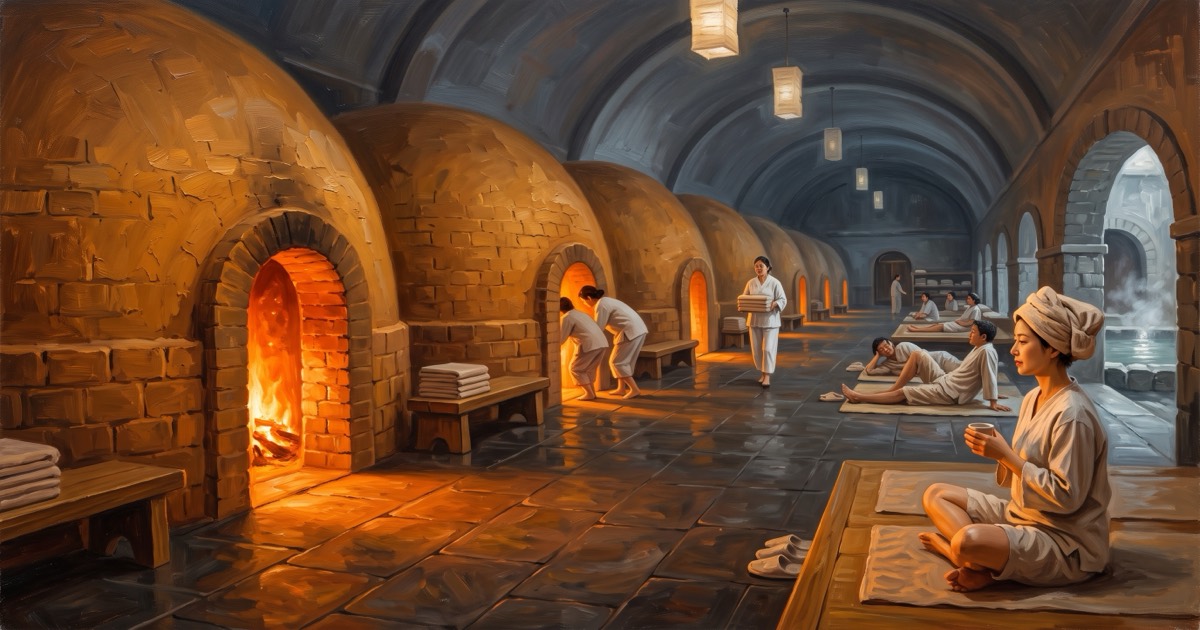
A vast bathhouse in Busan's Dongnae district, among the largest hot spring complexes in Asia, with more than forty baths: herbal pools, mineral baths, mud, saunas and cold plunges.
Entry costs roughly the price of a coffee, which is the point: this is civic infrastructure rather than luxury. The scale is genuinely unusual. The current building opened in 1991, spans roughly 4,300 square metres across five floors, can hold around 3,000 people at once and takes something in the order of four million visits a year. The water is alkaline, emerging between 45 and 56 degrees, and carries the highest magnesium concentration of any hot spring spa in Korea. Around forty bath types run through the complex, changing with the season, with event baths infused with medicinal herbs and fruit essences including cherry, lavender and citrus.
Setting: Dongnae-gu, Busan, in a district with a hot spring tradition going back centuries, reachable by metro.
Bathhouse food is part of the culture: simple, hot and eaten in the common areas between sessions.
A day facility with no accommodation of its own, though it connects by skywalk to the adjacent Hotel Nongshim and many Korean jjimjilbang allow overnight resting in common areas. Two practical points matter more than any of that. The bathing floors are gender-segregated and nudity is required, which is standard Korean practice and not negotiable; the mixed jjimjilbang floor is where the clay sauna rooms and the ice room sit, and clothing is worn there. Unlike many Japanese onsen, Korean bathhouses including this one are generally tattoo-friendly. The facility is also documented as wheelchair accessible, with accessible entrance, parking and restrooms, which is rare at this scale. Busan has the full range of hotels, typically US$50 to 200 a night, rates observed 2026.
More than forty, across herbal pools, mineral baths, mud, saunas and cold plunges, in one of the largest hot spring complexes in Asia. At around eleven dollars entry it is the best value in this entire guide, and it is used by Busan residents as ordinary infrastructure rather than as a treat.
Many Korean bathhouses restrict entry for visible tattoos, and policies vary by venue. It is worth checking ahead rather than discovering it at the desk. Coverings are sometimes accepted; sometimes they are not.
A purpose-built wellness hotel in woodland on Jeju, with a wellness centre offering health checks, hydrotherapy and structured programmes, and a forest programme using the woodland around it.
Jeju is a volcanic island with UNESCO World Heritage status for its lava tubes and volcanic landscape, and the forest here is genuine rather than landscaped. The site sits at around 350 metres on the mid-slopes of Hallasan, inside the UNESCO-designated Jeju Biosphere Reserve, and roe deer cross the paths. The structural point is the pairing: the hotel operates alongside WE Hospital, part of the Halla Medical Foundation, and describes the arrangement as Korea's first combining a five-star hotel with hospital services on one site. The Korea Tourism Organization lists it as a recommended wellness destination.
Setting: Seogwipo, on the southern side of Jeju Island, around 40 minutes from Jeju airport.
Jeju has distinctive produce and its own food culture, quite separate from the mainland.
Purpose-built rooms in woodland with a large wellness centre attached, each with ondol heated flooring, wooden furnishings and either ocean or mountain views. The distinguishing feature is the water: volcanic bedrock water drawn from beneath Hallasan, carrying minerals including vanadium, selenium and bicarbonate, and piped throughout the property to guest room showers, the pools and the spa. The hotel is careful not to claim it treats anything, and this guide takes the same position; it is unusual water used at unusual scale, which is a sufficient reason to be interested. Three centres run alongside the rooms, covering medical spa, health promotion and beauty, with forest therapy, meditation and movement programmes outdoors. Dining is at Dachae, all day, and Slow Matcha. Comfortable and functional rather than designed, with the forest setting doing much of the work.
It is a volcanic island with UNESCO World Heritage status for Hallasan and its lava tube system, an excellent long-distance coastal trail network, and a distinct food culture. Flights from Seoul are frequent and short. April to June and September to November are the best months; summer is hot and typhoon season runs into autumn.
Structured time walking and resting in woodland, guided rather than solitary. It is pleasant, the walking is good, and time in forest reliably improves mood, which is reason enough. Claims that go further than that are not well supported, and this page does not repeat them.
A spa in Gangnam operated by the Korea Ginseng Corporation, built around six-year-cultivated Korean red ginseng, the same raw material as the company's skincare line.
Ginseng is Korea's most significant traditional botanical, and six-year cultivation is the standard grade rather than a marketing distinction.
Setting: Gangnam-gu, Seoul, in the centre of the city and easily reachable by metro.
No significant dining on site, but Seoul is one of the great food cities and Gangnam is full of it.
A day spa with no accommodation, created by Korea Ginseng Corporation, the company behind Cheong Kwan Jang, whose ginseng business dates to 1899. The spa traded as Spa 1899 until it was rebranded to Spa 1978, so both names appear in older coverage. Treatments use the Donginbi skincare line and are built around red ginseng cultivated for six years before harvest, then steamed and slowly dried, which is what distinguishes red ginseng from fresh. The menu runs from sixty-minute facial, body or foot treatments to multi-hour signature rituals combining face, full body, foot and scalp work. Single and couple rooms have their own shower and locker, and tea is served on arrival. On the claims: ginseng has a long and genuine place in Korean tradition, and the treatments are skilled and pleasant, but there is no good evidence that topical ginseng slows ageing or eliminates toxins, and this guide does not present it as doing so. Seoul has the full range, typically US$80 to 400 a night in Gangnam, rates observed 2026. Book treatments ahead, particularly at weekends.
The treatments are pleasant and the products are well made, which is the honest description. Ginseng applied topically does not produce the systemic effects sometimes attributed to the botanical taken orally. If you buy oral preparations to take home, note that ginseng can interact with anticoagulants and diabetes medication, and tell your own doctor.
It is the standard grade for Korean red ginseng rather than a marketing claim: the root is grown for six years before harvest, which is the traditional benchmark. The Korea Ginseng Corporation is the long-established producer, and this spa uses the same material as its skincare line.
A luxury hanok hotel, traditional Korean timber construction with hanji paper, courtyard gardens and heated ondol floors, built in Songdo near Incheon airport.
Purpose-built rather than a converted historic house, which means traditional form with modern comfort. The airport proximity makes it unusually practical.
Setting: 12 Technopark-ro, Yeonsu-gu, Songdo, Incheon, around 20 minutes from Incheon International Airport.
Korean cooking at a high standard, served in a traditional setting, which is much of the appeal.
Thirty rooms and suites with timber frames, hanji paper and ondol floors, arranged around courtyards, in a single-storey building that opened in 2015. The craftsmanship is the substance of the place rather than a decorative theme: the build involved holders of Korea's Important Intangible Cultural Heritage designations, including the master carpenter Choi Ki-young and the tile master Lee Geun-bok, with lacquerwork and traditional window frames by other designated masters. Yeongdong province timber was used throughout. The building deliberately omits dancheong, the bright decorative colouring seen on temples, in favour of plain eaves, which is the restrained end of the hanok tradition. It is the only hanok hotel rated five stars by the Korea Tourism Organization, took a Stars of Korean Tourism award, and won its category at the 2024 Korea Architecture Culture Awards. There is no pool, sauna or bar, and hanbok wearing and traditional games are offered instead. The most comfortable property on this page, and the easiest to reach on arrival or departure.
Traditional Korean architecture: timber frame construction without nails, hanji paper on doors and windows, tiled roofs, courtyard layout and ondol underfloor heating. This one is purpose-built rather than converted, so you get the traditional form with modern plumbing and insulation, which is a reasonable trade.
For the cultural experience and the ondol rather than for treatment, and the page says so plainly. There is no assessment and no programme. It is included because twenty minutes from Incheon airport, a proper hanok makes an excellent first or last night in Korea, particularly bookending a temple stay or a bathhouse trip.
Six entries across the destination with the most everyday wellness culture in this guide. One holds more than forty baths and charges about eleven dollars to enter. One is a working seventh-century monastery running the national Temple Stay programme, where guests keep monastic hours and ceremonies begin around three in the morning, for around sixty dollars. One takes your phone at check-in and has no wifi, no television and no air conditioning. The bathhouse etiquette note leads this page because single-sex nude bathing and tattoo restrictions surprise almost every Western visitor.
Bathing areas are single-sex and fully nude, and thorough washing before entering is required and taken seriously. Common jjimjilbang areas, where you wear the provided clothing, are mixed. Many bathhouses also restrict entry for visible tattoos, and policies vary by venue, so check ahead if that affects you. Standard heat cautions apply throughout.
Yes. It is a national programme open to anyone, and participants of all faiths and none take part. What is required is respect: these are working monasteries and you are a guest of a religious community. Follow the guidance on dress, silence, photography and behaviour without exception. Expect pre-dawn ceremonies, shared simple accommodation and floor sleeping.
Traditional Korean medicine, a traditional system with its own training and framework rather than evidence-based medicine in the Western sense. Herbal preparations can interact with prescribed medication, so tell practitioners what you take and tell your own doctor what you were given. Nothing offered at these properties replaces medical care, and anyone managing a condition should continue under their own doctor.
Two entries here are the best value in the entire guide. Heosimcheong Spa gives you more than forty baths for around eleven dollars, and it is used by Busan residents as ordinary infrastructure. Beomeosa Temple Stay is around sixty dollars for a one- or two-night programme at a seventh-century monastery. Neither is a discount version of anything; both are the real thing at their normal price.
April to June and September to November. Korean summers are hot and humid, which matters particularly at the mountain retreat, which has no air conditioning by design. Winters are cold and dry, which suits bathhouses well. Jeju's typhoon season runs into autumn, so check forecasts if travelling there in September.