Turkey has one of the oldest continuous bathing cultures in the world and one of the most aggressive medical-wellness industries in it, and this page separates them carefully. Eski Kaplica in Bursa is a working Ottoman hammam on Byzantine foundations, fed by thermal springs, and it is remarkable. Several other properties sell water fasting, ozone therapy, hyperbaric oxygen and IV infusions alongside massage and yoga. Those are medical procedures with real risks, not spa treatments, and the page names them plainly before it describes anywhere. Read the safety note first. It matters more here than on any other page in this guide. Two of these are wellness retreats with fixed residential programmes, and those are precisely the two where the safety note applies most; the rest are wellness resorts and historic baths you use at your own pace.

| Resort | Location | Type | Stay | Price Range | Best Season | Signature Experience | Wellness Focus |
|---|---|---|---|---|---|---|---|
| Six Senses Kaplankaya | Bodrum, Muğla | A La Carte | 3+ nights | $$$$$ | Apr-Oct | Aegean coastline from a hillside above the bay | Programme-based coastal wellness |
| Sianji Well-Being Resort | Turgutreis, Bodrum | All-Inclusive | 7 nights | $$$$ | Apr-Oct | Structured residential programmes | Detox programmes, see safety note |
| Kervansaray Thermal (Eski Kaplica) | Bursa | A La Carte | Day or stay | $$ | Year-round | An Ottoman hammam on Byzantine foundations | Historic thermal bathing |
| Richmond Nua Wellness-Spa | Sapanca, Sakarya | A La Carte | Flexible | $$$ | Apr-Oct | Lakeside spa two hours from Istanbul | Adults-only lakeside spa |
| Huzur Vadisi | Kayakoy, Fethiye | All-Inclusive | 7 nights | $$ | May-Oct | Yoga retreat in a valley above an abandoned village | Yoga retreats, small groups |
| Doğa Thermal Health & Spa | Pamukkale, Denizli | A La Carte | Flexible | $$ | Apr-Jun, Sep-Nov | Thermal water beside a UNESCO site | Thermal bathing near Hierapolis |
Some properties on this page offer medical procedures rather than spa treatments. Where they appear, this guide names them plainly.
If you are considering any of these, discuss it with your own doctor first, not with the centre selling it.
Laid out as a Mediterranean village across hills of wild olive and cypress on the Bodrum peninsula, with a 10,000 square metre spa, the largest wellness facility in Turkey. Separate hydrotherapy suites, a vitality pool above the Aegean, a traditional hammam and outdoor treatment cabanas.
Programmes covering sleep, stress and nutrition are set after a wellness screening. This is a luxury resort with an exceptional spa rather than a clinic, and there is no resident physician.
Setting: A headland on the northern Bodrum peninsula facing the Aegean, with olive groves, maquis and swimming coves and almost nothing else around. The ancient Greek city of Iasos is nearby, and Bodrum town, with its castle and the site of the Mausoleum of Halicarnassus, is around an hour.
The sleep programme is the best-founded thing on offer, and it is the reason to book a programme here rather than treatments alone.
Aegean cooking is one of Turkey's great regional cuisines, built on olive oil, wild greens and seafood.
Villas and rooms spread across the hillside in a village layout, finished to a high standard. This is the most expensive property on the Turkey page, and the seclusion and the spa are what the price buys.
No, and that distinction matters on this page. Kaplankaya is a luxury resort with an exceptional spa and structured programmes set after a wellness screening. It is not a clinic. If you want physician-supervised treatment, the Dead Sea properties on the Israel page are the comparison, not this.
The sleep programme. Sleep is one of the few areas in commercial wellness where the underlying science is solid and the interventions are genuinely useful. The stress and nutrition programmes are pleasant and well run; the sleep work is the one with real foundations.
A dedicated wellbeing resort on the Aegean near Turgutreis, built around structured nutritional programmes with resident nutritionists and more committed to the format than most Turkish resorts. Alongside the programmes sit a hammam, massage, fitness and yoga.
Its core offering is restrictive eating, and the page states that plainly rather than describing it as rejuvenation. Medical involvement is arm's length rather than on site: blood tests and body composition analysis are described as carried out by physicians at a contracted clinic, not by resident doctors at the resort. That is a meaningful difference from a medical spa where a doctor supervises you daily.
This property's core offering is restrictive eating. Anyone with a history of disordered eating should speak to their own clinician before booking.
Setting: Turgutreis, on the western tip of the Bodrum peninsula, facing the Greek island of Kos across the water and known for its sunsets. Quieter than Bodrum town, with a long seafront and a substantial weekly market.
Programme-set rather than chosen, which is the nature of the property.
Comfortable seaside accommodation with a residential rhythm, and fellow guests generally on the same programme. More affordable and more structured than Kaplankaya, and considerably less luxurious.
Detox is a marketing category rather than a physiological process; the liver and kidneys do that work continuously and cannot be assisted by a juice. What these programmes actually deliver is a week of structure, restricted eating, daily movement and rest, which reliably makes people feel better. That is worth having, and it is what this page describes.
Anyone with a history of disordered eating, without first speaking to their own clinician. Anyone pregnant, diabetic, or with kidney, liver or cardiac conditions should take their own doctor's advice before any restrictive programme. Note that medical input here comes through a contracted clinic rather than a physician resident at the property, so day-to-day supervision during a fast is not clinical supervision.
The hotel contains Eski Kaplica, the oldest thermal bath in Cekirge, built by Sultan Murat I in 1389 on a site already in use since the Byzantine era. Byzantine remains, including a lion-head fountain, were found here during construction.
You are bathing inside a functioning archaeological structure. The hotel around it is a large, conventional Turkish thermal hotel rather than a boutique property — 211 rooms including suites and two accessible rooms, built in 1987 and renovated since, with several restaurants and bars and both indoor and outdoor thermal pools. Come for the bath, not the hotel. The Eski Kaplıca and the health club have generally run from around 07:30 to 22:00, and the historic hamam is free to hotel guests while private family baths are charged separately. CHECK BEFORE BOOKING: guests have reported arriving to find the baths closed for refurbishment without having been told at reservation, so confirm the hamam is open for your dates, which nothing else in this guide offers. Bursa was the first Ottoman capital, and Cekirge has been its thermal quarter for seven centuries.
Setting: Kükürtülü Mahallesi, Çekirge Meydanı, on the slopes above Bursa, in around 9,000 square metres of green grounds with Uludag rising behind. Reachable from Istanbul by high-speed ferry from Yenikapi to Guzelyali, around 75 minutes, then a short transfer.
The historic baths are divided into separate men's and women's sections; know this before arriving. Cekirge's waters run between 39 and 80 degrees across the district's facilities, and the thermal water here runs at around 44 degrees.
Three restaurants and four bars on site, and Bursa is a serious food city.
211 rooms in traditional dome-roofed architecture, last renovated in 2011. The bath is the reason to come; the hotel is functional, and the page says so plainly.
Because it represents Turkey's actual wellness inheritance, which is hammam and thermal bathing rather than imported detox programmes. Eski Kaplica was built in 1389 on a site already in use in Byzantine times, and you bathe inside the structure. Nothing else in this guide offers that.
Easily. The high-speed ferry from Yenikapi to Guzelyali takes around 75 minutes, then a short transfer up to Cekirge. Day access to the bath is available without staying, which makes Bursa a genuine day trip from Istanbul, though the city deserves longer.
Ninety minutes from Istanbul on Lake Sapanca, and the most accessible wellness escape for anyone based in or visiting the city. A lakeside spa resort with Turkish bathing traditions, forest surroundings and structured weekend programmes.
Adults only, which is unusual in Turkey and is much of the appeal. The hotel opened in 2005 with 131 rooms — 96 superior, 14 deluxe, 20 suites and one accessible room — and a spa of around 2,700 square metres. It presents itself as Turkey's first destination spa hotel and was recognised as such at the country's first national spa and wellness congress, which is a real industry award rather than a reader vote, though an old one. There is a private lake beach, two hot tubs on the pool terrace, and two or three restaurants depending on season, including one built around lighter cooking. No physician on site; this is a spa resort rather than a clinic.
Setting: Sapanca sits between Istanbul and Bolu on a freshwater lake ringed by forested hills, green and temperate and a genuine contrast to the Aegean coast. The hotel is on the lakeshore within a protected natural area, about 100km from Sabiha Gökçen airport and 30km from Izmit, roughly an hour to ninety minutes from Istanbul depending on traffic. The Kartepe hills behind offer walking and, in winter, snow — which makes this one of the few entries in the guide that works as a cold-weather destination.
Short-format weekend wellness packages rather than extended programmes, which is the right fit for its market.
Marmara regional cooking, with the lake and the surrounding farmland supplying much of it.
A comfortable lakeside resort, adults only, with rooms facing the lake or the forest. The most convenient property on this page and the best option for a two- or three-night break.
For a weekend, yes, and that is what it is built for. Ninety minutes by road puts it within reach of a Friday evening departure, and the lake and forest are a genuine change from the city. For a longer wellness stay, the Bodrum properties or Bursa's thermal baths are better suited.
It is unusual in Turkey, where resorts are overwhelmingly family-oriented, and it is much of why the property works as a short escape. If you are travelling with children, this is not the entry for you.
In pine forest above the Turquoise Coast near Fethiye, running week-long yoga and meditation retreats in an intentionally simple setting. Near the abandoned village of Kayakoy and the Lycian Way.
The least expensive and least luxurious property on this page, and honest about it. What it offers is yoga, walking, simple food and quiet in a beautiful place. No physician, no spa, no programme beyond the practice.
Kayakoy was a Greek Orthodox community, depopulated in the 1923 population exchange between Greece and Turkey. Several hundred houses and two churches stand empty on the hillside.
It is a place of real historical weight, the physical remains of a forced population movement, rather than a ghost village attraction. It is open to visitors and worth walking, and it should be described accordingly.
Setting: The pine hills above the Oludeniz and Fethiye area, with the Turquoise Coast below and the Lycian Way running through the region. Kayakoy is a short walk away.
Shared meals, largely vegetarian, cooked simply and eaten together. That is part of the format rather than a limitation.
Ensuite rooms following a change of ownership. Confirm what you are booking. Genuinely rustic, and the property does not pretend otherwise. Small groups, which is much of why it works.
Ownership note, and it matters. The venue that ran here for thirty years was sold recently. Its own website states that the site now has ensuite accommodation, a refurbished pool and refurbished public spaces under a new owner, and that the original team have moved their retreat programme to other venues in Turkey, Wales, Spain and Norway. The yurts that made this place well known are no longer what you book. The location, the valley and the yoga shala are unchanged. Confirm the accommodation and who is running your retreat before booking, because the same name now covers two different things.
It is among the finest long-distance paths in the Mediterranean, running roughly 540 kilometres along the Turquoise Coast past Lycian tombs, empty bays and hill villages. You do not need to walk it all: day sections from here are excellent. Go in spring or autumn, since summer heat inland is serious.
At the foot of the Pamukkale travertines, a UNESCO World Heritage Site where thermal water has deposited brilliant white calcium terraces over millennia, and where the Romans built the city of Hierapolis specifically around the springs. UNESCO inscribed the combined site in 1988.
Come for Pamukkale and Hierapolis; the spa is the convenience rather than the reason. The most affordable property on this page, and excellent value.
Setting: Pamukkale, meaning cotton castle, is a cliff almost 200 metres high hung with white travertine terraces, formed as calcite-laden spring water loses carbon dioxide on reaching the surface and deposits calcium carbonate. The terraced section runs roughly 2,500 metres long by 500 wide. The water emerges at around 35 to 38 degrees. On the plateau above stands Hierapolis, founded as a thermal cult centre and spa by the Attalid kings of Pergamon late in the second century BC, and for centuries a destination for patients and pilgrims from across the Roman empire — effectively a Baden-Baden two thousand years early. The two were inscribed together by UNESCO in 1988 as a mixed natural and cultural World Heritage Site, one of relatively few. Denizli is 20 minutes away; the site is around three hours from the Aegean coast. Karahayıt, a few kilometres north where most of the larger thermal hotels sit, has separate iron-rich springs that deposit red rather than white travertine.
Hotel dining and the village below, straightforward rather than notable. Denizli, 20 minutes, has more.
A functional thermal hotel with good facilities at a low price. Its real distinction is location and archaeology rather than the spa itself, and the page states that plainly.
On designated barefoot routes only, and access is regulated for conservation. The formations were damaged by unrestricted access and hotel development in the twentieth century, and the current rules exist to prevent a repeat. Follow them without exception.
The pool is real and remarkable: a thermal pool at Hierapolis containing submerged ancient columns, which fell in during an earthquake. The Cleopatra association is legend rather than history. Swimming among Roman columns in warm mineral water needs no embellishment.
Six properties on the page in this guide that required the most correction. One is a functioning Ottoman bath from 1389 built on Byzantine foundations, and it represents Turkey's actual wellness inheritance. One sits beneath a UNESCO site where the Romans built a city around the springs. Two sell medical procedures alongside spa treatments, and the page names them plainly before describing anywhere. Three legends are identified as legends rather than repeated as history. One changed hands recently and no longer offers the accommodation it was known for, and the page says so.
Kervansaray Thermal in Bursa, without much competition. Eski Kaplica was built by Sultan Murat I in 1389 on a site already in use in Byzantine times, and Byzantine remains including a lion-head fountain were found during construction. You bathe inside a functioning archaeological structure. Bursa was the first Ottoman capital and Cekirge has been its thermal quarter for seven centuries. Pamukkale offers the other genuine inheritance: Roman Hierapolis was built around the springs.
That several are medical procedures rather than spa treatments. Water fasting carries risk of electrolyte disturbance, cardiac arrhythmia and refeeding syndrome, which can be fatal and occurs when eating resumes. Ozone therapy is described by the US FDA as a toxic gas with no known useful application in preventive medicine. Hyperbaric oxygen has specific licensed indications that do not include wellness or longevity. Colonic hydrotherapy carries risks of perforation and infection with no evidence of benefit. Discuss any of these with your own doctor rather than with the centre selling them.
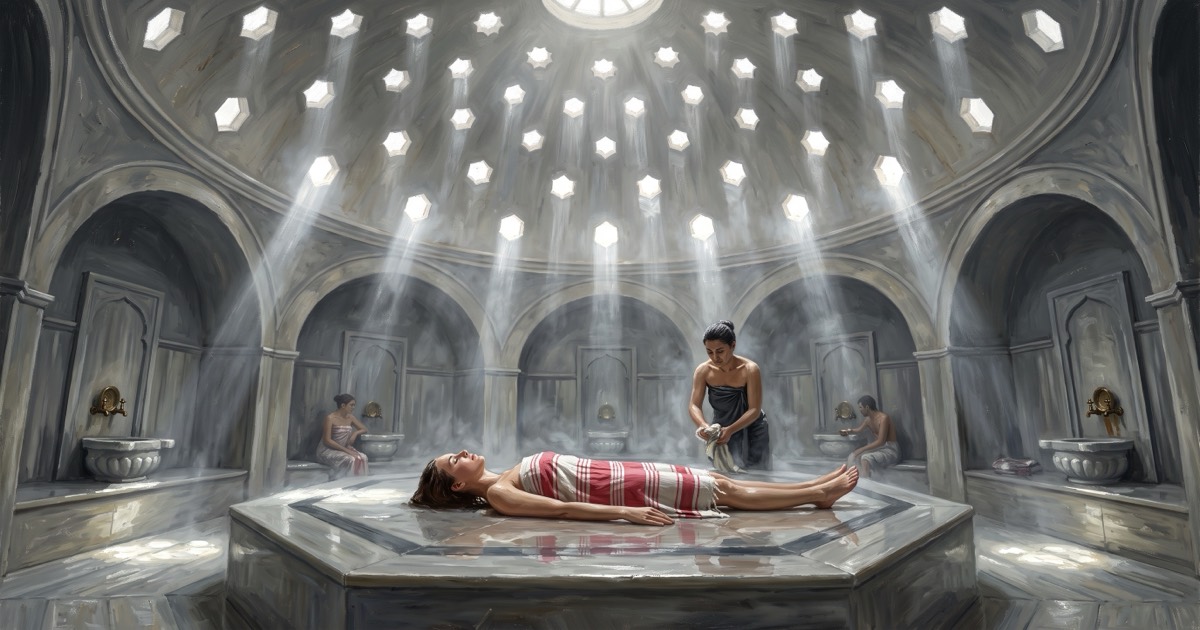
You warm up on a heated marble slab, then an attendant scrubs you with a kese mitt and washes you in olive-oil foam. The scrub is considerably more vigorous than most spa treatments and can leave skin sensitive for a day; say so if it is too hard, and attendants adjust readily. Historic hammams are usually sex-segregated, either by separate sections or alternating hours, so check before arriving. No alcohol beforehand, and leave when you have had enough.
Three appear on this page and all three are legend rather than history. The Bursa waters were not the secret behind the beauty of the Byzantine empress Theodora. Cleopatra did not bathe at Pamukkale. And Kayakoy is not a ghost village but the physical remains of a Greek Orthodox community depopulated in the 1923 population exchange, which deserves to be described as what it is.
April to October for the Aegean coast, with July and August genuinely hot and busy. Spring and autumn are better for walking the Lycian Way and for Pamukkale, where summer heat on the plateau is punishing. Bursa works year-round and is arguably best in winter, when Uludag has snow and a 44-degree thermal bath makes the most sense.