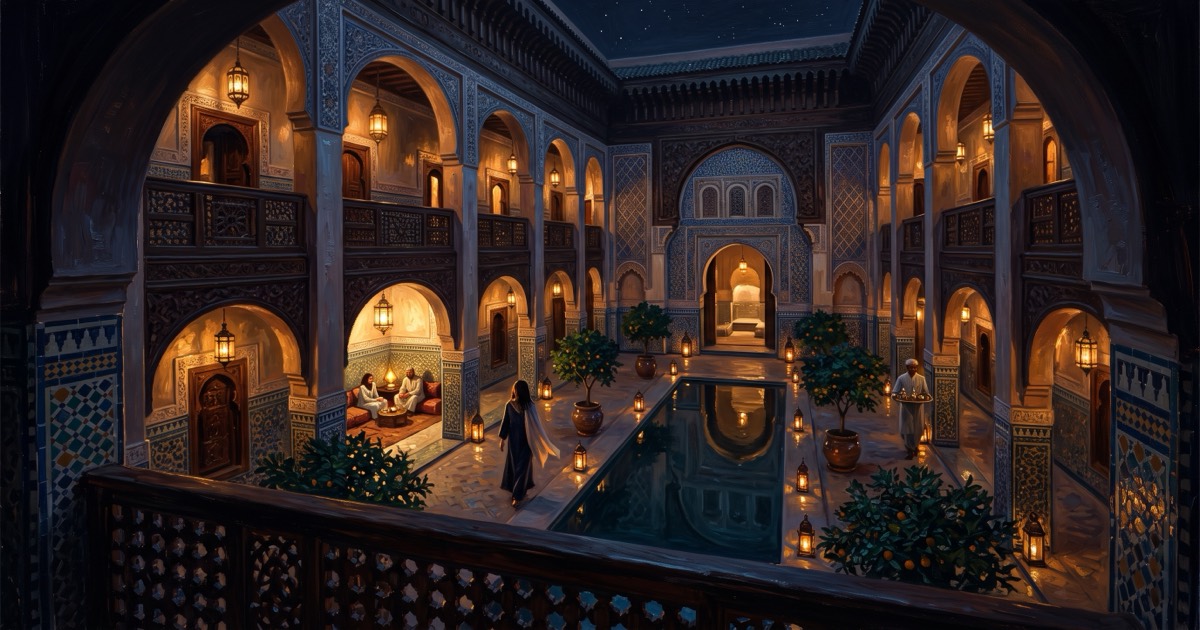
Morocco's wellness retreats are built around bathing rather than programmes: the hammam is a social and cleansing ritual with centuries behind it, and the wellness resorts here pair it with thalassotherapy on the coast and argan-based treatments inland.

Are you ready for extraordinary independently curated Morocco wellness resorts? We handle the brilliant research. You can simply relax and enjoy! here you will find the finest wellness sanctuaries throughout Morocco's breathtaking landscapes!
Morocco's wellness culture is anchored in the ancient hammam tradition: communal bathhouses that have served as centers of purification, social connection, and healing throughout the Islamic world for over a thousand years. The Moroccan approach to beauty and wellness revolves around locally sourced ingredients like argan oil, rhassoul clay from the Atlas Mountains, and rose water from the Dades Valley, natural treasures now coveted by luxury brands worldwide. Moroccan wellness resorts, particularly in Marrakech's enchanting medina and the serene Atlas foothills, envelop guests in intoxicating sensory experiences where ornate zellige tilework, fragrant orange blossoms, and centuries-old healing rituals create an atmosphere of profound restoration.
| Resort | Location | Type | Stay | Price Range | Best Season | Signature Experience | Wellness Focus |
|---|---|---|---|---|---|---|---|
| Royal Mansour | Marrakech | A La Carte | Flexible | $$$$$ | Oct to Apr | Royal 3-floor riad spa | Palace hammam & haute couture spa |
| La Mamounia | Marrakech | A La Carte | Flexible | $$$$$ | Oct to Apr | Heritage Shiseido spa garden | Historic palace & garden wellness |
| Four Seasons Marrakech | Marrakech | A La Carte | Flexible | $$$$ | Oct to Apr | Menara garden-view hammam | Moroccan spa & family wellness |
| Amanjena | Marrakech | A La Carte | Flexible | $$$$$ | Oct to Apr | Rose-petal basin meditation | Desert serenity & Aman tranquility |
| Mandarin Oriental | Marrakech | A La Carte | Flexible | $$$$ | Year-round | 27-acre olive grove spa | Atlas Mountain views & hammam |
| The View Bouznika | Bahia Golf Beach, Route Côtière km 44, 13100 Bouznika, Morocco | A La Carte | Flexible | $$$ | May to Oct | Atlantic thalassotherapy pool | Oceanfront healing & sea air |
The mystical terrain of Morocco beckons the weary soul with a siren song of sensory delights and extraordinary wellness experiences. Here, where ancient traditions meld with contemporary luxury, Morocco wellness resorts stand as sanctuaries of rejuvenation amidst landscapes that ignite the imagination with fierce beauty. The wellness resorts Morocco offers are not merely an escape but a metamorphosis: each destination a universe unto itself where the pursuit of well-being becomes an odyssey of body and spirit. As you journey into these Moroccan wellness resorts, you'll discover havens where time decelerates, senses awaken, and the mundane world dissolves into the extraordinary. From the vibrant energy of Marrakech to the tranquil foothills of the Atlas Mountains, these wellness resorts Morocco invite you to embark on a pilgrimage of self-discovery and profound renewal.
Royal Mansour opened in June 2010 inside the walls of Marrakech, commissioned by King Mohammed VI, who owns it, to show Moroccan craft at its highest level. It is not laid out as a hotel: guests stay in 53 individual three-storey riads arranged as a private medina of alleyways and courtyards across a walled five-hectare estate, each riad with its own plunge pool and roof terrace, serviced through hidden corridors and underground tunnels so staff are never seen arriving. Craftsmen from Marrakech, Fes, Meknes and Essaouira executed the zellige, tadelakt, carved plaster and wood. The spa runs to 2,500 square metres over three floors with its own entrance through a citrus garden and a celebrated white ironwork atrium, offering traditional hammam and gommage alongside contemporary treatments, with a medicinal herb plantation in the spa garden grown for its wellness programmes. Four restaurants operate under internationally starred chefs, and the hotel holds two MICHELIN Keys. Wellness is a la carte and there is no medical supervision. Among Morocco wellness resorts it is the benchmark for privacy and craftsmanship.
La Mamounia has operated since 1923 within the ramparts of Marrakech, on gardens given by an eighteenth-century sultan as a wedding present, and remains the city's defining institution; Churchill called it the loveliest spot in the world and painted its gardens repeatedly. A 2010 renovation by Jacques Garcia produced the current version, palatial and deliberately maximalist, with rooms, suites and riads set in twenty acres of olive, citrus and rose garden. Its spa covers 2,500 square metres across two floors below garden level, and the architecture alone, Moorish arches, zellige, carved stucco, is the reason many guests come: a traditional hammam at its centre, indoor pool, treatment rooms and a long menu built on argan oil, rose and orange blossom, with day passes available to non-residents, one of the few ways into a Marrakech palace spa without staying. It holds three MICHELIN Keys, the guide's highest rank, one of only two in Morocco. Wellness is a la carte with no programme or medical supervision. Among Morocco wellness resorts it is the historic choice, for guests who want the most famous spa in the country and a hotel that is itself a destination.
Four Seasons Resort Marrakech sits just outside the medina walls in the Hivernage district, a short walk from the Menara gardens and about fifteen minutes from the airport, laid out as a series of low Moorish pavilions through forty acres of olive groves, orange trees and water gardens. It is the most family-capable property on this page, with two pools, one adults-only, a large kids' club and generous suites and villas, several with private pools. The wellness element is a substantial spa of around 2,500 square metres with a traditional hammam, indoor pool, sauna and steam, treatment rooms including couples' suites, and a menu that pairs Moroccan rituals, black soap gommage, rhassoul clay, argan oil, with international brands, alongside a full fitness centre, tennis and daily yoga. Multi-day spa packages are available but nothing is prescribed, and there is no medical supervision. Among Morocco wellness resorts it is the reliable family choice, where one traveller can take a serious hammam circuit while the rest of the party uses the gardens and pools.
Amanjena opened in 2000 on the Ouarzazate road about ten kilometres from the medina, and was the Aman group's first resort in Africa. Ed Tuttle designed it over two years in rose-tinted pise, the packed-earth technique of Berber building, taking the Alhambra and the twelfth-century Menara gardens as references: 32 pavilions and seven two-storey maisons arranged around a long central basin and geometric gardens of palm and Almoravid olive across five hectares. Domed Venetian stucco ceilings sit above zellige floors, Berber rugs and bathtubs of green Ouarzazate marble. The Aman Spa is built around Moroccan hammam ritual, with treatment suites, a heated pool, and the group's wellness immersions available over several days; there are also two restaurants, tennis, and guided journeys into the Agafay desert and the Atlas. It holds two MICHELIN Keys, awarded in Morocco's first Key selection. Children are genuinely welcome, with a kids' club and interconnecting maisons. Wellness is a la carte and there is no medical supervision. Among Morocco wellness resorts it is the architectural high point, for guests who want stillness and proportion above all.
Mandarin Oriental, Marrakech spreads across roughly fifty acres of olive grove and rose garden on the edge of the city, with the Atlas mountains on the horizon, and is laid out almost entirely as private villas, each walled, with its own garden and heated pool, so seclusion comes from distance rather than doors. That scale is why it belongs among Morocco wellness resorts: guests can be as private as they wish, and the property has room for a spa of around 1,800 square metres with a traditional hammam, indoor pool, sauna, steam, a salon and treatment suites, offering Moroccan rituals with rhassoul and black soap alongside the group's signature therapies and multi-day journeys for detox, sleep and de-stress. There is a fitness centre, tennis, a yoga pavilion and gardens laid out for walking. The kitchen includes a Michelin-recognised Moroccan restaurant. Wellness is a la carte, with no minimum stay and no medical supervision. It suits a couple or family who want villa privacy and garden calm within reach of the medina.
The View Bouznika is the one property on this page that is not in Marrakech, and that is its argument. It stands above the Atlantic at Bouznika, on the coast between Casablanca and Rabat, roughly forty minutes from Casablanca airport, facing the ocean rather than the desert, which gives it a cooler climate through the summer months when Marrakech becomes difficult. The setting is contemporary rather than palatial, with rooms and suites oriented to the sea, a beach below and a pool terrace above it. Its wellness offering centres on a spa with a traditional hammam, treatment rooms, sauna and steam, thalasso-influenced treatments drawing on the Atlantic, and a fitness area, with yoga and multi-day spa packages available. Wellness is taken a la carte, and there is no programme requirement or medical supervision. Among Morocco wellness resorts it is the coastal alternative and the best summer choice, well suited to a guest who wants Moroccan hammam culture with sea air rather than the heat and intensity of the imperial city.
A 53-riad palace hotel in Marrakech commissioned by King Mohammed VI, with a 2,500 square metre spa
Royal Mansour MarrakechRoyal Mansour was commissioned by King Mohammed VI and opened in 2010, built as a private medina of 53 individual riads inside the walls of Marrakech. The spa runs to around 2,500 square metres beneath a white latticework atrium, and carries Sisley, Dr Burgener and Subtle Energies alongside traditional hammam. It sits between categories: more than a hotel spa, since practitioners including naturopaths and osteopaths run multi-day programmes, but not a medical clinic: there is no resident physician team and no diagnostics.
Setting:
The hotel is laid out as a miniature medina: individual riads along private lanes, courtyards and fountains, within the city walls near the Koutoubia. The spa is the architectural set piece: a three-storey atrium in white ironwork and latticework, filtering light down into the treatment floors. The craftsmanship throughout was executed by Moroccan artisans over several years, and it is a substantial part of what the rate buys.
Signature Spa Treatments:
Water Facilities:
Commercial pools require chemical treatment and monitoring by regulation. Ozone and ionisation systems reduce the chlorine needed but do not replace it, and no pool here is chemical-free.
Programmes include:
Each programme incorporates:
These are wellness programmes delivered by therapists and complementary practitioners, not medical treatment, and the hotel does not publish outcome data. Claims sometimes made in this category (that treatments eliminate toxins, boost immunity or regenerate cells) are not supported by evidence. Anyone managing a health condition should speak to their own doctor before booking.
Additional Activities:
Several restaurants across Moroccan, French and Mediterranean cooking, with the kitchens able to adapt menus for guests on a programme. Dining is a strength of the hotel in its own right rather than an extension of the spa.
Menu Highlights:
Menus change with the season and by restaurant, so specific dishes are not published in advance. The Moroccan kitchen covers the classical repertoire (tagines, pastilla, couscous) while the French restaurant works to its own menu. Dietary requirements and programme plans are accommodated on request.
Accommodations:
Service Approach:
The hotel's best-known feature is structural: a network of service tunnels beneath the property lets staff reach each riad without crossing the guest lanes, so deliveries and housekeeping happen largely unseen. Combined with a high staff-to-guest ratio and a butler per riad, the effect is a degree of privacy unusual even at this level. Whether that reads as remarkable or as slightly theatrical is a matter of taste, and worth knowing before booking.
Estimated Pricing & Value:
Prices are indicative and change by season. This is among the most expensive hotels in Morocco; confirm current rates directly.
Included:
Breakfast, return airport transfers, butler service, access to the fitness facilities and pools, and an initial wellness consultation. Spa treatments are charged separately unless part of a programme.
FAQ:
Is this a wellness destination or a hotel with a spa?
Between the two, and closer to the second. The spa is exceptional in scale and setting, and multi-day programmes are genuinely offered with naturopaths, osteopaths and visiting practitioners rather than therapists alone. But there is no resident medical team, no laboratory and no diagnostic workup, which is what separates this from Chenot or Clinique La Prairie. Treat it as a great city hotel with a serious spa attached: excellent if you want Marrakech with treatments, not the right choice if you want supervised clinical intervention.
How does the hammam compare with a public hammam?
The ritual is the same (black soap, steam, kessa exfoliation, ghassoul clay) but delivered privately, unhurried, and at many times the price. A neighbourhood hammam is communal, quick and inexpensive, and is no less authentic; anyone interested in the tradition should try one. What the hotel adds is privacy, control over temperature, and a therapist working to your preferences and skin, which suits guests who would find the communal version uncomfortable.
Can dietary requirements be accommodated on a programme?
Yes. The kitchens handle plant-based, gluten-free and dairy-free requirements across the restaurants, and menus are adapted for guests on a wellness programme in consultation with the spa team. Give notice when booking rather than on arrival, particularly for anything involving allergy rather than preference. Note that adapted menus here are a matter of the kitchen accommodating you, not a clinical nutrition protocol.
Inspected ratings
Judged awards and rankings
Reader votes
Nominations: World Travel Awards and World MICE Awards
The inspected entries are the ones to weigh. Forbes Five Stars for the hotel and, more relevant on a wellness page, Four Stars for the spa assessed in its own right are both awarded by anonymous inspection against published standards, not voted. Only a handful of properties in this guide hold a separately rated spa at all.
Fourteen of the entries above are nominations rather than wins, across two years of World Travel Awards and World MICE Awards. Both are decided by industry and public voting, and annual re-entry means the same categories recur without anything changing at the property. Presented as a single list, that volume reads as a decorated record; grouped by type, it reads accurately.
The La Liste and World's 50 Best entries are genuine peer and panel-based recognition. Note that the restaurant recognition belongs to La Grande Table Marocaine and Sesamo rather than to the hotel.
A 1923 palace hotel in Marrakech, with a 2,500 square metre spa
La MamouniaLa Mamounia opened in 1923 and is among the best-known hotels in North Africa, set within walled gardens beside the Marrakech medina. Its spa runs to around 2,500 square metres and combines traditional hammam ritual with treatments from Valmont, Augustinus Bader and the Moroccan brand marocMaroc. This is a grand hotel with an excellent spa rather than a wellness clinic: there is no resident medical team and no diagnostic programme, and it should be chosen on that basis.
Setting:
The hotel sits inside the ramparts on Avenue Bab Jdid, within walking distance of the medina, in gardens that predate the building by some two centuries. The spa is underground and deliberately dim, worked in zellige tile, carved plaster and marble around a central pool. The contrast between the noise of the medina and the quiet of the spa a few minutes away is much of the appeal.
Signature Spa Treatments:
Water Facilities:
Commercial pools require chemical treatment and monitoring by regulation. Ozone and UV systems reduce how much chlorine is needed but do not replace it, and no pool here is chemical-free.
Programmes include:
Each programme incorporates:
These are spa treatments, not medical or detoxification programmes. The body's detoxification is carried out continuously by the liver and kidneys and cannot be performed by a spa treatment; what a hammam and massage sequence offers is cleansing of the skin, relief of muscle tension and rest.
Additional Activities:
Several restaurants across Moroccan, French, Italian and Pan-Asian cooking, alongside the bars and the patisserie. Dining here is a strength of the hotel in its own right rather than an adjunct to the spa, and menus are not built around a wellness protocol.
Menu Highlights:
Menus change with the season and by restaurant, so specific dishes are not published in advance. The Moroccan restaurant covers the classical repertoire (tagines, pastilla, couscous) while the French and Italian restaurants work to their own kitchens' menus. The patisserie is a destination in its own right. Dietary requirements are accommodated on request.
Accommodations:
Service Approach:
Formal Moroccan hospitality, delivered by a large staff at a ratio typical of grand hotels rather than small retreats. Spa therapists are trained in both hammam technique and the international brands the spa carries. The style is attentive and traditional, which some guests find gracious and others find more formal than a wellness retreat would be.
Estimated Pricing & Value:
Prices are indicative and change by season. Confirm current rates directly with the hotel.
Included:
Breakfast, access to the fitness facilities and pools, arrival airport transfer and turndown service. Spa treatments are charged separately and are not included in the room rate.
FAQ:
How does the hammam here differ from a public hammam in Marrakech?
The ritual is the same in substance (black soap, steam, exfoliation with a kessa glove, rhassoul clay) but the setting and pace differ entirely. A public hammam is communal, brisk, inexpensive and part of ordinary life; the hotel version is private, unhurried and costs many times more. Neither is more authentic than the other, and anyone interested in the tradition would do well to try a neighbourhood hammam too. What the hotel offers is privacy, marble, controlled temperature and a therapist working to your preferences, which suits guests who would find the communal version uncomfortable.
Is this a wellness destination or a hotel with a spa?
A hotel with a very good spa, and worth being clear about the distinction. There is no resident medical team, no diagnostics, and no structured multi-day protocol of the kind offered at Chenot or Clinique La Prairie. Treatments are booked individually or as a sequence, and the rest of the stay is a city hotel stay: gardens, restaurants, the medina ten minutes away. That suits a traveller who wants Marrakech with excellent spa facilities. It does not suit someone seeking a supervised wellness programme, and the price of the rooms reflects the hotel rather than any clinical service.
When is the best time to visit?
Spring, roughly March to May, and autumn, September to November, are the most comfortable for combining the spa with time in the gardens and the city. Summer in Marrakech is genuinely hot, regularly above 38°C in July and August, which makes the underground spa a refuge but limits daytime sightseeing; plan around early mornings and evenings. Winter is mild by day and cool at night, quieter, and often better value. The spa operates year-round.
Inspected ratings
Wins
Publication listings
Nominations
The Forbes Four-Star rating is the only inspected entry, assessed anonymously against published standards. The World Travel Awards and World Spa Awards are decided by industry and public voting; the Condé Nast placing is a reader ballot; and the Gold List, Fodor's and Travel + Leisure entries are editorial or reader listings rather than assessed awards.
Note the pattern in the spa category: a nomination in 2023 became a win in 2024. Annual re-entry means a category can move between the two without anything changing at the property, so a single year's result is weak evidence either way.
Within the voted programmes, the 2023 record is genuinely strong: three World Travel Awards wins including a global category. Read it as standing within the sector rather than as an assessment of the property.
A 16-hectare garden resort between the medina and the Ville Nouvelle, with a 3,000 square metre spa
Four Seasons Resort Marrakech at MenaraFour Seasons Resort Marrakech sits on 16 hectares, around 40 acres, of gardens between the old medina and the Ville Nouvelle. Le Spa runs to roughly 3,000 square metres, built around traditional hammams and indoor-outdoor treatment rooms. This is a family-capable city resort with an excellent spa rather than a wellness destination: there is no medical team, no diagnostics and no structured multi-day protocol. Its strengths are the gardens, the two pools, and being close enough to the medina to use the city properly.
Setting:
Forty acres of gardens with olive trees, palms and roses, laid out around pools and shaded paths, with the Atlas Mountains visible to the south. The resort sits on Boulevard de la Menara, close to the Menara gardens and a short drive from the medina, which makes it more practical as a base for seeing Marrakech than properties further out. The spa uses arched walkways, lattice screens and earth tones in a contemporary rather than historicist register.
Signature Spa Treatments:
Water Facilities:
Commercial pools require chemical treatment and monitoring by regulation. UV and silver-copper ionisation systems reduce the chlorine needed but do not replace it, and no pool here is chemical-free. Contrast bathing is comfortable and can feel invigorating; it does not detoxify the body, which the liver and kidneys do continuously.
Programmes include:
Each sequence incorporates:
These are spa treatments rather than a wellness programme in the clinical sense. There is no medical supervision, no diagnostics and no published outcome data. Anyone managing a health condition should speak to their own doctor before booking treatments.
Additional Activities:
Three restaurants across Moroccan and international cooking, using seasonal local produce and herbs from the resort's own garden. Menus can be adapted for dietary requirements; they are not built around a wellness protocol.
Menu Highlights:
Menus change with the season and by restaurant, so specific dishes are not published in advance. Expect the Moroccan repertoire (tagines, grills, mezze) alongside Mediterranean and international dishes, with vegetarian options throughout. A new executive chef was appointed in 2026, so menus may have changed; check current offerings when booking.
Accommodations:
Service Approach:
Standard Four Seasons service: attentive, consistent and unobtrusive, with a large staff and the brand's usual reliability. Spa therapists are trained in both hammam technique and the international lines the spa carries. Families are genuinely well handled here, which is not true of every property in this guide and is worth weighing if you are travelling with children.
Estimated Pricing & Value:
Prices are indicative and change by season. Confirm current rates directly with the resort.
Included:
Breakfast, access to the fitness centre and pools, scheduled yoga and stretching classes, use of the tennis courts with equipment, concierge service and Wi-Fi. Spa treatments are charged separately.
FAQ:
What does the hammam involve here?
The standard sequence: black soap made with olive oil, steam, exfoliation with a kessa glove, a rhassoul clay mask, then a rinse and argan oil. What the resort adds is a private room, a therapist adjusting pressure and temperature to you, and no queue, which suits people trying a hammam for the first time. A neighbourhood hammam in the medina is communal, brisk and far cheaper, and is no less authentic; if the tradition interests you, both are worth doing.
Is this a wellness destination or a resort with a spa?
A resort with a very good spa. Le Spa is large and the hammam is properly done, but there is no medical team, no diagnostics and no structured multi-day programme of the kind at Chenot or Clinique La Prairie. Treatments are booked individually or sequenced across a stay. That suits a traveller who wants Marrakech, gardens, pools and treatments in the same place. Anyone looking for supervised clinical intervention should look elsewhere in this guide.
How does it work for families?
Better than most properties in this guide. The 35-metre pool has shallow areas and alcoves designed for children, there is a separate adults-only quiet pool so the two do not compete, and the kids' club is built as a small kasbah with supervised activities. Villas suit families needing space. Family yoga can be arranged. On spa treatments for under-18s: availability, minimum ages and parental consent requirements are set by the resort and vary by treatment, so ask directly rather than assuming. Note that the adults-only pool and much of the spa are, by design, not family areas.
Inspected ratings
Wins
Nominations, 2025
Nominations, earlier years
Distinctions
Forbes Five Stars in three consecutive years is the entry that counts, assessed by anonymous inspection against published standards rather than voted, and sustained rather than a single result.
Nineteen of the entries above are nominations rather than wins, across the World Travel Awards, World MICE Awards and World Spa Awards. All are decided by industry and public voting, and annual re-entry means the same categories recur year on year without anything changing at the property. Two wins in three years is the accurate summary of that programme.
Note that the spa has been nominated but not awarded: Morocco's Best Resort Spa in 2023 was a nomination. On a wellness page that is the relevant line, and it is worth reading alongside the hotel-level recognition rather than merged into it.
An Aman resort outside Marrakech on the Ouarzazate road, built around a central reflecting pool
AmanjenaAmanjena, meaning peaceful paradise, sits about twelve kilometres outside Marrakech on the road to Ouarzazate, next to the Amelkis golf course. It is built as a walled compound of pavilions and maisons in ochre pisé, arranged around a large central basin fed by fountains. The spa has two hammam suites, each opening onto its own courtyard, alongside a gym and tennis courts. This is a hotel with a good spa rather than a wellness destination: there is no medical team, no diagnostics and no clinical programme.
Setting:
Ochre-pink walls, arcaded courtyards and symmetrical planning, drawing on Moorish and Saadian precedent rather than reproducing it. The central bassin, lined with palms and olive trees, is the organising feature and is lit at night. The location on the Ouarzazate road puts the resort well outside the city, which buys quiet at the cost of a drive to the medina, about twenty minutes, and worth planning around. The Atlas Mountains are visible to the south.
Signature Spa Treatments:
Water Facilities:
Commercial pools require chemical treatment and monitoring by regulation. Ionisation systems reduce the chlorine needed but do not replace it, and no pool here is chemical-free. A hammam is a steam and cleansing ritual: it softens and cleans the skin thoroughly, but it does not detoxify the body, which the liver and kidneys do continuously.
Programmes include:
Each sequence incorporates:
These are spa treatments, not medical or clinical programmes. Visiting practitioner offerings vary and are not standing services; check what is scheduled for your dates. Anyone managing a health condition should speak to their own doctor before booking treatments.
Additional Activities:
Three distinct kitchens: Moroccan cooking drawing on Berber, Moorish and Andalusian influences at the main restaurant; an Italian menu from Arva, Aman's group-wide Italian concept; and a Japanese restaurant with a sushi bar and robata grill. The Pool Terrace and Olive Grove handles all-day dining.
Menu Highlights:
Menus change with the season and by restaurant, so specific dishes are not published in advance. The range across three kitchens is unusual for a property this size and is a genuine strength. The Caidal tent in the olive grove can be set for private dinners. Dietary requirements are accommodated on request.
Accommodations:
Service Approach:
Aman's standard model: a high staff ratio, service that is present without being intrusive, and a preference for quiet over ceremony. Guests consistently single out being left alone when they want to be, which is the point of the property and the reason it suits some travellers and not others. The spa team works in both Moroccan ritual and international treatment technique.
Estimated Pricing & Value:
Prices are indicative and change by season. Confirm current rates directly with the resort.
Included:
Breakfast, airport transfers, access to the fitness centre and pool, use of the tennis courts, non-alcoholic minibar, and fruit and flowers in the room. Spa treatments are charged separately.
FAQ:
What is the hammam like here?
Two marble hammam suites, each opening onto its own courtyard, which is unusual and is the best thing about the spa. The ritual is standard (beldi black soap, steam, kessa exfoliation, rhassoul clay, rinse, argan oil), delivered privately and unhurried, with the therapist adjusting heat and pressure to you. A neighbourhood hammam in the medina is communal, quick and far cheaper, and is no less authentic; if the tradition interests you, do both. What you are paying for here is privacy, the room itself, and not being rushed.
Is this a wellness destination or a hotel with a spa?
A hotel with a good spa. There is no medical team, no diagnostics and no structured multi-day protocol of the kind at Chenot or Clinique La Prairie; treatments are booked individually or sequenced across a stay. What Amanjena offers instead is quiet on a scale few properties manage, three genuinely different kitchens, golf next door, and architecture worth the trip on its own. Choose it for that, not for clinical intervention.
When should I visit, and does the location matter?
Spring, March to May, and autumn, September to November, are the most comfortable, roughly 20-30°C and suited to using the courtyards and pool. Winter is mild by day, cool at night, quieter, and often better value, with snow on the Atlas visible from the grounds. Summer is genuinely hot, regularly above 38°C in July and August, so plan around early mornings and evenings. On location: being twelve kilometres out on the Ouarzazate road is the reason the resort is so quiet, but it means every trip into the medina is a drive of around twenty minutes each way. If you intend to spend most of your time in the city, a property inside the walls will suit you better.
Wins: recent
Wins: historic
Nominations and shortlistings
Note the dates on the World Travel Awards wins. All seven are from 2020 or earlier, and five are from 2005 to 2012. That is a record of long-standing reputation rather than current assessment, and it is grouped separately for that reason. A win from 2005 tells you about the property's standing two decades ago.
The current entries that matter are the two Africa's Best Wellness Retreat wins, in 2023 and 2024. Consecutive wins in the category directly relevant to this guide, decided by industry and public voting rather than inspection.
Everything from 2023 onward in the World Travel Awards is a nomination rather than a win. Aman holds group-level awards that are sometimes attributed to individual properties; only recognition made to Amanjena specifically is listed above.

A villa resort in 20 hectares of gardens, whose spa won World's Best Resort Spa in 2024
Mandarin Oriental, MarrakechMandarin Oriental, Marrakech is laid out as a village of private villas across 20 hectares of gardens and olive groves on the Route du Golf Royal. Its spa runs to around 1,800 square metres and was named World's Best Resort Spa at the World Spa Awards in 2024, a genuine global win, and the strongest single credential of any property on this page. The approach combines Mandarin Oriental's treatment protocols with Moroccan hammam. It is a luxury resort with an outstanding spa rather than a clinic: there is no medical team, no diagnostics and no supervised programme.
Setting:
Twenty hectares of gardens and olive groves outside the city on the Route du Golf Royal, next to the Royal Golf Club. Architecture is contemporary with Moroccan detailing rather than pastiche, and the villa layout means most guests see very little of the resort beyond their own walls and the spa. The Atlas Mountains are visible to the south. Being out by the golf course buys space and quiet at the cost of a drive to the medina.
Signature Spa Treatments:
Water Facilities:
Commercial pools require chemical treatment and monitoring by regulation. Ozone and mineral systems reduce the chlorine needed but do not replace it, and no pool here is chemical-free.
Programmes include:
Each sequence incorporates:
These are spa treatments, not medical or detoxification programmes. The body's detoxification is carried out continuously by the liver and kidneys and cannot be performed by a treatment. Anyone managing a health condition should speak to their own doctor before booking.
Additional Activities:
Several venues covering Moroccan, Mediterranean and Chinese cooking, using produce from the resort's garden and local growers. Menus can be adapted for dietary requirements or for guests on a treatment sequence.
Menu Highlights:
Menus change with the season and by venue, so specific dishes are not published in advance. Expect the Moroccan repertoire alongside Mediterranean dishes and a Chinese kitchen that is genuinely uncommon in Marrakech. Dietary requirements are accommodated on request.
Accommodations:
Service Approach:
Mandarin Oriental's standard model, delivered by Moroccan staff: attentive, formal and consistent, with butler service for villa guests. Spa therapists are trained in both hammam technique and the group's own protocols, which is a plausible part of why the spa took a global title. The villa layout means service comes to you rather than the other way round, which suits guests who want privacy.
Estimated Pricing & Value:
Prices are indicative and change by season. Confirm current rates directly with the resort.
Included:
Breakfast, airport transfers, access to the fitness centre and group classes, internet, and butler service for villa guests. Spa treatments are charged separately.
FAQ:
Is the spa really the best on this page?
By the clearest external measure available, yes: The Spa at Mandarin Oriental, Marrakech was named World's Best Resort Spa at the 2024 World Spa Awards, beating a global field. That is a voted award rather than an inspected rating, so treat it as strong evidence rather than proof, but it is a genuine international title, and no other property in this guide's Morocco selection holds one. What it buys in practice is scale, consistency and therapists trained to a global standard.
What does the Asian and Moroccan combination actually mean?
In practice: Mandarin Oriental's treatment protocols, developed across its Asian properties, applied alongside Moroccan hammam and local ingredients such as argan, rose water and rhassoul clay. Therapists are trained in both. It is a well-executed combination of two treatment traditions rather than a therapeutic system in itself; descriptions elsewhere invoking meridians or energy balance should be read as a description of massage technique, not as a medical claim.
Does the villa layout suit everyone?
It suits guests who want privacy and space, and who are happy for the resort to come to them: treatments, dining and yoga can all be arranged within the villa. It suits less well anyone who wants the sociability of a hotel, since the layout is deliberately dispersed and you may see few other guests. The location by the Royal Golf Club is a genuine draw for golfers and a genuine drawback if you intend to spend your days in the medina, which is a drive away.
Spa wins: The Spa
Hotel wins
Nominations
This is the strongest spa record in Morocco, and the awards belong to the spa rather than the hotel. The Spa took World's, Africa's and Morocco's Best Resort Spa in 2024, having held the Morocco title in 2023: four wins across two years in the category this guide is actually about.
The World Spa Awards are decided by industry and public voting rather than by inspection, so read this as sustained standing within the sector. It is nonetheless a clearer wellness credential than a hotel-level rating, because the spa was the thing being judged.
Eight of the entries above are nominations rather than wins. Mandarin Oriental holds group-level awards that are sometimes attributed to individual properties; only recognition made to this property specifically is listed.
Atlantic thalassotherapy between Casablanca and Rabat, with a resident health team
The View BouznikaThe View Bouznika is a 130-room beachfront hotel on Morocco's Atlantic coast, built around a 3,200 square metre wellness centre. It was named Morocco's Best Wellness Retreat 2025 at the World Spa Awards. The centre is organised around thalassotherapy, using seawater pumped from the ocean, and follows the French thermal medicine tradition; a resident team including a general practitioner, osteopath, physiotherapists and dietician sets programmes after an initial assessment. Alongside the clinic there is a beach, an adjacent 18-hole golf course and several restaurants. The proposition is a coastal hotel with an unusually serious wellness operation attached: not a medical clinic, and not a conventional resort spa either.
Setting:
A beachfront position on the Atlantic, within the Bahia Golf Beach development between Casablanca and Rabat, roughly 45 minutes from either. The architecture is contemporary and oriented to the sea, with ocean views from most rooms and from the wellness centre. The coast here is open Atlantic: cooler and windier than Mediterranean Morocco, with surf that draws surfers to Bouznika. That climate is part of the appeal for a thalassotherapy property and worth knowing if you expect Marrakech warmth.
Signature Treatments:
Water & Wellness Facilities:
Seawater pools still require treatment and monitoring under public bathing regulation; descriptions of them as needing no chemical treatment are not accurate. Cryotherapy is not suitable for everyone: people with cardiovascular conditions, uncontrolled high blood pressure, or who are pregnant should not use it, and any facility should screen for this. Ask what screening is done before booking.
Programmes include:
Each programme incorporates:
These are wellness programmes with medical oversight, not medical treatment, and the hotel publishes no outcome data. Claims often made for thalassotherapy (that seawater has a mineral composition matching blood plasma, that it detoxifies the body, or that inhaled pine compounds oxygenate cells) are not supported by evidence. Warm seawater bathing, structured exercise, dietary change and rest are each worthwhile, and are what a programme here actually delivers. Anyone managing a health condition should speak to their own doctor before booking, and should not treat an arrival assessment as a substitute for their own medical care.
Activities:
Five restaurants across Italian, Mediterranean, Spanish-influenced beachfront and all-day dining, with the kitchens able to adapt menus for guests on a programme in consultation with the dietician. Atlantic seafood is landed locally and features across the venues.
Dining Venues:
Isola Ristorante for Italian cooking with ocean views; Folie Bouznika for Mediterranean dishes; Le Chiringuito for Spanish-influenced beachfront dining with tapas and seafood; Le V as the main all-day restaurant, where breakfast is served; and Le Dielli for poolside food. Menus change with the season, so specific dishes are not published in advance. The range of five venues is unusual for a property of 130 rooms and means guests on longer programmes are not eating the same menu each night.
Accommodations:
Service & Wellness Team:
The health centre team is the property's real distinction: a general practitioner, an osteopath, physiotherapists, sports coaches, a dietician, yoga teachers and spa practitioners, with an assessment offered on arrival. That breadth of resident professional staffing is unusual in a Moroccan resort and is why programmes here can be set individually rather than chosen from a menu. Staff work in English, French, Spanish and Arabic. Note that the wellness team keeps clinic hours rather than being available around the clock; if continuous medical cover matters to you, confirm the arrangements directly with the hotel before booking.
Estimated Pricing & Value:
Prices are indicative and change by season. This is materially better value than the Marrakech properties in this guide. Confirm current rates directly.
Included in Stay:
Breakfast at Le V, access to the indoor and outdoor seawater pools, use of the fitness centre and cardio studio, daily group classes including yoga and aqua fitness, beach access with loungers, sauna and relaxation areas, concierge service, Wi-Fi and parking. Treatments and programmes are charged separately.
FAQ:
What is thalassotherapy, and what can it reasonably do?
Thalassotherapy is the use of seawater, marine air and seaweed in treatment, developed in nineteenth-century France and still offered widely across French and North African coastal spas. At The View, seawater is drawn from the Atlantic in front of the hotel and used in heated pools, hydrotherapy circuits and individual baths. What warm seawater bathing reliably offers is buoyancy that takes load off joints, warmth that eases muscle tension, and a setting that encourages rest, which is why it is used in recovery and rehabilitation contexts. Claims that seawater's mineral composition matches human blood plasma, or that marine treatments detoxify the body, are frequently repeated and are not supported by evidence; the body's detoxification is carried out continuously by the liver and kidneys. Judge a thalassotherapy stay on rest, structured exercise and dietary change, which are real, rather than on marine biochemistry.
How medical is the wellness centre?
More so than any other property on this page, and less so than a clinic like Chenot or Clinique La Prairie. There is a resident general practitioner, an osteopath, physiotherapists and a dietician, and programmes follow an arrival assessment rather than being picked from a list. There is no laboratory, no diagnostic imaging and no inpatient care. It suits a guest who wants a structured, supervised week with genuine professional input at a fraction of Swiss prices. It does not suit anyone who needs actual medical treatment, and a stay should complement care from your own doctor rather than replace it.
What is the Jacquier air bowl?
A French inhalation device through which guests breathe air carrying compounds derived from pine resin, offered here as part of the treatment menu. It is marketed for muscle recovery, stress, concentration and sleep, and described as supporting cellular oxygenation. That last claim is not supported by evidence, and the others are not established by clinical research. Inhaling pine-scented air in a quiet room is pleasant and relaxing; treat the session on that basis. Anyone with asthma or a respiratory condition should check with the wellness team, and with their own doctor, before booking it.
Wins
Location and setting
Facilities
The Clean Beaches eco-label, held for a nineteenth consecutive year, certifies Bouznika Beach, the public beach, rather than the property. It is a genuine audited certification and a real advantage of the location, but it is not a hotel credential.
Use by the Moroccan national football team for pre-competition preparation is a notable endorsement and says something real about the facilities, but it is a commercial arrangement rather than an award.
That leaves one win: Morocco's Best Wellness Retreat at the 2025 World Spa Awards, decided by industry and public voting rather than inspection. A short record is not a criticism; it is simply accurate.
On the facilities: cryotherapy is not suitable for people with cardiovascular conditions or uncontrolled high blood pressure, or during pregnancy. Thalassotherapy offers warmth, buoyancy and rest, which are genuinely useful; claims that seawater matches blood plasma or that marine treatments detoxify the body are not supported by evidence.