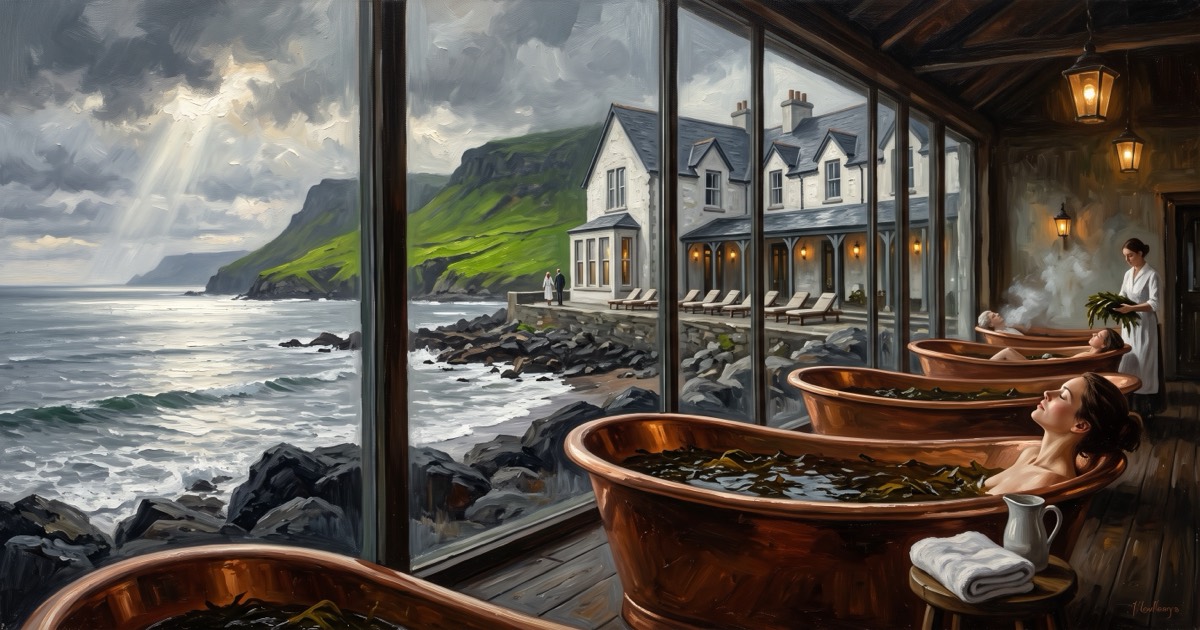
Ireland has one wellness tradition that is genuinely its own, and it is not what the spa hotels sell. Seaweed bathing, hot seawater and whole hand-harvested fronds in a Victorian cast-iron bath, has been practised on the Atlantic coast for well over a century, and two working bathhouses still do it properly. Kilcullen's has been in the same family since 1912, using the original porcelain. Voya draws forty thousand people a year to a village in Sligo. Both send their spent seaweed to local farmers as fertiliser, which is the kind of loop most properties only claim. The four hotels on this page are here for their settings and their food, and the page is clear about which is which. Ireland's wellness retreats are coastal and traditional rather than clinical: none of these runs a fixed residential programme, and two are bathhouses rather than places to stay at all.

| Resort | Location | Type | Stay | Price Range | Best Season | Signature Experience | Wellness Focus |
|---|---|---|---|---|---|---|---|
| Voya Seaweed Baths | Strandhill, Co. Sligo | Day Visit | Day sessions | $ | Year-round | Hot seawater and whole seaweed in a Victorian bath | Seaweed bathing & sports recovery |
| Kilcullen's Seaweed Baths | Enniscrone, Co. Sligo | Day Visit | Day sessions | $ | Apr-Oct | Bathing in the original 1912 porcelain | Seaweed bathing & heritage |
| Cliff House Hotel | Ardmore, Co. Waterford | A La Carte | Flexible | $$$$ | May-Sep | A private rock pool cut into the cliff | MICHELIN dining & coastal spa |
| Ashford Castle | Cong, Co. Mayo | A La Carte | Flexible | $$$$$ | May-Sep | The castle seen across Lough Corrib | Estate spa & country pursuits |
| Inchydoney Island Lodge | Clonakilty, Co. Cork | All-Inclusive | 3-7 nights | $$$ | May-Sep | Seawater therapy above two beaches | Thalassotherapy since 1998 |
| The Ice House | Ballina, Co. Mayo | A La Carte | Flexible | $$$ | Apr-Oct | Hot tubs set over the River Moy | Riverside spa & Wild Atlantic Way |
A private room with a Victorian cast-iron bath, hot seawater, and whole fresh seaweed, usually bladderwrack, hand-harvested locally rather than imported as an extract. The seaweed releases a smooth gel as it warms. Most rooms also have a steam box. You soak for around an hour, and the effect is warm, softening and unmistakably of the Atlantic.
What it does not do is detoxify anything, and minerals are not absorbed through the skin. Those claims appear even on the bathhouses' own sites, and this guide does not repeat them.
It is widely described as Ireland's only indigenous spa therapy, and that framing is defensible. Coastal communities bathed in seaweed long before it was commercial, and the practice survived on the Sligo and Mayo coast when it died out elsewhere.
There is a good economic footnote: historically, Irish coastal land was valued above inland land precisely because seaweed access made poor soils productive.
Opened in 2000 by Neil Walton, a former professional triathlete, with his father Mick Walton, combining sports recovery, aquaculture knowledge and the local bathing tradition. Around 40,000 visitors a year.
At the foot of Knocknarea, the mountain carrying Queen Maeve's cairn, on the Coolera Peninsula seven miles from Sligo town.
Setting: Shore Road, Strandhill, Co. Sligo, directly behind the beach on the Wild Atlantic Way.
The clientele is genuinely varied: couples, runners, cyclists, Gaelic footballers, and Buddhist monks from Cavan.
Strandhill is a small village with a good food scene for its size, and Sligo has more.
Voya is a bathhouse, not a hotel. It was opened in 2000 by Neil Walton, a former professional triathlete who encountered seaweed bathing at Kilcullen's while looking for sports recovery methods and went on to build the skincare brand of the same name. The bath is heated Atlantic seawater with fresh, organically certified bladderwrack harvested locally, taken in a private cabin, usually preceded by a steam box. It now takes around 40,000 visitors a year, which is why booking ahead matters. Spent seaweed goes to local farmers and community gardeners as fertiliser, continuing the older use that made coastal land more valuable than inland in the nineteenth century. Stay in Strandhill village, a short walk away, in surf hostels, guesthouses and a handful of small hotels, typically 90 to 200 euro a night, rates observed 2026. Sligo town is seven miles away with a fuller range. Book the bath before the bed, since slots fill at weekends.
Strandhill, in County Sligo. Voya also operates at the Twelve Hotel in Barna, County Galway, which is a different location entirely. Check which you are booking.
Yes, especially at weekends and in summer. Forty thousand people a year pass through a small building, and walk-in availability is unreliable. Book the bath first and arrange accommodation around it.
Site acquired 1898; the bath house opened 1912. Fifth generation of the same family, using the original porcelain baths and brass fittings in the tiled cubicles.
Over a century of continuous family operation in the original building is a stronger claim than any award, and unlike an award it can be checked.
Setting: Cliff Road, Enniscrone, Co. Sligo, on the shore of Killala Bay.
The distinction from Voya is age and continuity. The fittings are the ones installed in 1912, and the photograph does the historical work the text otherwise has to carry alone.
A small cafe at the baths, with the village and Ballina nearby for more.
Kilcullen's is a bathhouse with no accommodation, and the oldest continually operating seaweed bathhouse in Ireland. The Kilcullen family acquired the site in 1898 and opened the building in 1912, calling it Kilcullen's Modern Bath House to distinguish it from an older establishment dating to the middle of the nineteenth century. It is now run by the fifth generation of the same family and has changed remarkably little: the original glazed porcelain baths, solid brass taps, panelled wooden shower cisterns and reproductions of the old steam boxes are all still in use. The bath is heated seawater with fresh Atlantic seaweed steeped in it, taken privately, and the Atlantic itself is a few steps away on Enniscrone strand if you want the cold plunge afterwards. Enniscrone has guesthouses and self-catering along the strand, typically 80 to 180 euro a night, rates observed 2026. Ballina is 20 minutes inland, and The Ice House, elsewhere on this page, is there. Confirm the baths are open before booking a bed.
Different registers. Voya is larger, open year-round and geared to a broad clientele including athletes. Kilcullen's is smaller, seasonal, and its distinction is age: the same family since 1912, in the original building with the original porcelain. If the history is what draws you, come here.
It goes onto the family's own pasture as fertiliser. Historically this is why Irish coastal land was valued above inland land: seaweed access made poor soils productive. The loop is genuinely closed, which is more than most sustainability claims can say.
The building cascades down seven floors to the shore, clinging to the south side of Ardmore Bay. Around 39 bedrooms, most with sea views.
Its restaurant, The House, holds One MICHELIN Star, awarded by inspection rather than by voting. That makes it the strongest credential on this page.
Setting: Middle Road, Ardmore, Co. Waterford, about an hour from both Cork and Waterford airports.
The reason many people come. The House holds One MICHELIN Star, and Irish produce is far better than its international reputation suggests.
Around 39 bedrooms stepped down the cliff, most with sea views and floor-to-ceiling glass. Confirm the current room count at booking, as published figures date from 2021. Service is polished without being formal.
This one, and it is not close. The House holds One MICHELIN Star, awarded by inspection rather than by voting, which makes it the single strongest credential on the Ireland page. Ashford Castle and The Ice House both cook well, but the Star is a different order of recognition.
Yes. It is one of Ireland's oldest Christian settlements, the cliff walk is excellent, and the Copper Coast UNESCO Geopark runs along the shore. Waterford is close enough for a day, and the whole stretch is far quieter than the west coast.
On the shore of Lough Corrib, Ireland's second largest lake, at Cong in County Mayo. Once home to the Guinness family, and now the most extravagant property on this page.
The scale and the water reflection are what make it recognisable, and the estate runs to hundreds of acres.
Setting: Cong, Co. Mayo, on the Galway border, around an hour and a half from Galway city.
Formal country house dining, with Irish produce and a serious wine cellar.
Rooms and suites across the castle and estate lodges. The register is grand and traditional: antiques, open fires and a formal service style. This is the most expensive property on the Ireland page by a clear margin, and it does not pretend to be a wellness retreat.
No, and the page is clear about it. Ashford is a grand estate hotel with a good spa, not a wellness programme. There is no assessment, no protocol and no clinical provision. It earns its place through the setting, the estate pursuits and the sheer scale of the thing.
Ireland's first falconry school is on the estate and is genuinely well regarded. This guide takes a cautious position on animal-handling attractions generally, and notes that birds of prey in falconry are working animals under specialist care rather than exhibits. Ask about the birds' welfare and daily routine if it matters to you, as it should.
Ireland's first thalassotherapy centre, opened 1998, on a headland between two beaches at Inchydoney, near Clonakilty in West Cork. Around 51km from Cork Airport.
A four-star hotel, and the only one on this page. It earns its place on the thalassotherapy history rather than on luxury, and the page says so plainly.
Setting: Inchydoney Island, Clonakilty, Co. Cork, with the Atlantic on both sides of the headland.
West Cork is one of Ireland's strongest food regions, and the hotel draws on it.
A comfortable four-star property, family-friendly and unpretentious, with most rooms facing the sea. Expect a relaxed Irish hotel rather than a design destination. The position between two beaches is the draw.
Treatment using warm seawater, seaweed and marine products. It is pleasant, warming and relaxing. The frequently repeated claim that seawater resembles blood plasma is not true, and minerals are not absorbed through the skin. What Inchydoney genuinely has is the history: it opened Ireland's first thalassotherapy centre in 1998, and the seawater is drawn from directly below the building.
Very much so. It is one of the best food regions in Ireland, the coastline west toward Mizen Head is exceptional, and it is far less visited than Kerry. Cork Airport is about an hour, which makes it more accessible than it feels.
A landmark on the Moy estuary for nearly two centuries, converted from a nineteenth-century ice store. Restaurant 54 degrees 9 occupies the original ice house, which is where the hotel's name comes from.
The signature: two outdoor hot tubs positioned over the River Moy, one of Europe's great salmon rivers.
Setting: The Quay, Ballina, Co. Mayo, on the Moy estuary on the Wild Atlantic Way.
The restaurant is the property's strongest element, and it occupies the original ice store.
A four-star property combining the original stone building with a modern wing. Rooms vary considerably, and guest accounts differ on value. Ask for a river-facing room, which is the reason to be here.
Because it was one. The building was a nineteenth-century ice store on the Moy estuary, where ice was kept for preserving salmon before refrigeration. The restaurant now occupies the original ice house, and the structure has been a landmark on the quay for nearly two centuries.
Easily. Kilcullen's at Enniscrone is 20 minutes away, and Voya at Strandhill is around an hour. A few days based in Ballina covers both bathhouses, the Moy and the north Mayo coast, which is a strong itinerary and largely undiscovered by international visitors.
Six properties, of which two are working bathhouses rather than hotels, and they lead the page because seaweed bathing is the only wellness practice native to Ireland. One holds a MICHELIN Star, awarded by inspection. One opened Ireland's first thalassotherapy centre in 1998. One has been run by the same family since 1912. Three carry claims this guide declined to print because no awarding body could be named, and it says which and why. Ownership is disclosed where a group also appears on another country page. Prices run from a single seaweed bath to a castle suite.
A private room with a Victorian cast-iron bath, hot seawater, and whole fresh seaweed, usually bladderwrack, hand-harvested locally rather than imported as an extract. The seaweed releases a smooth gel as it warms. Most rooms also have a steam box. You soak for around an hour, and the effect is warm, softening and unmistakably of the Atlantic. What it does not do is detoxify anything, and minerals are not absorbed through the skin, claims that appear even on the bathhouses' own sites and which this guide does not repeat.
It is widely described as Ireland's only indigenous spa therapy, and that framing is defensible. Coastal communities bathed in seaweed long before it was commercial, and the practice survived on the Sligo and Mayo coast when it died out elsewhere. There is a good economic footnote: historically, Irish coastal land was valued above inland land precisely because seaweed access made poor soils productive.
Cliff House, and it is not close. Its restaurant holds a MICHELIN Star, awarded by inspection rather than by voting, which makes it the strongest single credential on this page. Ashford Castle and The Ice House both cook well, and Ireland's produce generally is far better than its reputation suggests.
May to September for the coastal hotels, when the Atlantic is at its least hostile. The bathhouses work year-round, and a hot seaweed bath in January with a westerly coming off the sea is arguably the better experience, though Kilcullen's runs seasonally so confirm before travelling. Expect weather in any month; the Wild Atlantic Way is not a reliable sunshine destination and does not pretend to be.
The two bathhouses and The Ice House sit within an hour of each other in Sligo and Mayo, which makes a strong three or four day itinerary on the Wild Atlantic Way. Cliff House and Inchydoney are on the south coast, several hours away, and work better as a separate trip. Ashford Castle sits between the two, in Mayo.