Iceland bathes because of geology rather than fashion. Geothermal water is the national heating system, public pools are civic infrastructure, and the lagoons that draw visitors sit on the same resource. This page covers the flagship retreat at the Blue Lagoon, a remote farm in the north with river immersion, two newer lagoons that locals actually use, a design hotel beside a geothermal plant, and a bathing site in the west built on the country's most powerful hot spring. Three things matter before you go: the peninsula is volcanically active, cold-water immersion is genuinely risky, and Icelandic bathing etiquette is not optional. None of these runs a fixed daily programme, so Iceland's wellness retreats are geological rather than clinical: three are places to stay and three are day bathing sites with no rooms at all.

| Resort | Location | Type | Stay | Price Range | Best Season | Signature Experience | Wellness Focus |
|---|---|---|---|---|---|---|---|
| The Retreat at Blue Lagoon | Grindavik, Reykjanes | A La Carte | 2-4 nights | $$$$$ | Year-round | A private lagoon in an 800-year-old lava flow | Geothermal bathing & in-water treatment |
| Deplar Farm | Fljot, Troll Peninsula | All-Inclusive | 3-7 nights | $$$$$ | Feb-Sep | A converted sheep farm with thirteen rooms | Adventure-led, remote |
| Forest Lagoon | Vadlaskogur, Akureyri | Day Visit | Day sessions | $$ | Year-round | The only geothermal spa in Iceland set among trees | Forest geothermal bathing |
| Sky Lagoon | Kopavogur, Reykjavik | Day Visit | Day sessions | $$ | Year-round | An infinity edge reading into the North Atlantic | Seven-step Skjol Ritual |
| ION Adventure Hotel | Nesjavellir, Selfoss | A La Carte | Flexible | $$$$ | Sep-Apr | Northern lights from a lava-field hotel | Geothermal pool & Þingvellir |
| Krauma Geothermal Baths | Reykholt, Borgarfjordur | Day Visit | Day sessions | $$ | Year-round | Europe's highest-flow hot spring, cooled by glacier | Graduated outdoor baths |
1. Volcanic activity. The Reykjanes peninsula is volcanically active and closures can occur at short notice. Check current advice at vedur.is and safetravel.is, and confirm your booking's cancellation terms before travelling.
2. Cold water. Several properties offer cold plunge and river immersion. Sudden cold-water entry causes an involuntary gasp and a sharp rise in heart rate and blood pressure, the cold shock response, which can be dangerous even in people with no known heart condition.
3. Bathing etiquette. Icelandic pools and lagoons require thorough washing without a swimsuit before entering, in communal facilities. This is non-negotiable, taken seriously, and surprises many visitors.
A luxury hotel built into an 800-year-old lava flow beside the Blue Lagoon, with a private lagoon reserved for guests, an underground spa cut into the rock, and in-water treatments.
Architecturally it is the most considered building in this guide, and the private lagoon is the whole point: the public Blue Lagoon is busy, and this is not.
Setting: Nordurljosavegur 9, Grindavík, on the Reykjanes peninsula, around 20 minutes from Keflavík airport and 45 from Reykjavík. The address needs context: Grindavík itself was evacuated in November 2023, the first time in around fifty years that an entire Icelandic town had been cleared, and its roughly 4,000 residents have not returned in any number since. The Blue Lagoon site sits outside the town and operates independently of it, but visitors should not expect a functioning town nearby.
Moss Restaurant is among the most ambitious in Iceland, built on Icelandic produce that is far better than its reputation suggests.
Sixty suites facing the lava field and the lagoon, in a low building by Basalt Architects that reads as part of the landscape, deliberately without screens and with floor-to-ceiling glass onto either pale water or dark rock. It opened in 2018 and holds a MICHELIN Key. The spa is the substance: roughly 2,300 square metres carved into the rock and opening onto a lagoon reserved for guests, so the public Blue Lagoon can be skipped entirely. The Blue Lagoon Ritual is self-guided through three interconnected chambers, a mineral salt scrub, then silica mud left for about fifteen minutes, then microalgae, each rinsed under rain showers between steps. In-water massage and float therapy run in a secluded section of the lagoon. Moss holds a Michelin star, the only starred hotel restaurant in Iceland, with a wine cellar cut into the lava. Silica, algae and minerals genuinely affect how skin feels; claims beyond that are cosmetic rather than medical. The most expensive property on this page, and the privacy is what the price buys.
Substantially. Hotel guests use a private lagoon in the same geothermal system, separate from the public site, and it is quiet in a way the main lagoon never is. If the images that drew you to Iceland were of empty blue water and steam, this is the version that delivers them.
Take it seriously rather than worry. The Reykjanes peninsula has been volcanically active, and closures happen at short notice. Check vedur.is and safetravel.is, book flexible terms, and follow official instruction without argument. Icelandic civil protection is exceptionally good at this.
A converted sheep farm on the remote Troll Peninsula in northern Iceland. Thirteen rooms, a spa of around 5,000 square feet holding an isopod flotation tank, sauna, steam room and cold plunge, and a geothermal indoor-outdoor pool with a swim-up bar, glazed to the landscape. There is also a gym, a yoga and pilates studio, and a music room — the last being unusual enough to be worth mentioning.
The offering is adventure-led rather than programme-led: heli-skiing, river work and fjord country, with the spa as recovery rather than as the reason to come.
Setting: The Fljót Valley on the Troll Peninsula, northern Iceland, about 90 minutes from Akureyri airport and roughly five hours' drive from Keflavík. The lodge is run by Eleven Experience and occupies a sheep farm the operator dates to the fifteenth century, rebuilt in black timber under a living turf roof with floor-to-ceiling glazing. It is genuinely remote, and worth understanding why: the Fljót Valley receives some of the highest average snowfall anywhere on earth, and the eastern road in is closed for the whole winter. Access in season is by the western route or by helicopter, and there are two helipads on the property.
All-inclusive, with a kitchen working from Icelandic produce and a very small number of guests to cook for.
Thirteen rooms in a converted sheep farm on the Troll Peninsula in the far north, run by Eleven Experience, with private buyout available for groups, with private buyout available for groups. The remoteness and the guide team are what you are paying for, and both are exceptional.
Not in the programme sense. Deplar is an adventure lodge with an excellent spa, and the page says so. There is no assessment, no protocol and no clinical provision. What restores people here is hard days outside in extraordinary country, followed by a geothermal pool. That is a legitimate mechanism and needs no dressing up.
February to May for heli-skiing and the northern lights, June to September for fjord activity and near-endless daylight. Winter here is dark and the roads are serious; the property handles transfers, but build flexibility into travel plans.
The only geothermal spa in Iceland where you bathe surrounded by trees, which in a country famously short of forest is genuinely novel. Two pools cut into the birch and pine of Vadlaskogur, above Akureyri and the fjord.
Newer and less crowded than the Reykjavík lagoons, and genuinely used by locals as well as visitors — memberships are common, and Thursday evenings bring live music for bathers. Capacity is capped at around 200 people at a time, which is the main reason it does not feel like the southern lagoons; it also means booking ahead matters, particularly on summer weekends. Access is unusually well handled: the site is wheelchair accessible and there are private non-binary changing rooms, which is not standard across Icelandic bathing culture.
Setting: Vaðlaskógur, on the eastern shore of Eyjafjörður across the water from Akureyri, about 3.5km from the town centre. The origin is worth knowing: the geothermal water was found by accident in the mid-2010s when crews boring the 7.5km Vaðlaheiðargöng road tunnel struck a hot spring inside the mountain. The strike was serious enough to delay the tunnel's opening by more than a year. Rather than waste the resource, the flow was channelled into a purpose-built bath, which opened in 2022. It was designed by Basalt Architects, the practice behind the Blue Lagoon and GeoSea at Húsavík, with a timber front section built in cross-laminated timber and a rear of pre-cast concrete set against the mountain rock.
A restaurant on site with fjord views, and Akureyri has a good small-city food scene.
A day facility with no accommodation. Stay in Akureyri, Iceland's second city and the capital of the north, a few minutes across the fjord. The lagoon opened in 2022 in the Vadlaskogur forest, which is itself the point: two infinity pools looking down Eyjafjordur, a dry sauna with a picture window and a cold plunge, set among trees on an island that has almost none. It is markedly quieter than the Reykjavik lagoons, which has the full range from guesthouses to hotels, typically ISK 20,000 to 50,000 a night, rates observed 2026. The lagoon is a few minutes across the fjord.
Because Iceland has almost none. Deforestation began with settlement over a thousand years ago and the country has been largely treeless since. Vadlaskogur is a planted forest, and bathing inside it is an experience available nowhere else in Iceland. It also shelters the pools from wind, which matters more than it sounds.
Different, and quieter. Sky Lagoon has the North Atlantic and the ritual; Blue Lagoon has the scale and the fame. Forest Lagoon has trees, fewer people and a view over Akureyri. If you are in the north, it is the obvious choice and worth planning around.
On the coast at Kopavogur, minutes from central Reykjavik, with an infinity edge that reads straight into the North Atlantic. The seven-step Skjol Ritual moves through lagoon, cold plunge, sauna, cold mist, scrub, steam and shower.
The most accessible serious bathing in Iceland, and the ritual gives it structure that the other lagoons lack. NOTE THE AGE LIMIT: children under twelve are not admitted at all, and guests aged twelve to fourteen must be accompanied by a guardian of eighteen or over, with staff entitled to ask for identification. That rules Sky Lagoon out for families with younger children, and it is also the main reason the atmosphere stays calm. The site is wheelchair accessible, and reachable by public bus, hotel shuttle, or on foot in about an hour and a quarter along the coastal path.
Setting: Vesturvör 44, on Kársnes Harbour in Kópavogur, roughly 6km and ten to fifteen minutes from central Reykjavík. Construction began in early 2020 and the lagoon opened on 30 April 2021. It was designed by Halldór Eiríksson of T.ark Architects, drawing on turf-house form and basalt colour so the buildings sit low against the shoreline. The infinity edge runs around 70 to 75 metres depending on the source, with the water held between 38 and 40 degrees year-round. On a clear day the view takes in Snæfellsjökull glacier, the mountain Keilir, the Reykjanes peninsula and Bessastaðir, the Icelandic president's residence.
On-site dining and a swim-up bar, with the whole of Reykjavik ten minutes away.
A day facility with no accommodation. Stay in Reykjavik, ten minutes away, with everything from hostels to design hotels, typically ISK 25,000 to 70,000 a night, rates observed 2026. The lagoon opened in 2021 on the Karsnes shoreline, and the infinity edge is set against the open North Atlantic rather than a lava field, with the turf-roofed entrance built in the Icelandic sod-house tradition. The Skjol ritual runs seven steps in fixed order: the warm lagoon at around 38 to 40 degrees, a cold plunge near 10, a sauna with a picture window onto the sea, a cold mist, a salt scrub, a steam room, and a final rinse back into the lagoon.
A seven-step sequence: warm lagoon, cold plunge, sauna, cold mist, salt body scrub, steam, then shower. It takes around an hour done properly. The alternation of heat and cold is the same principle as Nordic bathing everywhere, and the effect is genuine relaxation rather than anything more elaborate.
Sky Lagoon is closer to Reykjavik, cheaper, faces the open Atlantic and has the ritual structure. Blue Lagoon is larger, more famous, further out and on the volcanic peninsula. If you have one day and are based in the city, Sky Lagoon is the practical answer.
A minimalist hotel on a lava field at Nesjavellir, near Þingvellir National Park, a UNESCO World Heritage Site and the place where the Althingi, one of the world's oldest parliaments, was founded in 930.
The building began as an inn for workers at the Nesjavellir geothermal plant, Iceland's second largest, and stood abandoned for years before Sigurlaug Sverrisdóttir, a former member of cabin crew, bought it in 2011 and commissioned the Santa Monica studio Minarc, run by the Icelandic architects Erla Dögg Ingjaldsdóttir and Tryggvi Thorsteinsson. It reopened in 2013 with 45 rooms. The new wing is cantilevered over the lava on tall pillars, and the reference is deliberate: they stand for the high-seat pillars that Ingólfur Arnarson, Iceland's first settler, is said to have thrown from his ship in 874, building where the gods brought them ashore. The geothermal pool outside is still the reason most people book it.
Setting: Nesjavöllum við Þingvallavatn, on the lava slopes of Mount Hengill, around 45 minutes from Reykjavík and roughly 20 minutes from Þingvellir, beside a working geothermal power station that supplies the capital. A driving warning worth heeding: road 435 is closed every winter, from 1 October to 1 May, but continues to appear as a route in satellite navigation. From Reykjavík take road 36 towards Þingvellir and turn onto road 360 for Nesjavellir. This catches people out annually and matters in a country where a wrong turn in winter is a serious matter.
Silfra Restaurant on site, working from Icelandic produce, with no alternatives nearby given the location.
Design-led rooms in a building cantilevered on concrete stilts over the lava, most facing the lava field or Lake Thingvallavatn, built largely from reclaimed and local materials on the site of former geothermal workers' quarters. The Northern Lights Bar is a glass-walled room built for watching the sky, and there is an outdoor geothermal pool. Ask for a lava-facing room. The hotel is small and isolated, so plan to eat on site.
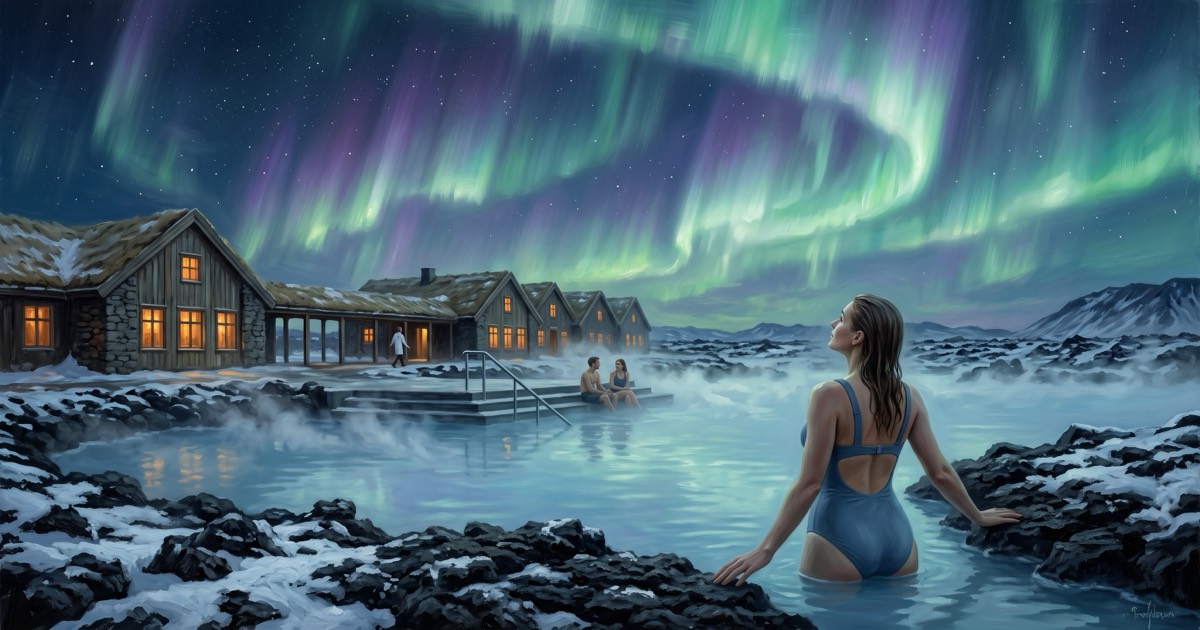
Among the best in reach of Reykjavik. It is 45 minutes from the city lights, has a glass-walled bar built for watching, and an outdoor geothermal pool to wait in. The season runs September to April and nothing is guaranteed, but the setup is as good as it gets this close to the capital.
A UNESCO World Heritage Site and the founding place of the Althingi in 930, among the oldest parliaments in the world. It also sits in the rift valley between the North American and Eurasian tectonic plates, so the geology and the history are equally remarkable. It is minutes from the hotel.
Fed by Deildartunguhver, the highest-flow hot spring in Europe. Water emerges at close to 100 degrees and must be cooled with cold water drawn from Rauðsgil, which rises in what was once the Ok glacier. That phrasing is deliberate: Ok lost its glacier status in 2014 and in 2019 became the first Icelandic glacier given a memorial plaque, so the water cooling these baths comes from a glacier that no longer exists before use. Six baths in total: five warm, generally held between about 37 and 42 degrees, and one cold tub at roughly 5 to 10, plus a cold tub.
No chemicals are added because the water is replaced continuously, which is a genuine consequence of the flow rate rather than a marketing line.
Setting: Deildartunguhver, 320 Reykholt on road 50, in Borgarfjörður in western Iceland, about 97km and 90 minutes from Reykjavík. The baths opened in 2017, roughly 70 metres from the spring itself. Deildartunguhver is working infrastructure as much as a landmark: it pushes out around 180 litres per second, and that output is piped 34km to heat Borgarnes and 64km to Akranes, one of the longest hot-water pipelines in the country. Anyone who has showered within about 64km of here has effectively already bathed in it. The spring itself is free to visit, with boardwalks and viewing platforms, and its steady heat supports ferns and plants found nowhere else in Iceland. Reykholt village, two kilometres on, was the home of Snorri Sturluson, and his medieval bathing pool Snorralaug still survives there.
A restaurant on site overlooking the spring, working from western Icelandic produce.
A day facility with no accommodation. Stay in Borgarfjordur or Borgarnes. The baths are fed by Deildartunguhver, the highest-flow hot spring in Europe, which emerges at close to 100 degrees and has to be cooled with water from the Ok glacier before anyone can get in; there is no chemical treatment because the water is continuously replenished. Five baths at graded temperatures, two steam rooms and a cold tub, with Snorri Sturluson's Reykholt a few minutes away, typically ISK 18,000 to 40,000 a night, rates observed 2026, or visit as a day trip from Reykjavik, 90 minutes away.
Because it emerges at close to 100 degrees. Deildartunguhver is the highest-flow hot spring in Europe, producing enormous volumes of near-boiling water, and it is cooled with glacial water from Ok before reaching the baths. The flow is also why no chemicals are needed: the water is replaced continuously rather than treated.
Ninety minutes each way, and yes if you pair it with Borgarfjordur. Reykholt, Hraunfossar and the Vidgelmir lava cave are all close, which makes a full day. As a bathing site alone it is quieter and cheaper than the Reykjavik lagoons, with a spring beside it that is genuinely worth seeing.
Six entries on a page where bathing is infrastructure rather than fashion. One is fed by the highest-flow hot spring in Europe and must be cooled with glacial water before anyone can enter it. One is the only geothermal spa in the country set among trees, in a land that has been largely treeless for a thousand years. One sits beside a UNESCO World Heritage Site where a parliament was founded in 930. Three properties offer cold immersion, and the risks are stated before any of them are described. Two are day facilities costing a fraction of the hotels, and the page says so plainly.
Thorough washing without a swimsuit before entering, in communal facilities. This is non-negotiable, taken seriously, and surprises a great many visitors. It exists because Icelandic pools use minimal chemical treatment, and it applies at every lagoon on this page.
It carries real risk and this page states it before describing any property. Sudden cold-water entry causes an involuntary gasp and a sharp rise in heart rate and blood pressure, the cold shock response, which can be dangerous even in people with no known heart condition. Never enter alone, never after alcohol, enter gradually, and think in seconds rather than minutes. Anyone with cardiac history, high blood pressure or who is pregnant should take medical advice first.
It should change how you book rather than whether you go. The Reykjanes peninsula reawakened in 2021 after around 800 years of quiet and has erupted repeatedly since, with nine eruptions on the Sundhnúkur crater row since December 2023 alone. This affects the Blue Lagoon area specifically: the town of Grindavík was evacuated in November 2023 and remains largely empty, and the Blue Lagoon and its hotels have closed and reopened several times, with lava reaching the car park in November 2024. Defensive barriers have so far protected the lagoon and buildings, and closures have generally been short. Elsewhere in Iceland, including the north and west, the properties on this page are unaffected. Check vedur.is and safetravel.is before travelling, confirm your booking's cancellation terms, take insurance that covers volcanic disruption, and follow official instruction without argument. Icelandic civil protection handles this exceptionally well: the November 2023 evacuation of Grindavík was completed in 95 seconds.
Sky Lagoon if you are based in Reykjavik and want the ritual and the Atlantic. Forest Lagoon if you are in the north and want trees, quiet and a fjord view. Krauma if you are heading west and want the geology, since Deildartunguhver beside it is the highest-flow hot spring in Europe. The Retreat is the one to book if you want a private lagoon rather than a shared one.
September to April for northern lights, with bathing outdoors in cold air being the whole point. June to August for near-endless daylight, hiking and the highlands, though the lagoons are busier. Deplar Farm's heli-skiing runs roughly February to May. Winter driving in Iceland is serious; check road.is daily and do not push conditions.