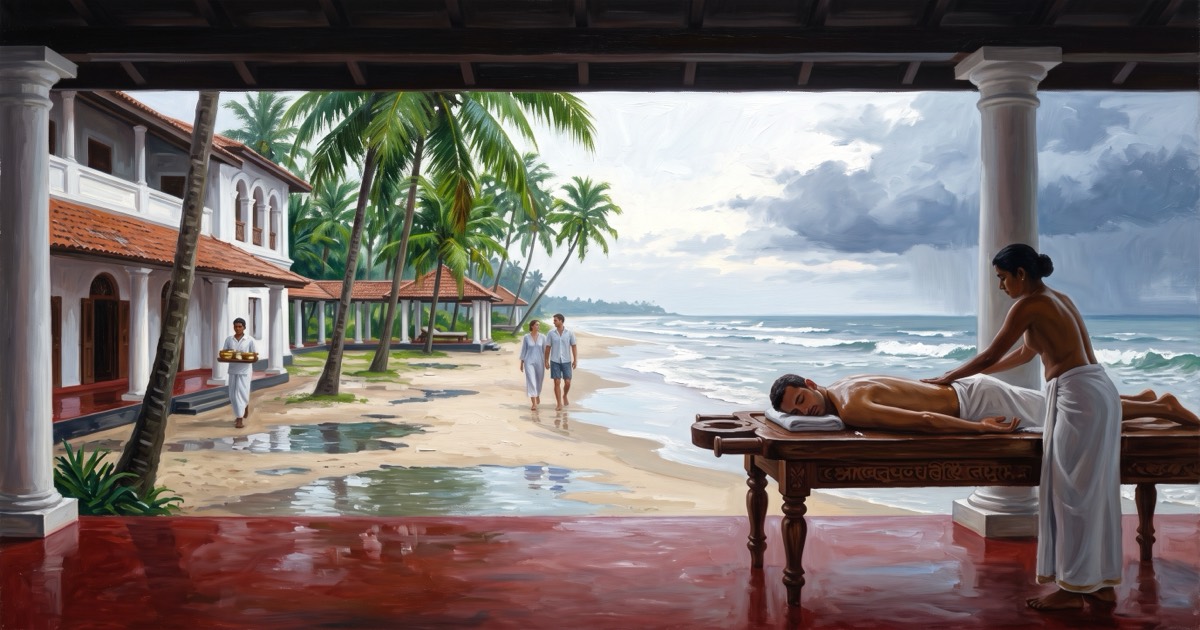
Sri Lanka has the most clinically serious Ayurvedic provision of any destination in this guide, with comprehensive assessment by qualified physicians and programmes measured in weeks. It also has an off-grid village retreat with no electricity and no wifi, and a five-star resort on a coconut plantation that asks nothing of you at all. Because most properties here prescribe internal herbal preparations, the safety note below is the most consequential on this site. Read it before booking anything, and read it especially if you take prescribed medication. This is the page where the distinction matters most: five of these are wellness retreats with residential programmes and a physician-set daily structure, and only the last is a wellness resort you can simply check into.

| Resort | Location | Type | Stay | Price Range | Best Season | Signature Experience | Wellness Focus |
|---|---|---|---|---|---|---|---|
| Barberyn Ayurveda Resorts | Beruwala & Weligama | All-Inclusive | 14-21 nights | $$ | Dec-Apr | Physician-led Ayurveda since the 1980s | Clinical Ayurveda |
| Santani Wellness Resort | Kandy hills | All-Inclusive | 5-14 nights | $$$$ | Year-round | Minimalist architecture at 800 metres | Design-led wellness |
| Siddhalepa Ayurveda Health Resort | Wadduwa | All-Inclusive | 7-21 nights | $$ | Dec-Apr | A resort run by a herbal manufacturer | Ayurveda, beachfront |
| Sen Wellness Sanctuary | Rekawa, Tangalle | All-Inclusive | 5-14 nights | $$$ | Dec-Apr | Founded by a Sri Lankan Ayurvedic doctor | Ayurveda, yoga & breathwork |
| Ulpotha | Near Dambulla | All-Inclusive | 7-14 nights | $$ | Jan-Mar, Jul-Aug | Off-grid village with no electricity or wifi | Yoga & Ayurveda, off-grid |
| Anantara Peace Haven Tangalle | Tangalle | A La Carte | Flexible | $$$$ | Dec-Apr | A coconut plantation above the southern coast | Resort spa, undemanding |
Ayurvedic programmes here involve internal herbal preparations prescribed by practitioners. Four things every guest should know.
1. Herb-drug interactions are real. Ayurvedic preparations can interact with prescribed medication, including anticoagulants, diabetes medication and immunosuppressants. Tell the Ayurvedic physician everything you take, and tell your own doctor what you were given.
2. Some traditional preparations, particularly rasa shastra metallic and mineral formulations, have been found on testing to contain lead, mercury or arsenic, sometimes at harmful levels. This is documented in peer-reviewed literature and is not a fringe concern. You may ask whether a prescribed preparation contains metallic or mineral ingredients, and you may decline it.
3. Bring your prescribed medication and do not stop it for a programme except through your own doctor.
4. Panchakarma is demanding, involves purgative and emetic procedures, and is unsuitable in pregnancy, during acute illness, and for people who are frail or underweight. Anyone with a history of disordered eating should discuss it with their own clinician first.
Two long-established Ayurvedic centres on the southern and western coasts, and the most clinically serious properties on this page: comprehensive assessment by qualified Ayurvedic physicians, with programmes prescribed individually and measured in weeks.
Operating since the 1980s, and the clientele is largely European guests returning for repeat treatment courses.
Setting: Beruwala on the west coast and Weligama on the south coast, both beachfront, around 90 minutes and three hours from Colombo respectively.
Food is prescribed as part of the treatment, cooked to each guest's constitution and programme.
Comfortable beachfront accommodation, simple rather than luxurious, with no televisions or radios in the rooms by design; standard rooms run to around 300 square feet, deluxe to 400 and deluxe studios to 452. The clinical provision is what you are paying for, and the register is medical rather than resort-like. The history matters here: Barberyn Reef at Beruwala was founded in 1968 by Sudano Rodrigo and is generally credited as the first Sri Lankan resort to offer Ayurveda to Western visitors; Barberyn Beach at Weligama followed in 2003, and Barberyn Waves, built on stilts around existing medicinal trees with a water garden by the artist Laki Senanayake, is the newest. It remains family-run. Each property has its own health centre staffed by resident Ayurvedic doctors, therapists and dieticians, preparing their own medicines and oils, and a doctor or dietician is present at meals to advise on what suits your prescription. Note that the Panchakarma programmes include Virechana, purgation therapy, and Vasti, medicated enema therapy. These are substantial interventions rather than spa treatments, they should be undertaken under the physician supervision that is provided here, and anyone managing a medical condition or taking prescribed medication should discuss suitability with their own doctor before booking. The clinical provision is what you are paying for, and the register is medical rather than resort-like.
Fourteen to twenty-one days for a genuine treatment course. That is the format Ayurveda is built around, and it is why the clientele here is largely repeat European guests booking a fortnight. A three-night stay is a spa break with Ayurvedic styling rather than treatment.
Everything you take, including over-the-counter supplements. Ayurvedic preparations can interact with prescribed medication, including anticoagulants, diabetes medication and immunosuppressants. Bring your medication, do not stop it for the programme except through your own doctor, and tell your own doctor afterwards what you were given.
At 800 metres on a 48-hectare estate of forest and old rice terraces an hour from Kandy, and the most architecturally considered wellness property on the island.
Minimalist buildings shaped to the terraces, with Ayurveda alongside contemporary wellness rather than as the whole programme. The altitude makes it noticeably cooler than the coast.
Setting: Arathenna Estate, Werapitiya, near Theldeniya, in the hills an hour east of Kandy.
Programme-aligned cooking using estate and Sri Lankan produce, with no fixed menu.
Twenty standalone chalets of around 46 square metres, sixteen facing the mountains and four garden-view set apart for families with children over twelve, each with a full glass wall onto the valley and no television. The open design lets hill air move through, so there is no air conditioning and none is needed at 2,800 feet. The buildings draw on the Tampita Vihara tradition of timber structures raised on stone pillars. The estate runs to 48 acres of former tea plantation at Werapitiya, looking across to the Knuckles range, a UNESCO World Heritage site. The spa is around 6,000 square feet and holds what the property says is Sri Lanka's only thermal salt bath. Every stay opens with an assessment by the head of wellness and Ayurvedic doctors, and the food follows from it: there are no menus, and the kitchen proposes each meal to each guest from produce grown on site. It holds a MICHELIN Key. Kandy is about an hour and a half by road, Colombo around four hours, or a seaplane to Victoria Reservoir then an hour's drive. The most expensive property on this page, and the architecture and the altitude are what the price buys.
Altitude. At 800 metres it is noticeably cooler and less humid than the coast, which makes a difference across a two-week stay. It is also year-round, since it sits between the two monsoon patterns that govern Sri Lanka's coasts. Kandy and the Knuckles range are both close.
Less so than Barberyn or Siddhalepa. Santani offers Ayurveda alongside contemporary wellness with assessment and structured programmes, but it is a design-led resort rather than a physician-led treatment centre. Both are legitimate; the page keeps the distinction clear.
A beachfront Ayurvedic resort at Wadduwa on the west coast, operated by Siddhalepa, a long-established Sri Lankan Ayurvedic manufacturer producing its own herbal preparations.
That vertical integration is unusual: the company making the medicines also runs the treatment centre, which means traceability but also means the products are the house brand.
Setting: Samanthara Road, Wadduwa, on the west coast around an hour south of Colombo.
Prescribed Ayurvedic diet, cooked to constitution and programme.
Comfortable beachfront accommodation with a clinical rhythm, across seven acres of herbal gardens and indigenous trees at Wadduwa, facing the Indian Ocean. The institutional depth is what separates this from a hotel with Ayurvedic treatments. It belongs to the Hettigoda family and draws on roughly two centuries and six generations of practice in Hela Wedakama, the indigenous Sri Lankan system rather than the Indian tradition. It is the only resort on the island affiliated with its own Ayurveda hospital, it runs an in-house therapist training centre, and it manufactures its own medicines in GMP and ISO certified facilities. Over forty qualified staff work across the centre. Programmes are long by design, with Panchakarma courses running 21 to 28 nights, alongside daily yoga, meditation, cooking sessions and herbal garden walks. Good value for a full treatment programme, with a clientele largely on multi-week courses. Understand what Panchakarma involves before booking: it is a substantial intervention including purgative and enema therapies, not a spa treatment, and while it is delivered here under physician supervision, Ayurveda is a traditional system rather than an evidence-based one. Anyone under medical treatment should continue it and tell their own doctor what they intend to undertake. Good value for a full treatment programme, with a clientele largely on multi-week courses.
Both ways. Siddhalepa is a long-established Sri Lankan Ayurvedic manufacturer, so the preparations used are traceable to a known producer, which is genuinely useful. It also means what you are prescribed comes from the house range. Ask what is in anything you are given, and remember you may decline it.
Both are physician-led with prescribed programmes and both are good value. Barberyn is the longer-established name with two locations and a largely repeat European clientele; Siddhalepa has the manufacturer connection and sits closer to Colombo. Choose on location and length of stay rather than on any claimed difference in method.
A small beachfront retreat near Rekawa, founded by a Sri Lankan Ayurvedic doctor, combining Ayurveda with yoga, breathwork and bodywork in a deliberately intimate setting.
Rekawa beach is a significant sea turtle nesting site, and that proximity carries obligations as well as appeal.
Setting: Rekawa, near Tangalle on the southern coast, around four hours from Colombo.
Ayurvedic-aligned Sri Lankan cooking, largely vegetarian and set to the programme.
Fourteen rooms in three grades, gallery rooms, eco-conscious cabanas and luxury cabanas, several with private balconies facing the Indian Ocean, furnished in sustainable and locally made materials. Intimate rather than luxurious, and the small scale is deliberate: groups stay small and the founder's involvement is direct. Sam Kankanamge, an osteopath who also runs Sen Wellness in London, is founder and medical director, and the offer combines Ayurveda with osteopathy and acupuncture rather than Ayurveda alone. Every stay opens with a private consultation with the resident Ayurvedic doctor, who sets treatments, yoga and herbal medicines against your constitution. Food is Sri Lankan vegetarian with occasional fish, cooked without sugar, salt or preservatives and served family-style at a communal table, which suits some guests and not others. The setting is the rest of it: the sanctuary sits between Rekawa Lagoon and Rekawa Beach inside a nature reserve, on Sri Lanka's first protected marine turtle nesting site, with an open-air yoga shala among the treetops. Note that the daily routine is described as balancing hormone levels and resetting the nervous system; those are not established effects, though regular sleep, unprocessed food and daily movement are genuinely worth having. Intimate rather than luxurious, and the small scale is deliberate: groups stay small and the founder's involvement is direct.
Only with the established Rekawa conservation project, at night, without lights or flash, and without approaching or touching nesting turtles or hatchlings. Sea turtles are protected and disturbance affects nesting success. Any operator offering handling should be declined outright.
It is gentler than a full panchakarma course and combines Ayurveda with yoga and breathwork rather than treating exclusively. The small scale means more direct attention. For a serious multi-week treatment course, Barberyn or Siddhalepa are the clinical options on this page.
An off-grid village retreat in jungle near Dambulla, open only in season, with mud-and-thatch dwellings, open-air bathing, a natural lake, and no electricity and no wifi.
It functions as a working village as well as a retreat, and the absence of infrastructure is the design rather than a limitation.
Setting: Ulpotha, Embogama, near Dambulla in the dry zone of central Sri Lanka, around four hours from Colombo.
Vegetarian Sri Lankan food grown largely on site, eaten communally, cooked over wood.
Around eleven hand-built mud-and-adobe huts open to the air, with shared bathing, allocated on a twin-share basis so single occupancy is generally not offered. Genuinely basic and deliberately so, at a price that reflects it. The least conventional property in this guide. There is no electricity in the huts and no wifi; evenings are lit by oil lamps and flares, and most guests end up rising and sleeping with the light. Bathing is in a lotus-ringed lake at the centre of the site. Ulpotha began in 1994 when Giles Scott and Viren Perera set out to test whether a traditional way of living with the land could work, and what followed was reforestation, the revival of ancient irrigation tanks and organic farming across roughly twenty acres at the foot of the Galgiriyawa mountains. It remains a working village that opens to paying guests for part of the year, and profits fund a local Ayurveda clinic for the surrounding community. Meals are organic, largely vegan, cooked over wood fires and eaten together in the ambalama pavilion. Stays run a minimum of one week and typically a fortnight, everything included, with tipping not permitted. Three hours from Colombo airport. Genuinely basic and deliberately so, at a price that reflects it. The least conventional property in this guide.
No electricity, no wifi, oil lamps after dark, open-air mud-and-thatch dwellings and shared bathing. That is the design rather than a shortcoming, and people either love it or last two days. If you need to be reachable, or are uneasy with insects and open structures in jungle, this is the wrong entry.
Seasonally, typically January to March and July to August, and it books out well ahead. Confirm dates before planning anything around it. The dry zone is hot and dengue is present, so repellent and covered clothing matter during daylight as well as at dusk.
A five-star resort on a coconut plantation above a dramatic stretch of southern coast, and the most comfortable and least demanding property on this page.
It is included deliberately as the alternative to a treatment course: a good hotel with a good spa, and the page says exactly that rather than dressing it as Ayurvedic medicine.
Setting: Goyambokka Estate, Tangalle, on the southern coast, around four hours from Colombo.
Several restaurants at five-star standard, and Sri Lankan cooking is one of the most under-rated cuisines in Asia.
Around 152 rooms and villas across a 42-acre coconut plantation on a rocky headland at Goyambokka, of which 32 are private pool villas with plunge pool, butler and outdoor dining; two-bedroom garden pool villas run to about 171 square metres. Comfortable and undemanding, which is precisely why it is on the page: not every trip to Sri Lanka needs to be a treatment course. Accessible accommodation is available, which is worth knowing since it is uncommon in this part of the island. The Anantara Spa offers Ayurvedic massage and reflexology with wellness programmes overseen by a resident Ayurvedic doctor, so there is a genuine clinical thread if you want one, alongside a 25-metre pool, a 24-hour gym, tennis and badminton, yoga on the beach or in-villa, and a children's and teens' club. Six dining venues include a cliff-top Italian and a Sri Lankan teppanyaki on the beach, and Spice Spoons cooking classes run on site. It has placed in the top fifteen of Conde Nast Traveler's fifty best resorts in Asia, which is a reader vote rather than an inspection. Colombo is about three and a half hours by road, or thirty minutes by light aircraft to Dickwella. Comfortable and undemanding, which is precisely why it is on the page: not every trip to Sri Lanka needs to be a treatment course.
Because a page of physician-led Ayurvedic centres and an off-grid village serves only one kind of traveller. This is a very good hotel with a very good spa on a beautiful coast, and it asks nothing of you. That is a legitimate reason to book, stated plainly rather than dressed up as medicine.
December to April, when the south-west monsoon has passed. May to September is the wrong season here and the right season for the east coast, which is the commonest planning mistake visitors make in Sri Lanka.
Six properties across the destination with the most clinically serious Ayurvedic provision in this guide. Two are physician-led treatment centres running courses of fourteen to twenty-one days. One is operated by a long-established herbal manufacturer, which gives traceability and also means the house range. One is genuinely off-grid, with no electricity and no wifi, open only in season. One is a five-star resort included precisely because it asks nothing of you. The safety note leads this page because internal herbal preparations are prescribed at most of them, and the contamination findings in the literature are not a fringe concern.
Four things. Herb-drug interactions are real, and Ayurvedic preparations can interact with prescribed medication including anticoagulants, diabetes medication and immunosuppressants, so tell the physician everything you take. Some traditional preparations, particularly rasa shastra metallic and mineral formulations, have been found on testing to contain lead, mercury or arsenic, sometimes at harmful levels; you may ask and you may decline. Bring your medication and do not stop it for a programme except through your own doctor. And panchakarma is demanding, unsuitable in pregnancy, during acute illness, or for anyone frail or underweight.
Fourteen to twenty-one days. That is the format the tradition is built around, and it is why the clientele at the clinical properties is largely repeat European guests booking a fortnight. A three-night stay is a spa break with Ayurvedic styling, which is fine as long as you know that is what you are buying.
Sri Lanka has two monsoons, and booking the wrong coast for the season is the commonest mistake visitors make. The south-west coast is best December to April. The east coast is best May to September. The hills around Kandy sit between the two patterns and work year-round.
Dengue is present year-round and is mosquito-borne during daylight hours rather than only at dusk, so repellent and covered clothing matter more here than many travellers expect. Beyond that, take normal tropical precautions and note that several southern beaches have strong currents and are unguarded.
Only with the established conservation project, at night, without lights or flash, and without approaching or touching nesting turtles or hatchlings. Sea turtles are protected and disturbance affects nesting success. Any operator offering to let you handle turtles should be declined outright.