France carries the best-documented credential in this guide, and two properties on this page hold it. The Palace distinction is a formal state certification created in 2010, administered by Atout France and awarded by the Ministry of Tourism, sitting above the five-star classification and requiring both on-site inspection and an oral hearing before a commission. It runs for three years and must be renewed. In June 2026 Atout France completed the first full reassessment in seven years, and both properties here passed. France also invented thalassotherapy, holds the only UNESCO-inscribed Great Spa Town in the country, and is where cuisine minceur was created in 1975. French wellness retreats work by the cure rather than the programme: several of these sell fixed multi-day thalassotherapy or slimming courses you book in advance, while the rest are wellness resorts where treatments are chosen a la carte.

| Resort | Location | Type | Stay | Price Range | Best Season | Signature Experience | Wellness Focus |
|---|---|---|---|---|---|---|---|
| Hôtel Royal, Évian Resort | Evian-les-Bains | A La Carte | Flexible | $$$$$ | May-Sep | A 1909 Belle Epoque palace above Lake Geneva | Palace-classified spa resort |
| Les Prés d'Eugénie | Eugénie-les-Bains | A La Carte | Flexible | $$$$$ | Apr-Oct | Where cuisine minceur was created in 1975 | Thermal village & Palace hotel |
| Lily of the Valley | La Croix-Valmer, Var | All-Inclusive | 3-14 nights | $$$$$ | May-Oct | Built from the ground up around wellness | Structured programmes, Starck design |
| La Reserve Ramatuelle | Ramatuelle, Var | All-Inclusive | 3-7 nights | $$$$$ | May-Oct | Structured programmes above a Riviera bay | Programme-led coastal retreat |
| Sofitel Quiberon Thalassa | Quiberon, Brittany | A La Carte | Flexible | $$$$ | Apr-Oct | Thalassotherapy where the discipline began | Marine cures & Atlantic coast |
| Celestins Spa Thermal, Vichy | Vichy, Auvergne | A La Carte | Flexible | $$$ | Apr-Oct | France's only UNESCO Great Spa Town | Thermal cures & Vichy showers |
A formal French state certification, created 2010, administered by Atout France and the Palace Commission, and awarded by the Ministry of Tourism. It sits above the five-star classification, itself an Atout France category based on more than 240 technical criteria.
This is an inspected state certification rather than a vote or an editorial pick, which is why it leads this page.
Thalassotherapy was developed in France and the country still has the deepest infrastructure for it. The frequently repeated claim that seawater closely resembles blood plasma is not correct, and minerals are not absorbed through the skin in meaningful quantity. Warm seawater bathing, marine muds and supervised movement are pleasant and ease muscular tension, which is the accurate description.
French thermal cures, cures thermales, can be prescribed and part-reimbursed through the national health system, typically as a three-week course. That is a genuine clinical pathway, quite distinct from a spa weekend, and it is arranged through a French doctor rather than booked as a holiday.
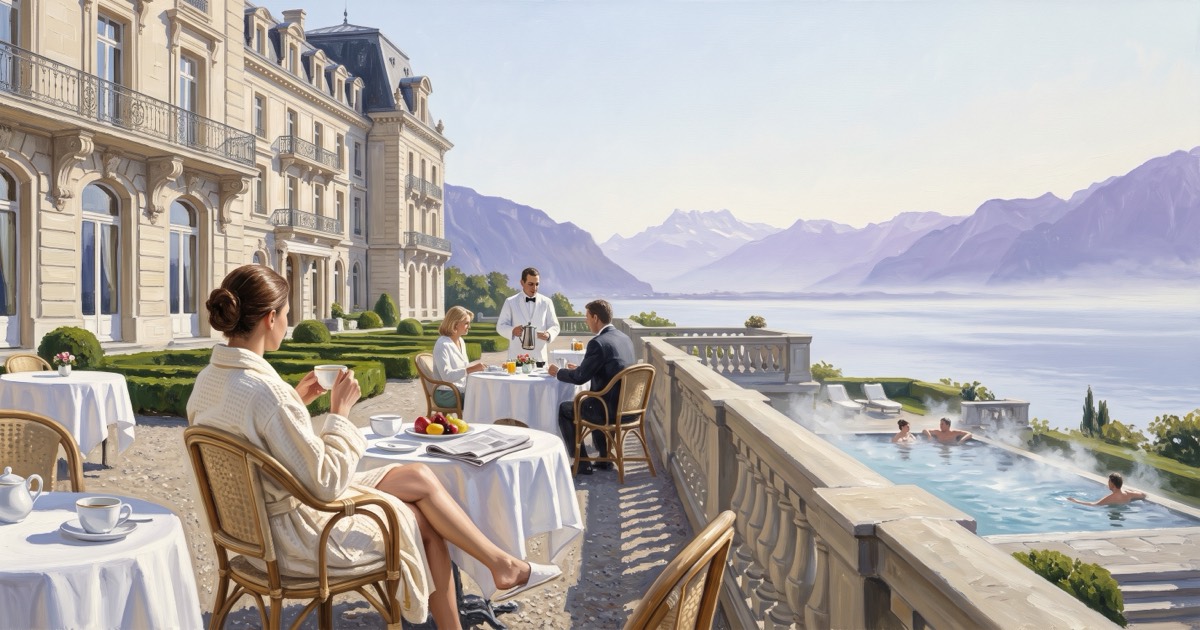
A Belle Époque palace hotel opened in 1909, set in 47 acres of forested grounds above Lake Geneva, and the anchor of the wider Évian Resort estate.
It holds the French state Palace distinction, renewed at the 2026 reassessment. That is an inspected certification awarded by the Ministry of Tourism, not a vote, and it is the strongest credential on this page.
Setting: 960 Avenue du Léman, Évian-les-Bains, on the French shore of Lake Geneva, around 45 minutes from Geneva airport.
Several restaurants across the estate, at a standard that reflects the Palace classification.
Rooms and suites in a restored 1909 palace, most facing the lake. Ask for a lake-facing room; the alternative faces the forest, which is pleasant but is not what you came for. Service is formal in the French palace tradition.
A formal French state certification created in 2010, administered by Atout France and awarded by the Ministry of Tourism. It sits above the five-star classification and requires both an on-site inspection and an oral hearing before a commission. It runs three years and must be renewed. Thirty-three hotels hold it after the June 2026 reassessment, and this is one of them.
A grand hotel with an excellent spa, and the page says so. There is no medical assessment and no prescribed programme. For structured wellness in France, Lily of the Valley or La Réserve Ramatuelle are the properties built for it; for a thermal cure, Vichy.
In a village classified as a thermal spa destination since 1861, and the creation of Michel Guérard, who developed cuisine minceur here in 1975. That is a genuine landmark in the history of cooking, not a marketing claim.
Palace distinction renewed 2026, first awarded 2017, and the property also holds two MICHELIN Keys, which are inspected.
Setting: 334 Rue René Vielle, Eugénie-les-Bains, in the Landes in south-west France, around an hour from Pau and 90 minutes from Biarritz.
The point of the property. Cuisine minceur was invented in this kitchen in 1975 and is still served alongside a full gastronomic menu.
Rooms across several buildings on the estate, decorated in a country-house style rather than a contemporary one, in a nineteenth-century property at Eugénie-les-Bains, a thermal town in the Landes at the foot of the Pyrenees named for the Empress Eugénie. It holds two MICHELIN Keys. The reason it belongs on a wellness page rather than only a gastronomic one is Michel Guérard, who married the owner and moved his kitchen here, and who invented cuisine minceur, the slimming cuisine that showed French cooking could be built without butter and cream while remaining serious food. The spa is fed by the town's own thermal springs, and the estate runs both a gastronomic table and a lighter one, so a stay can be indulgent or restrained without leaving the property. Palace-classified, with service to match, in a village of a few hundred people.
A style of fine cooking developed by Michel Guérard here in 1975, built around reduced fat and sugar while keeping the technique and the pleasure of gastronomic food. It was genuinely influential and changed how a generation of chefs thought about lightness. It is a way of cooking rather than a diet programme.
Because Eugénie-les-Bains has been a classified thermal spa destination since then, which in France is a formal status rather than a description. The village is named after Empress Eugénie, who took the waters here. The thermal infrastructure and the Guérard kitchen grew up together, which is unusual.
Designed by Philippe Starck and built from the ground up around wellness rather than adapted to it, which is genuinely unusual and is the reason it belongs on this page. Set in pine and vineyard above the bay at Gigaro.
Programmes run from three to fourteen nights with assessment, and the property is structured for them rather than offering them alongside a beach holiday.
Setting: Quartier de Gigaro, La Croix-Valmer, on the Var coast near Saint-Tropez, around 90 minutes from Nice airport.
A nutrition kitchen aligned to the programmes, alongside conventional Mediterranean dining for guests not on one.
Starck-designed rooms and suites in white and pale wood, most with sea or pine views. Contemporary rather than traditional, and quite unlike the two Palace properties on this page.
Because most wellness hotels are conventional hotels with a spa added, and it shows in how the day is organised. Lily of the Valley was designed around programmes: the kitchen, the coaching, the spa and the timetable were planned together. Whether that justifies the price is your call, but the distinction is real.
Yes, and many guests do. It works perfectly well as a coastal hotel with an exceptional spa. But the programmes are what distinguish it, and a three-night stay without one is a lot of money for a beach hotel.
Above one of the better bays on the Riviera, a short drive from Saint-Tropez, styled after 1950s Côte d'Azur decoration and deliberately quiet.
Its distinguishing feature is a series of structured multi-night programmes with assessment, which is unusual on this stretch of coast where most properties sell a beach and a spa menu.
Setting: Chemin de la Quessine, Ramatuelle, on the Saint-Tropez peninsula, around 90 minutes from Nice airport.
Programme-aligned dining alongside conventional Mediterranean cooking, at a high standard.
Rooms, suites and villas styled after 1950s Côte d'Azur decoration, most facing the bay. Ask for a sea-facing room. Service is discreet rather than formal, in keeping with the quiet.
Both run structured programmes on the Var coast and both are expensive. Lily of the Valley was purpose-built around wellness and is contemporary in design; La Réserve is a more traditional Riviera house, quieter, and closer to Saint-Tropez. Choose on register rather than on facilities, since both are strong.
May to October, avoiding late July and August when the whole peninsula fills and prices rise sharply. Late May, June and September are the sweet spots: warm sea, open restaurants and the coastal path walkable without the heat.
On the Quiberon peninsula where the Atlantic meets the Brittany coast, and among the longest-established thalassotherapy centres in France. The discipline was developed in this country, and Quiberon is one of the places where it was formalised.
Marine cures of several days, seawater drawn directly from the Atlantic, and a working clinical rhythm rather than a spa menu.
Setting: Pointe de Goulvars, Quiberon, on the narrow peninsula in southern Brittany, around 30 minutes from Vannes and four hours from Paris by train and road.
Brittany is one of the best seafood regions in Europe, and the property draws on it.
A large seafront property with rooms facing the Atlantic or the peninsula, at the foot of the Cote Sauvage on the Quiberon peninsula in Brittany. The history matters, because this is where modern French thalassotherapy began. Louison Bobet, three times winner of the Tour de France and world road race champion in 1954, opened the institute here in 1964 after using seawater treatment for his own recovery; the mayor of Quiberon gave him the site at the end of the peninsula, and the hotel followed five years later. It set the template every French thalasso centre has used since, combining the treatment institute, accommodation and restaurant on one site. The boulevard outside now carries his name. Treatments run to seaweed baths, underwater jets, marine rain exfoliation, hydrotherapy and cryotherapy, with programmes for slimming, sport and post-natal recovery. Thalassotherapy is well established in France as a rehabilitation and recovery tradition; that is not the same as evidence that seawater treats disease. Comfortable and functional rather than luxurious, with a clientele weighted toward guests on multi-day cures.
Treatment using warm seawater, marine muds and algae, usually alongside supervised movement, over several consecutive days. It was developed in France and the infrastructure here is the deepest anywhere. It is warming, restful and eases muscular tension. The frequently repeated claim that seawater resembles blood plasma is not correct.
Three at minimum, and the traditional cure runs six. The format is built around consecutive days of repeated treatment rather than a single session, which is what distinguishes it from a spa visit. Book the cure first and the room around it.
In Parc Napoléon III on the banks of the Allier, in France's only UNESCO-inscribed Great Spa Town. The hotel connects by covered walkway, which you cross in a bathrobe, to the Vichy Célestins thermal spa.
Vichy is where the Vichy shower comes from, and the town's thermal infrastructure is genuine rather than decorative.
Setting: 111 Boulevard des États-Unis, Vichy, in the Auvergne, around three hours from Paris and an hour from Clermont-Ferrand.
Hotel dining with light cure-aligned options, and a town with genuine Auvergnat cooking.
A comfortable hotel in the park with direct spa access. The most affordable property on this page, and the connection to the thermal spa is what distinguishes it from staying elsewhere in town.
An affusion treatment in which you lie on a table beneath a horizontal bar of warm-water jets while a therapist works. It takes its name from this town, where it was developed as part of the thermal cure. It is genuinely relaxing and is the treatment most associated with Vichy anywhere in the world.
It is France's only entry in the Great Spa Towns of Europe, inscribed in 2021 alongside Bath and ten others. The inscription recognises the European spa town as a cultural phenomenon: the architecture, the parks, the galleries and the social ritual that grew around thermal water in the eighteenth and nineteenth centuries. Vichy's Belle Époque quarter is largely intact.
Six properties, two of which hold the best-documented credential in this guide. The Palace distinction is a French state certification requiring on-site inspection and an oral hearing before a commission, awarded for three years, and both properties here were renewed at the June 2026 reassessment when several hotels lost it. One property is in France's only UNESCO-inscribed Great Spa Town. One is where cuisine minceur was created in 1975. One was built from the ground up around wellness rather than adapted to it. One sits where thalassotherapy was developed as a discipline.
A formal French state certification created in 2010, administered by Atout France and awarded by the Ministry of Tourism. It sits above the five-star classification, itself based on more than 240 technical criteria, and the process includes both an on-site inspection and an oral hearing before the Palace Commission. It is awarded for three years and must be renewed. In June 2026 Atout France completed the first full reassessment in seven years: thirty-three hotels now hold it, twenty-seven renewed and six added, with several removed. It matters because it is inspected rather than voted.
Treatment using warm seawater, marine muds and algae alongside supervised movement, usually over several consecutive days. It was developed in France and the country still has the deepest infrastructure for it. It is warming, restful and eases muscular tension. The frequently repeated claim that seawater closely resembles blood plasma is not correct, and minerals are not absorbed through the skin in meaningful quantity.
French residents can. Cures thermales can be prescribed by a doctor and part-reimbursed, typically as a three-week course at a classified thermal centre such as Vichy or Eugénie-les-Bains. That is a genuine clinical pathway and quite distinct from booking a spa stay, and it is arranged through a French doctor rather than through a hotel.
Lily of the Valley or La Reserve Ramatuelle, both on the Var coast and both running assessed multi-night programmes. Lily of the Valley was purpose-built around wellness and is contemporary; La Reserve is a quieter, more traditional Riviera house. For a marine cure, Quiberon. For a thermal cure, Vichy. The two Palace hotels are grand hotels with excellent spas rather than programme properties, and this page says so.
May to October for the Var coast, avoiding late July and August when the Saint-Tropez peninsula fills completely. April to October for Eugénie-les-Bains and Vichy. Evian is at its best May to September, though the spa runs year-round and the Alps behind make winter viable. Quiberon works April to October, with the Atlantic cold in any month.