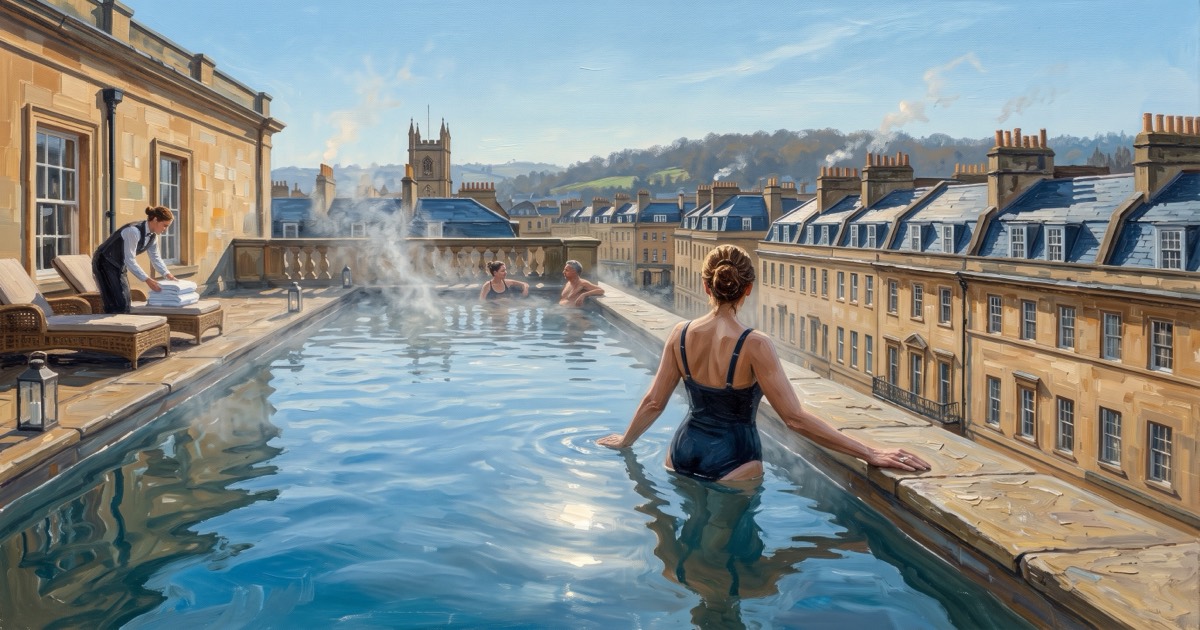
Britain has almost no thermal bathing tradition, and only one place where the water comes out of the ground hot. That is Bath, where the Romans built and where the modern Thermae Bath Spa now draws on the same springs, the only naturally hot bathing water in the United Kingdom, in a city inscribed by UNESCO twice over. Everything else on this page earns its place differently: a charity-owned metabolic health centre in the hills above Bath, a Grade I listed knot garden in North Wales, a clifftop eco hotel in Cornwall, a swimming hotel on Ullswater. The honest framing is that the UK does spa hotels and health retreats well, and thermal bathing barely at all. Only Combe Grove operates as a wellness retreat in the strict sense, with a clinical assessment on arrival and a programme set by an in-house GP, nurse or dietitian; the rest are wellness resorts and hotels where the treatments are chosen rather than prescribed.

| Resort | Location | Type | Stay | Price Range | Best Season | Signature Experience | Wellness Focus |
|---|---|---|---|---|---|---|---|
| Thermae Bath Spa | Bath, Somerset | Day Visit | Day sessions | $ | Year-round | Rooftop thermal pool over a UNESCO city | Britain's only natural hot springs |
| Stobo Castle Health Spa | Scottish Borders | A La Carte | Flexible | $$$$ | May-Sep | Scotland's only destination spa, all-inclusive | Destination spa, all meals and facilities included& golf |
| Combe Grove | Surrey | All-Inclusive | 3-14 nights | $$$$ | Year-round | UK's first metabolic health centre | GP-led metabolic health & digestive health |
| Bodysgallen Hall & Spa | Llandudno, Wales | A La Carte | Flexible | $$$ | Apr-Oct | The Grade I listed knot garden | Country house spa & gardens |
| The Scarlet | Mawgan Porth, Cornwall | A La Carte | Flexible | $$$ | May-Sep | Clifftop hot tubs above the Atlantic | Adults-only eco spa |
| Another Place, The Lake | Ullswater, Cumbria | A La Carte | Flexible | $$$ | Apr-Oct | Swimming with the lake through the glass | Family swimming & fell walking |
One, in practical terms. Bath sits on the only springs in the United Kingdom that rise naturally hot, at around 45 degrees, and Thermae Bath Spa is the only place you can bathe in them. Buxton, Harrogate and Royal Leamington Spa all have historic spa quarters, but their waters are cold or the bathing has long since stopped.
Anywhere in Britain advertising a thermal spa outside Bath is heating the water itself. That is not a criticism, but it is worth knowing before booking.
Combe Grove runs structured metabolic health programmes, and they are educational rather than indulgent. Expect a clinical assessment on arrival — typically including body composition, blood pressure, lipids and HbA1c, with an insulin resistance check — seasonal whole food with no alcohol, daily movement, and a plan to take home. The residential week is designed as the middle of a longer arc rather than the whole thing, with preparation beforehand and structured follow-up afterwards, including a returner's visit. THIS IS THE OTHER ENTRY IN THIS GUIDE WHERE THE EVIDENCE LARGELY SUPPORTS THE CLAIM, and it deserves saying: remission of type 2 diabetes through sustained dietary change and weight loss is well established in the clinical literature, and improving blood pressure, lipids and insulin sensitivity by the same route is uncontroversial. THREE HONEST QUALIFICATIONS. Remission is the accurate word rather than cure, it is not guaranteed, and it depends almost entirely on what you sustain in the months after you leave rather than on the week itself. The five roots and ten markers language is the property's own trademarked framework, not a clinical standard. And if you are on medication for diabetes or blood pressure, changes must be managed with your own doctor, because eating this way while medicated can drop blood sugar or pressure too far. The first two to three days are the hardest, and headache, fatigue and irritability are normal.
Britain's only natural thermal bathing. The springs at Bath rise at around 45 degrees, and Thermae is the only place in the country where you can get into them. The Romans built here; the modern building draws on the same water.
Bath is inscribed by UNESCO twice: once as a city in 1987, and again in 2021 as part of the Great Spa Towns of Europe, of which it is the only British member. No other British spa holds a comparable designation. The water itself is the reason: rain that fell around ten thousand years ago, sunk roughly two kilometres, heated by rock to an estimated 69 degrees, and rising through three springs that together deliver over a million litres a day. It carries more than forty minerals, sulphate, calcium and chloride most concentrated. These are the only naturally hot mineral springs in Britain, and the council has been their legal guardian since a Royal Charter of 1590. ONE QUESTION VISITORS ALWAYS ASK, ANSWERED HONESTLY: you cannot swim in the Roman Baths, and the reason is not preservation. Public bathing in Bath stopped in 1978 after a young woman died of amoebic meningoencephalitis contracted from the untreated water — an infection caused by Naegleria fowleri, an organism found in warm fresh water worldwide, not something peculiar to Bath. Bathing did not resume anywhere in the city for nearly thirty years. Thermae Bath Spa, which opened in 2006, exists precisely because the water is now drawn from boreholes and treated and monitored before it reaches a pool. That is the reassurance rather than the alarm: the modern spa is the answer to that closure, and the Roman Baths remain a monument to look at rather than a bath to get into.
Setting: The Hetling Pump Room on Hot Bath Street, in the centre of Bath, a short walk from the Roman Baths and the Abbey.
A cafe on site, and Bath itself has a strong independent restaurant scene within a few minutes' walk.
Thermae is a public bath, not a hotel. Bath has more accommodation per head than almost any English city: Georgian townhouse hotels, B and Bs and apartments, from around 110 to 400 pounds a night, rates observed 2026. Stay within the city walls if you can, since the spa, the Roman Baths and the Abbey are all walkable. Book the twilight session and a room the same night.
For naturally hot bathing water, yes. Bath's springs are the only ones in the United Kingdom that rise hot from the ground, and Thermae is the only facility where the public can bathe in them. Buxton, Harrogate and Royal Leamington Spa have historic spa quarters, but their waters are cold or the bathing stopped long ago.
Twilight, and ideally midweek. The rooftop pool with steam rising into cold air and the city lit below is the experience people remember, and it is arguably better in winter than summer. Sessions sell out at weekends, so book ahead.
Around 30 rooms and suites in a baronial mansion on the shore of the Scottish Borders, within private grounds among pine forest, gardens and a loch. Confirmed operating and taking bookings. WHY THIS ENTRY CHANGED: this slot previously held Cameron House on Loch Lomond. That is a fine resort hotel, but its spa is not in the building — it sits about three miles away and guests are shuttled to it — and on a page whose stated purpose is separating real wellness provision from a hotel with a pool, it was the weakest case in the six. Stobo is included on the opposite reasoning: it is the only property in Scotland that exists as a destination spa rather than a hotel with a spa attached.
The detail worth knowing: the entire business exists to be a spa rather than a hotel that has one. THAT DISTINCTION IS THE REASON THIS ENTRY REPLACED A LARGER AND BETTER-KNOWN SCOTTISH RESORT ON THIS PAGE. A destination spa is defined by guests coming for the spa itself rather than for golf, a loch view or a wedding, and Stobo is the only property in Scotland that meets it. Everything is included in the rate: dinner on arrival through to lunch on departure, full use of the spa and fitness facilities, and the classes. You are not handed a treatment menu with prices at check-in and asked to choose extras, which is the usual arrangement at country house spas and the thing that quietly doubles a bill. Facilities run to a 25-metre ozone-treated pool, hydrospa, crystal steam room, saunas, outdoor hot tubs overlooking the hills, a ladies' health suite, and a treatment list running to around eighty face and body treatments. There is a juice bar rather than a cocktail bar. The estate sits in private grounds among pine forest and a loch, with landscaped gardens, woodland walks and tennis. Very few properties anywhere can offer that.
Setting: Stobo, near Peebles in the Scottish Borders, roughly an hour from Edinburgh and about an hour and a half from Glasgow, in deep countryside rather than on a tourist route. The castle itself was built between 1805 and 1811 by the architects Archibald and James Elliot, on a manor with around a thousand years of history behind it. The Winyard family bought it in 1975 when it had fallen into disrepair and opened it as a health spa in 1978, at the beginning of Britain's health-farm era; it remains family-run and family-owned nearly fifty years later, which is rare at this level and shows in the consistency guests report.
Several restaurants across the estate, and Scottish produce is the strength.
Around 30 rooms and suites across the mansion, plus lodges and apartments on the estate. The building is Victorian baronial and the setting does much of the work. It is a large resort rather than an intimate retreat, and busy in summer.
No, and that is the point. Everything is included in the rate — all meals from dinner on arrival to lunch on departure, full use of the spa and fitness facilities, and the classes. Treatments beyond the included package are charged, so confirm what your particular package covers, but you will not be nickel-and-dimed for pool or facility access the way you are at most country house spas.
BE CLEAR ABOUT WHAT THIS IS AND IS NOT. It is a destination spa, not a medical facility: there is no physician, no clinical assessment and no prescribed protocol, and it does not claim any. Combe Grove elsewhere on this page is the property that provides that, and the two are complementary rather than competing — Combe Grove for a supervised metabolic programme, Stobo for rest, treatment and being fed well without making a single decision. The other honest note is that it is a rest cure rather than an activity holiday: there are walks and tennis and classes, but if you want mountains and long days outdoors, Another Place on this page is the better fit. Come here to stop.
The UK's first dedicated metabolic health centre, running Assessment with an in-house GP, nurse or dietitian in a Victorian house once home to Ivor Novello and Rex Harrison. Grounds adjoin 70 acres of woodland and meadow.
Owned by a charitable trust rather than an investor, which captures the property better than any award could. The estate was bought in 2017 by the philanthropist Helen Aylward-Smith and passed to the Elmhurst Foundation, whose remit extends beyond the retreat: it runs apprenticeships in health and wellbeing for local people and shares the facilities with the surrounding community. Surplus goes back into that rather than to shareholders It captures the property better than any award could.
Setting: Brassknocker Hill, Monkton Combe, on the southern edge of Bath, around fifteen minutes from the city centre and ninety minutes from London by train to Bath Spa.
Food is the programme rather than an accompaniment to it, built around seasonal whole ingredients with produce from the estate's own kitchen garden.
Rooms across a Georgian manor house and later buildings on a 70-acre estate of woodland and meadow above the Limpley Stoke valley, with views across the Bath countryside. Comfortable rather than luxurious, and the register is clinical: a metabolic health assessment on arrival with an in-house GP, nurse or dietitian, covering body composition, blood pressure, lipid profile and blood glucose, then a programme built around what those markers show. The distinction worth knowing is structural rather than cosmetic. Combe Grove is owned by the Elmhurst Foundation, a charitable trust, so it is not run to return profit to shareholders, and its stated purpose includes training apprentices and sharing facilities with the local community. Programmes run from a three-day introduction to five and six-night residential retreats and a twelve-month supported programme. Facilities include pools, tennis courts, a gym, walking trails through the estate and a kitchen garden that supplies the menus. Note that the advanced functional testing offered through external laboratories, including hormone panels, is not validated to the same standard as routine clinical diagnostics, and results should be discussed with your own doctor. Robes and slippers throughout is genuinely the dress code.
It is genuinely demanding, and worth knowing that before booking. Expect small portions, slow chewing, early final meals and abdominal treatment, with headache and fatigue normal in the first days. What it delivers is structured restriction, rest and medical supervision, and people reliably feel better afterwards. The mechanism is the regimen rather than anything mystical.
Longer than feels necessary. A short stay gives you the difficult phase and little of the recovery. Eight nights is the programme the property is built around, and three nights is really an introduction rather than a course.
A seventeenth-century hall above Llandudno, owned by the National Trust and operated on its behalf. Its distinction is horticultural: a Grade I listed knot garden, a rare surviving parterre, and the strongest designation on this page.
Grade I listing is conferred by statute against published criteria, which is why it carries weight where a spa award does not. CORRECTING A DETAIL THIS GUIDE PREVIOUSLY GOT WRONG: the designation applies to BOTH — the hall itself is Grade I listed and the gardens are separately registered at Grade I. That is an unusually strong pairing, and it is the reason this property is here.
Setting: Above Llandudno in North Wales, two miles south of the town in over 200 acres of parkland, with views toward Conwy Castle and the mountains of Eryri, or Snowdonia. There are 31 rooms and suites, roughly half in the main house and half in cottages across the estate. The core of the building is older than the seventeenth-century hall around it: a thirteenth-century watchtower, built to keep an eye on Conwy. The parterre is the rarity — box hedging filled with sweet-scented herbs, laid out around a sundial dated 1678 — alongside a walled rose garden, follies, lily ponds and a rockery cascade. One honest note for anyone hunting authenticity: the Gothic tower on the slope is a deliberate sham ruin built in the 1990s, not a medieval survival, and the estate makes no secret of it.
This is a country house hotel with a spa rather than a wellness programme. There is no assessment, no protocol and no clinical provision, and the entry does not pretend otherwise. What it has instead is an ownership structure worth knowing about. The house was rescued from decline by Historic House Hotels, founded in 1979 by Richard Broyd to buy and restore run-down country houses; restoration began in 1980 and the hotel opened in the early eighties. In 2008 the company and all three of its properties — this one, Hartwell House and Middlethorpe Hall — were GIVEN to the National Trust, with profits going to the charity thereafter. So the money you spend here funds conservation rather than a shareholder. That is not a wellness claim and this guide will not dress it up as one, but if you are choosing between comparable country house spas it is a real difference and a reason to pick this one.
The dining room is formal in the country house manner, and Welsh produce is the strength.
Thirty-one rooms and suites in total: fifteen in the hall itself, including four principal suites named Mostyn, Vaughan, Conwy and Lady Augusta, and sixteen cottage suites clustered around a secluded garden in the grounds, some available self-catering. The register is traditional country house: antiques, log fires and a quiet, formal service style. The ownership arrangement is worth understanding, because it is unusual. Historic House Hotels rescued the house from dilapidation in 1981 and restored it; in 2008 the company gave the property, and its two sister houses, to the National Trust outright, so profits now go to maintaining the houses and to the charity rather than to shareholders. The estate runs to over 200 acres two miles south of Llandudno, and the dining room holds three AA Rosettes, the only restaurant in the town to do so. National Trust ownership means the estate is maintained to conservation standards rather than commercial ones, which shows in the gardens.
It is a rare surviving seventeenth-century parterre, and Grade I listing places it in the highest category of protected heritage in England and Wales. Very few gardens of this age and type survive intact. It is the reason this property appears on a wellness page rather than a general hotel guide.
Yes, and it is under-visited by international travellers. Conwy Castle is UNESCO-inscribed, Bodnant is among the finest gardens in Britain, and Snowdonia is half an hour away. The Welsh coast in late spring is one of the quieter pleasures in these islands.
A purpose-built eco hotel on the cliff at Mawgan Porth, north Cornwall. Adults only. The property describes itself as an adults-only eco spa retreat with clifftop hot tubs and sea-view dining, which is an accurate summary.
Its distinction is that the environmental design is structural rather than decorative: a reed-bed filtered natural pool, biomass heating and a building set into the cliff rather than on top of it.
Setting: Tredragon Road, Mawgan Porth, on the north Cornish coast between Newquay and Padstow. Thirty-seven rooms across five levels, each with its own outside space, and a meadow garden running down to the South West Coast Path. The eco credentials are structural rather than retrofitted because the building is new: it opened in 2009 after an eight-year planning process and a roughly £12.5 million build, replacing a demolished older hotel on the site, with FSC-certified timber throughout, water-based paints and a roof planted with sea thrift. Note that one-night stays are commonly refused on Friday and Saturday. If you are travelling with children, read this before dismissing the area: The Scarlet is strictly adults only, but it is owned by the same family as Bedruthan, a 101-room hotel built for families that sits around 200 metres away and opened in 1959. Same owners, same stretch of coast, opposite propositions — so a family group can split across the two rather than compromise on one.
Sea-view dining with a Cornish emphasis, and north Cornwall is one of Britain's better food regions.
Thirty-seven rooms stepped into the cliff, every one facing the Atlantic, most with private outdoor space and sliding doors that open to the sound of the sea. The style is contemporary and deliberately unfussy, with green roofs and a cloister garden at the centre of the building. The spa is Ayurvedic-inspired rather than clinical: treatments in tented, lantern-lit rooms, ending with stillness in suspended cocoon pods in the relaxation room, and a personal consultation available beforehand to shape the treatment. Facilities include an indoor pool, the reed-filtered outdoor pool, a clifftop cedar barrel sauna, steam room, hammam, rhassoul and the clifftop hot tubs. A daily wellbeing class is included for guests, and treatments are reserved for overnight guests, with separate spa days for visitors. Adults only, which is the reason it stays quiet and the reason families should look at Another Place instead.
More structural than most. The building was designed as an eco hotel rather than retrofitted, with a reed-bed filtered natural pool, biomass heating and a cliff-set design that minimises visual impact. That is verifiable in the architecture rather than asserted in the marketing, which is the distinction this guide cares about.
May to September for the beach and the sea, though the property is open through winter and arguably better for it: a clifftop hot tub in a January gale is a particular pleasure. Cornwall is very busy in August, so late spring and early autumn are the sweet spots.
47 bedrooms in a Georgian house with a modern wing, on 18 acres at Watermillock on Ullswater. Opened August 2017.
Its distinguishing credential is unusual for this sector: an Ofsted-registered Kids' Zone. Ofsted registration is a statutory inspection regime for childcare provision, and it is a stronger indicator for families than any hospitality award.
Setting: Watermillock, on the shore of Ullswater in the Lake District, around 30 minutes from Penrith, in 18 acres of national park with a private lakeshore and jetty. The building is the former Rampsbeck, a Georgian country house dating to the early eighteenth century, bought in 2015 and reopened in August 2017 after a multi-million-pound restoration that added a contemporary wing; there are now roughly 40 to 47 bedrooms including family suites, dog-friendly rooms, shepherd huts and a treehouse. A NEAT CONNECTION FOR ANYONE USING THIS PAGE TO PLAN: it comes from the team behind the Watergate Bay Hotel in north Cornwall, which sits on the same stretch of coast as The Scarlet, two entries above. Same ethos of active relaxation, opposite ends of the country.
Relaxed rather than formal, with Cumbrian produce and a Victorian-style Glasshouse serving stone-baked pizza.
47 bedrooms across the Georgian house and modern wing, plus six shepherd huts and a treehouse, each with its own garden terrace and firepit. Swim Club is the hotel's term for its spa, and the register is honest about what it is: a 20-metre indoor pool walled in glass with a skylight, looking across Ullswater to Arthur's Pike, filtered by ultraviolet to keep chlorine low, with a shallow area for children. Beyond it, a plain outdoor hot tub with no jets, a sauna with lake views, a cardio room and two treatment rooms plus a snug, with treatments running fifty minutes. There is no thermal suite and none is claimed. What the property offers instead is the lake itself: paddleboarding, kayaking and open-water swimming from a private jetty with a resident cold-water swimming coach, alongside guided long-distance swims, stargazing and full-moon night swims. Day memberships are available to non-residents, and Swim Club access is included for hotel guests. The register is relaxed and family-oriented rather than hushed.
This one, without much competition. It has an Ofsted-registered Kids' Zone, family swim sessions, shepherd huts and dog-friendly rooms. Note the detail that catches people out: the hot tub and sauna are 16 and over, and swimming is zoned. The Scarlet is adults only, and Combe Grove is a health programme rather than a holiday.
Genuinely, yes, and it is the point of the place. A 20-metre pool with a glass wall onto the lake, UV-filtered and low-chlorine, plus guided open-water swimming in Ullswater itself and a treadmill pool with stroke feedback. If you swim, this is the UK property built for you.
Six properties, chosen on what can be verified rather than what is claimed. One holds the only naturally hot bathing water in the country. One has a Grade I listed seventeenth-century knot garden. One is registered with Ofsted for its children's provision, which is rarer than any spa award. Two carry superlatives this guide declined to print because no awarding body could be named, and it says which. Ownership is disclosed where a group operates across several countries in this guide. Prices run from a single session at a public bath to fourteen nights on a medical programme.
One, in practical terms. Bath sits on the only springs in the United Kingdom that rise naturally hot, at around 45 degrees, and Thermae Bath Spa is the only place you can bathe in them. Buxton, Harrogate and Royal Leamington Spa all have historic spa quarters, but their waters are cold or the bathing has long since stopped. Anywhere in Britain advertising a thermal spa outside Bath is heating the water itself.
It is genuinely demanding rather than relaxing, and worth knowing that before booking. Expect small portions, slow and thorough chewing, early final meals, no alcohol or caffeine, and abdominal treatment. The first two to three days are the hardest, and headache, fatigue and irritability are normal. It is not suitable in pregnancy, with diabetes or cardiac conditions, with a history of disordered eating, or for anyone on regular prescribed medication without speaking to their own doctor first. A short stay delivers the difficult phase and little of the recovery, so longer is genuinely better.
Bath works year-round, and the rooftop pool at Thermae is arguably better in winter with steam rising into cold air. Combe Grove sits just outside the same city and runs programmes all year. The Cornish and Cumbrian properties are at their best from late spring to early autumn, though both are open through winter and quieter for it. Stobo in the Scottish Borders is genuinely a year-round proposition and arguably better in winter, since almost everything happens indoors.
Another Place, without much competition. It has an Ofsted-registered Kids' Zone, family swim sessions, shepherd huts and dog-friendly rooms. Note the detail that catches people out: the hot tub and sauna are 16 and over, and swimming is zoned, with adults-only sessions early and late. The Scarlet is adults-only, and Combe Grove is a health programme rather than a holiday.
Two statutory ones, and neither is a hospitality award. Bath is inscribed by UNESCO twice, as a city and as part of the Great Spa Towns of Europe. Bodysgallen's knot garden is Grade I listed, the highest category of heritage protection in England and Wales. Both are conferred against published criteria, which is more than can be said for most awards in this sector.