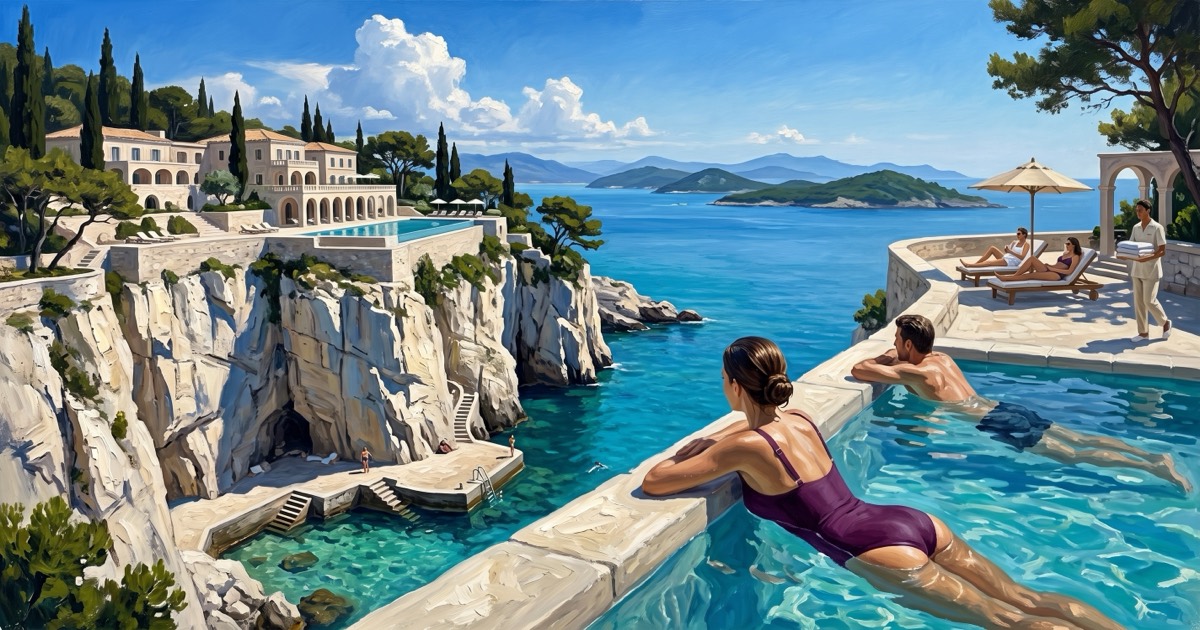
Croatia's wellness offering divides cleanly between coast and interior, and the interior is the part most visitors never see. The Adriatic islands hold design-led properties using local lavender and olive, and a bay on Lošinj with a documented history as a climatic health resort. Inland, the toplice, thermal spa towns an hour from Zagreb, offer some of the best value in European wellness at roughly a third of coastal prices, with genuine physiotherapy departments. This page covers both and is careful about the difference: physiotherapy is real clinical work, bathing is comfort, and they are not the same thing. None of these operates as a wellness retreat with a fixed residential programme; Croatia's wellness resorts are places you check into and use as you please, with the inland thermal properties offering supervised rehabilitation on top if you want it.

| Resort | Location | Type | Stay | Price Range | Best Season | Signature Experience | Wellness Focus |
|---|---|---|---|---|---|---|---|
| Maslina Resort | Stari Grad, Hvar | A La Carte | Flexible | $$$$$ | May-Sep | Island herbs and oils in an olive grove | Design-led island spa |
| Hotel Bellevue Lošinj | Mali Lošinj | A La Carte | Flexible | $$$$ | May-Sep | A documented climatic health resort in pine forest | Aromatherapy & seawater |
| Falkensteiner Iadera | Petrcane, near Zadar | A La Carte | Flexible | $$$$ | May-Sep | A peninsula with sea on three sides | Large coastal spa, adult-oriented |
| Terme Sveti Martin | Međimurje | A La Carte | Flexible | $$ | Year-round | Thermal pools on the Mura at three borders | Medical wellness & thermal |
| Hotel Villa Magdalena | Krapinske Toplice | A La Carte | Flexible | $$ | Year-round | A private thermal whirlpool in every suite | Thermal, family-run |
| Terme Tuhelj | Tuheljske Toplice, Zagorje | A La Carte | Flexible | $$ | Apr-Oct | Croatia's largest sauna complex and healing mud | Historic thermal, Istria |
The inland toplice offer some of the best value in European wellness, at roughly a third of coastal prices, and several have genuine physiotherapy departments.
Distinguish the physiotherapy, which is real clinical work, from the bathing, which is comfort. Both are worth having; they are not the same thing, and properties frequently blur them.
Among olive groves outside Stari Grad on Hvar, and the most design-led property in Croatia. The spa uses herbs and oils from the island, and Hvar's lavender is genuinely notable rather than a marketing flourish.
Stari Grad Plain, just inland, is a UNESCO World Heritage Site: an ancient Greek agricultural landscape still farmed on its original field divisions.
Setting: Put Maslinika 1, Stari Grad, on the northern side of Hvar, around 30 minutes from Hvar town and reached by ferry from Split.
Dalmatian cooking at a high standard, with a kitchen garden and island produce.
Fifty design-led rooms and suites plus three private villas, set across two hectares of pine forest and olive grove above Maslinica Bay, twenty minutes on foot from Stari Grad. The architecture is by the Croatian architect Tomislav Alujevic Grgas with interiors by Leonie Alma Mason and landscaping by Thomas Seconde, built in Brac island stone, terracotta, local wood and brushed brass, and the property is a Relais and Chateaux member. Pharomatiq Wellness runs to about 600 square metres over two floors and is named for Pharos, the island's ancient Greek name; it holds treatment rooms indoors and out, an aqua thermal suite of saunas, steam and cold plunge, and a gym over the sea, with two heated saltwater pools outside, one adults-only infinity and one for families. Treatments draw on herbs from the resort's own organic garden of roughly 7,000 square metres, which also supplies the restaurant. Sustainability is structural: no single-use plastics, on-site composting, greywater recycling, olive oil production and beekeeping. The wellness programmes are named Purify, Vitality, Longevity and Serenity and described as detoxifying; that word describes a programme category rather than a physiological process. The most expensive property on this page, and the design and the setting are what the price buys.
Because Hvar town is one of the busiest places on the Adriatic in summer, and Stari Grad is not. It is also one of the oldest towns in Europe, and Stari Grad Plain beside it is UNESCO-inscribed as an ancient Greek agricultural landscape still farmed on its original divisions. Hvar town is thirty minutes away when you want it.
Genuinely, yes. Hvar has a long lavender-growing tradition and the fields are in bloom around June. The spa uses island oils rather than imported ones, which is a real distinction. Aromatherapy is pleasant; essential oils do not treat disease, and the page does not claim they do.
On Čikat bay at Mali Lošinj, set in pine forest, with a large spa specialising in aromatherapy and seawater treatments.
Lošinj has a documented history as a climatic health resort, designated in the Austro-Hungarian period for its air, and the island still markets itself on that basis. The pine forest around Čikat was planted deliberately as part of it.
Setting: Čikat 9, Mali Lošinj, in the northern Adriatic, reached by ferry or by road via Krk and Cres.
Northern Adriatic cooking, lighter than Dalmatian and with strong Italian influence.
A large modern five-star hotel in Čikat Bay with Aleppo pine forest behind it, and the forest is the reason the island has a wellness reputation at all. In 1886 the Croatian botanist Ambroz Haračić began an afforestation programme that planted 80,000 Aleppo pines in its first year and hundreds of thousands of seedlings annually thereafter, and his measurements of the microclimate led Vienna to designate Lošinj a climatic health resort in 1892. The islands carry over 1,200 plant species, more than 200 of them noted for medicinal use, which is what the Garden of Fine Scents and the hotel's aromatherapy retreats draw on; guests distil essential oils from plants gathered in the bay. The Bellevue Spa Clinic, renovated in 2018, is EuropeSpa certified and divides into wellness, cosmetics, health and fitness, with dry, steam and Turkish saunas, a vitality pool, seawater pool and spa garden, and programmes developed with doctors, nutritionists and sports scientists. Comfortable and well run rather than boutique, and quieter than the Dalmatian islands in high season. Treatments described as detoxifying are pleasant and skilled; the term is marketing rather than physiology. Comfortable and well run rather than boutique, and quieter than the Dalmatian islands in high summer.
A designation from the Austro-Hungarian period recognising a place's air and climate as beneficial, particularly for respiratory conditions. Lošinj holds it, and the pine forest at Čikat was planted deliberately as part of that programme. It is genuine history rather than invented heritage, and it is treated here as history rather than as a modern clinical claim.
In summer, considerably. It is reachable by road via Krk and Cres rather than only by ferry, it is far less crowded than Hvar or Brač, and the northern Adriatic is cooler. The trade-off is that it is a longer journey from Split or Dubrovnik.
On a peninsula north of Zadar with sea on three sides, and one of the largest spa complexes on the Croatian coast: indoor and outdoor pools, an extensive sauna world and a large treatment area.
Positioned as the adult-oriented hotel of the resort — but verify for your dates, which is unusual on this coast and is much of the appeal.
Setting: Punta Skala, Petrčane, on a peninsula around 20 minutes north of Zadar in northern Dalmatia — 12km from the city, roughly 25km from Zadar airport. The hotel holds around 210 rooms and suites and sits inside the wider Falkensteiner Resort Punta Skala, a 30-acre estate with 1.4km of coastline, two private bays and fourteen restaurants and bars shared across several properties. It is a member of The Leading Hotels of the World.
Dalmatian cooking with Austrian influence, reflecting the operator, and good seafood from the local waters.
A large modern resort of around 210 rooms and suites, sea-facing, on the Punta Skala peninsula with pine forest on one side and the Adriatic on three, twenty kilometres from Zadar airport and a short drive from the old town. Adult-oriented, though confirm the current age policy for your datesadults only. Efficient and well run in the Austrian manner rather than characterful, and the peninsula position is genuinely good.
Not reliably, and this is worth checking rather than assuming. Iadera has been positioned as the adult-oriented hotel of the Punta Skala resort, with the neighbouring Hotel Diadora built for families, and that separation is much of why Iadera stays calm in high season. But recent guest reports describe families with school-age children staying at Iadera, so either the policy has changed or it is applied flexibly. Confirm directly for your dates. If you are travelling with children and want certainty, Diadora next door is designed for it, and the inland toplice on this page are better set up again and considerably cheaper.
More than its reputation suggests. The Roman forum sits in the middle of the old town, the sea organ is genuinely worth hearing, and it is the gateway to Kornati and Paklenica national parks. It is also far less crowded than Split or Dubrovnik.
In Međimurje, Croatia's northernmost county, on the Mura river at the Slovenian and Hungarian borders, with the Temple of Life indoor thermomineral pool complex, the outdoor MartiLandia aquapark, five sauna types, a nine-hole golf course with heated greens playable year-round, and a medical wellness department.
The Mura-Drava-Danube region is a UNESCO Biosphere Reserve, spanning five countries, and this property sits inside it.
Setting: Izvorska ulica 2, Sveti Martin na Muri, in northern Croatia, around 90 minutes from Zagreb and an hour from Maribor. The origin is accidental: in 1911 an Anglo-Hungarian company drilling for oil at Vučkovec struck thermomineral water instead. Locals began using it, the first pool and soaking baths were built in 1936, and the site traded for decades as Toplice Vučkovec — a summer-only bathing place with three pools and a restaurant — before being renamed and redeveloped from 2003. It now operates under the LifeClass brand with around 151 rooms and suites. The water is described by the operator as highly mineralised and roughly 43,000 years old, carrying lithium, strontium, fluorine, iodine, sodium and potassium.
Continental Croatian cooking, quite different from the coast, with a strong local wine tradition.
Comfortable hotel and apartment accommodation across the estate in Međimurje, the northern corner of Croatia between the Mura and Drava rivers, closer to Hungary and Slovenia than to the coast. The thermal water was found in the 1930s during oil exploration, which is how several central European spa towns began, and the site now combines pools and saunas with a licensed medical rehabilitation centre offering physiotherapy and post-operative recovery under physician supervision. A fraction of coastal prices, with genuine medical provision and a landscape most visitors to Croatia never see: vineyards, wooden hilltop chapels and a cycling network through the wine roads. The distinction worth understanding is that this is rehabilitation medicine rather than a spa concept, so the register is clinical and the other guests are frequently recovering from something specific. A fraction of coastal prices, with genuine medical provision and a landscape most visitors to Croatia never see.
Value and quiet. The inland toplice cost roughly a third of coastal prices, several have genuine physiotherapy departments, and almost no international visitors go. Međimurje is river country with a serious wine tradition, and it is inside a UNESCO Biosphere Reserve spanning five countries.
The physiotherapy is genuine clinical work and worth distinguishing from the bathing. Supervised physiotherapy has well-established value in musculoskeletal rehabilitation. The thermal water is comfort. Properties frequently blur the two, and this page separates them deliberately.
A small family-run hotel in the thermal village of Krapinske Toplice, an hour north of Zagreb, where every suite has its own thermal whirlpool fed directly from the spring.
That arrangement is rare anywhere and almost unheard of at this price. It is the reason this entry is on the page. The hotel is small — around 18 double rooms of 30 to 47 square metres and six suites of 49 to 64 — built into a hillside, with a panoramic wellness floor of about 350 square metres on the top storey. It is worth knowing what Krapinske Toplice is more broadly: this is a working medical town with specialist hospitals, best known in Croatia for cardiac and neurological rehabilitation, and the thermal water and fango mud are used clinically there. Villa Magdalena is a hotel rather than a clinic, and the entry does not confuse the two.
Setting: Mirna ulica 1, Krapinske Toplice, in the Zagorje hills of northern Croatia at about 155 metres, roughly 45 to 50km and an hour from Zagreb. The village draws on four hyperthermal springs; the water is pH-neutral and dominated by calcium, magnesium and hydrogencarbonate, and emerges hot enough that the resort quotes 39 to 41 degrees. Roman coins found locally gave the place its old name of Aquae Vivae, living water. The first written record of the springs dates from 1772, when three hot springs were in use; further baths followed, and the town's golden age began in 1859 when Jakob Badl bought the existing baths and added three more along with a hotel, restaurant and the chestnut promenade that still runs through the park.
Zagorje cooking, which is hearty continental food quite unlike the Dalmatian coast.
A small family-run hotel with suites, each with its own thermal whirlpool fed from the Krapinske Toplice springs, so the bathing happens in the room rather than in a shared facility. Krapinske Toplice has been a spa town since Roman times and its water emerges at around 39 degrees, carrying calcium, magnesium and hydrogen carbonate; the town's specialist hospital treats cardiovascular and orthopaedic rehabilitation, and the hotel sits within that tradition without being part of it. Personal service and exceptional value, and the antithesis of a large resort. Zagreb is roughly forty minutes away, which makes it the easiest thermal property here to reach. Thermal bathing eases stiffness and takes load off joints; claims that the mineral content itself treats disease are not established. Personal service and exceptional value, and the antithesis of a large resort.
Fed directly from the spring, in every suite. It is genuinely unusual, and at this price it is remarkable. It also means you bathe unsupervised, so the standard cautions apply more rather than less: no alcohol, limit sessions, and come out to cool.
It is one of the most attractive parts of continental Croatia and almost entirely undiscovered by international visitors. Hills, vineyards, castles at Trakošćan and Veliki Tabor, and the Krapina Neanderthal Museum built on a major excavation. An hour from Zagreb, and a completely different country from the coast.
Beneath an Water Planet, a pool complex of around 15,000 square metres in the Istrian interior, with thermal water and a bed of therapeutic peloid mud that matures naturally at the bottom of the spring. A dramatic setting, and one of the oldest continuously used spa sites in Croatia.
The sauna world is the property's real feature: the largest complex in Croatia, and the scale is genuinely striking.
Setting: Ljudevita Gaja 4, Tuheljske Toplice, in the Hrvatsko Zagorje hills of Krapina-Zagorje county, around 40km and under an hour northwest of Zagreb, at roughly 170 metres altitude. It is run by the Olimia Group, which also operates Terme Olimia across the border in Slovenia — a property that appears on this guide's Slovenia page, and worth knowing if you are comparing the two.
Zagorje cooking is hearty inland fare rather than Mediterranean, and the resort sources from more than thirty local producers.
A large continental thermal resort in the Zagorje hills, 40km from Zagreb, built on a natural thermal spring and a bed of peloid mud whose use is documented back to Roman times — when the sulphurous smell earned the site a rather unflattering local nickname. It is now one of Croatia's leading inland wellness centres, run by the Olimia Group under an art-and-spa concept that puts work by Croatian artists and a Zagorje-based menu alongside the bathing. The scale is the point: Water Planet covers around 15,000 square metres of indoor and outdoor pools, and the Sauna World is the largest sauna complex in Croatia, with four Finnish and three steam saunas, an outdoor panoramic sauna with its own whirlpool, a lapidarium, kneipp walk, cold pool, foot bath and several relaxation halls with waterbeds. Sauna programmes include air-swirl rituals and steam treatments using the peloid mud, salt and chocolate. The SPAeVITA centre runs eleven treatment cabins. Accommodation is spread across the four-star Hotel Well in six linked buildings, plus a hostel and a campsite, so the price range is unusually wide for this guide. The baroque Mihanović Castle on the estate hosts wine tastings. HONEST NOTE: this is a busy family resort, not a quiet retreat — guests consistently praise the food and the sauna world while noting crowds, long internal walks and variable treatment quality. Come for the scale and the value, not for seclusion. Basic rather than comfortable, and the page states that plainly. Many visitors stay in the hill towns nearby and come for the day.
This is a large resort rather than a boutique property, and the accommodation is comfortable rather than characterful — Hotel Well is functional four-star across six linked buildings, with a hostel and campsite alongside. The scale and the value are the point. If you want charm in Zagorje, Villa Magdalena at Krapinske Toplice, elsewhere on this page, is the small family-run alternative about half an hour away, and the two make a sensible pairing: Tuhelj for the sauna world and the pools, Krapinske for a quieter room with its own thermal whirlpool.
Because Zagorje is the part of Croatia that visitors drive past on the way to the coast, and it is where Croatians themselves go to bathe. Hills, castles, thermal water and a fraction of the Adriatic prices, under an hour from Zagreb. The Krapina Neanderthal Museum nearby is genuinely first rate, and Kumrovec's restored village museum is a short drive. Come for the water and the value rather than for scenery on the Adriatic scale.
Six properties split deliberately between coast and interior, because the interior is the part most visitors never see. Three are on the Adriatic, including one beside a UNESCO-inscribed ancient Greek field system still farmed on its original divisions, and one on an island designated a climatic health resort under Austro-Hungarian rule. Three are inland toplice at roughly a third of coastal prices, one of which gives every suite its own thermal whirlpool fed from the spring. The page separates physiotherapy, which is real clinical work, from bathing, which is comfort, because properties routinely blur them.
Both, and the interior is the surprise. The inland toplice cost roughly a third of coastal prices, several have genuine physiotherapy departments, and almost no international visitors go. Zagorje and Međimurje are attractive continental countryside with castles, vineyards and river landscapes. The coast has the islands, the design properties and the sea. They are different holidays.
The physiotherapy generally is, and it is worth distinguishing from the bathing. Supervised physiotherapy has well-established value in musculoskeletal rehabilitation. Warm mineral bathing eases muscular tension through heat and buoyancy, and minerals are not absorbed through the skin in meaningful quantity. Both are worth having; properties frequently present them as one thing, and this page separates them.
Most are pebble or rock rather than sand, and the water is exceptionally clear as a result. Water shoes are genuinely useful, and sea urchins are common on rocky shorelines, so look before you step. The Adriatic is warm from June to September and cold outside it.
May, June and September for the coast and islands. July and August are extremely busy, particularly Hvar and Split, and prices roughly double. The inland toplice work year-round and are at their best in spring and autumn. Istria's interior is best from April to October, with truffle season peaking in autumn.
The inland properties, without much competition. A suite with its own thermal whirlpool at Krapinske Toplice costs a quarter of an island resort room, and Međimurje offers thermal pools with physiotherapy for less again. If value matters more than the sea, go inland and drive to the coast for a few days.