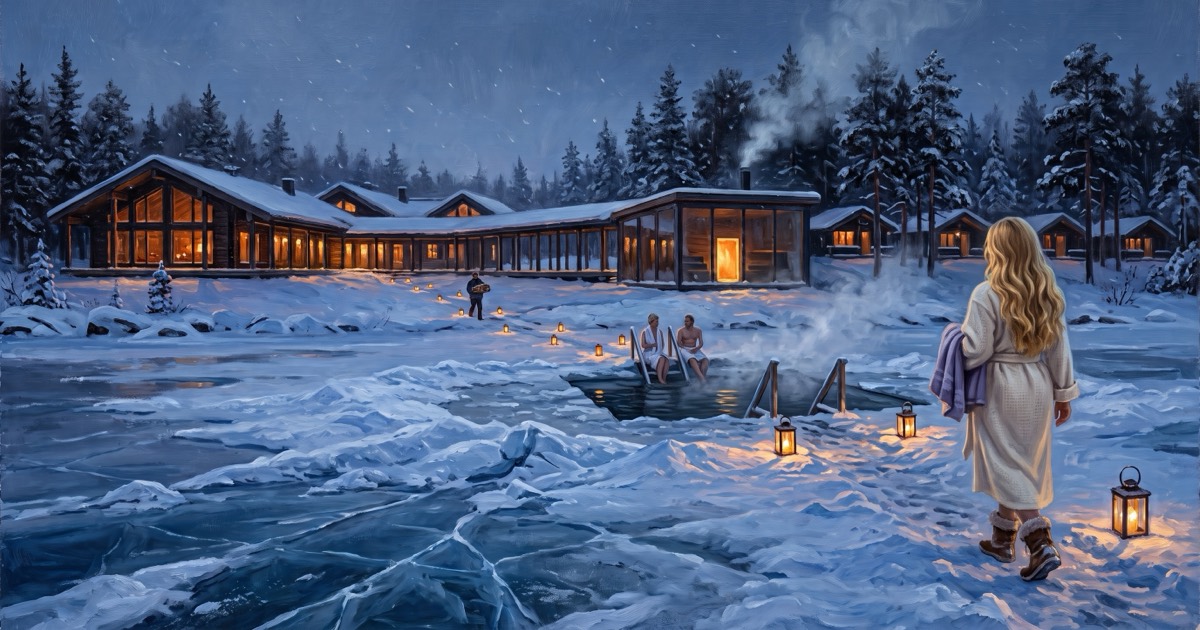
Finnish sauna culture was inscribed on the UNESCO Representative List of the Intangible Cultural Heritage of Humanity in 2020, and it is the only wellness tradition in this guide that is genuinely a national practice rather than an industry. Every property on this page is built around sauna and cold immersion: a wood-fired smoke sauna, the oldest and most highly regarded form; a sauna floating on pontoons where you drop straight into the lake; villas with private saunas and their own steps into the water. That combination is the whole point, and it is also where the risk lies, which is why the safety note comes first. None of these runs a fixed residential programme, so Finland's wellness retreats are built around a practice rather than a protocol: you come for the sauna, the water and the silence, and the rhythm of the days is yours.

| Resort | Location | Type | Stay | Price Range | Best Season | Signature Experience | Wellness Focus |
|---|---|---|---|---|---|---|---|
| Kuru Resort | Anttola, Lake Saimaa | A La Carte | Flexible | $$$$ | Jun-Sep | A private sauna and lake steps at every villa | Adults-only design retreat |
| Lehmonkärki Resort | Asikkala, Lake Paijanne | A La Carte | Flexible | $$$ | Jun-Sep | A traditional wood-fired smoke sauna | Savusauna tradition |
| Järvisydän | Rantasalmi, Lake Haukivesi | A La Carte | Flexible | $$$ | Jun-Sep | A sauna floating on pontoons over the lake | Sauna & Saimaa nature |
| Arctic TreeHouse Hotel | Rovaniemi, Lapland | A La Carte | Flexible | $$$$ | Sep-Mar | Aurora from bed in a glass-fronted suite | Arctic sauna & northern lights |
| Lapland Hotels SkyOunasvaara | Rovaniemi, Lapland | A La Carte | Flexible | $$$ | Sep-Mar | Outdoor hot tubs on top of a fell | Arctic sauna, convenient |
| Naantali Spa | Naantali, south-west coast | A La Carte | Flexible | $$$ | Jun-Aug | A large conventional spa open since 1984 | Full-service spa resort |
Sauna and cold immersion are the core of every property here. Both need honest framing.
Sauna: avoid alcohol before or during. Leave when uncomfortable rather than competing. Rehydrate afterwards. Anyone with a heart condition, uncontrolled blood pressure, or who is pregnant should take medical advice first. Do not sauna alone with any cardiac history.
Cold immersion and ice swimming: sudden cold-water entry causes an involuntary gasp and a sharp rise in heart rate and blood pressure, the cold shock response, which can be dangerous even in people with no known heart condition, and is a leading cause of sudden death in cold water.
A savusauna, or smoke sauna, has no chimney. It is heated for hours, the smoke is vented, and bathers enter once the fire is out and the stones hold the heat. It is the oldest and most highly regarded form of Finnish sauna, and the heat is softer and heavier than an electric one.
It also carries a genuine carbon monoxide risk if venting is incomplete, which is why smoke saunas are prepared and supervised by staff who know the building. Use them as directed, never light or manage one yourself, and leave immediately if you feel headachy or unwell.
An adults-only resort in pine forest on Lake Saimaa, and the most designed property on this page. Each villa has its own sauna and direct access to the water for cold immersion.
That combination, private sauna and private lake steps, is the ideal Finnish arrangement and is rare to find as a booking rather than as a family cottage.
Setting: Kurunlahdentie 15, Anttola, on Lake Saimaa in eastern Finland, around 30 minutes from Mikkeli and three hours from Helsinki.
Finnish cooking has improved enormously and the lake region supplies it well.
Design-led villas in pine forest, each with sauna and lake access. Adults only, and the most expensive property on this page. The privacy is what you are paying for, and it is genuine.
Because Finnish sauna is not a spa treatment with a timetable; it is something you do at your own pace, repeatedly, across an evening. Having your own sauna and your own steps into the lake means you can move between hot and cold as often as you like without an audience. That is how Finns actually use it.
Summer for the long light and swimmable water, with June to September the reliable window and midsummer nights that barely darken. Winter for ice swimming and silence, though the lake freezes and immersion moves to a cut hole, which should only be done at supervised facilities.
On a peninsula in Lake Päijänne, Finland's second-largest lake, with a traditional wood-fired smoke sauna, the oldest and most highly regarded form of Finnish sauna.
A savusauna has no chimney: it is heated for hours, the smoke is vented, and bathers enter once the fire is out and the stones hold the heat. The result is a softer, heavier heat than any electric sauna produces.
Setting: Rannankulmantie 10, Asikkala, on Lake Päijänne in southern Finland, around 90 minutes from Helsinki.
Restaurant on site with Finnish lake-country cooking, and self-catering in the cottages.
Cottages and villas along the shore, comfortable and Finnish in style rather than luxurious. The smoke sauna is the reason to book, and it is worth knowing what makes it different. A savusauna has no chimney: wood burns for hours until the stones hold the heat, the smoke is vented, the soot-blackened walls give the room its scent, and the heat that remains is softer and more enveloping than any stove can produce. It is the oldest form, it nearly disappeared, and it was revived from the 1980s onward. Finnish sauna culture as a whole was inscribed on the UNESCO Representative List of Intangible Cultural Heritage in December 2020, the country's first entry. At the heart of it is loyly, the steam thrown from water on hot stones. Heating a smoke sauna takes most of a day, so sessions are scheduled rather than available on demand. The smoke sauna is the reason to book, and it should be reserved when you book the room.
Dark, soft and heavy. There is no chimney, so the sauna is heated for hours with a wood fire, the smoke is vented, and you enter once the fire is out and the stones hold the heat. The walls are blackened, the air smells faintly of woodsmoke, and the heat is gentler and more enveloping than an electric sauna. Finns broadly regard it as the real thing.
When prepared and supervised properly, yes. The risk is carbon monoxide if venting is incomplete, which is precisely why staff who know the building manage the heating and the venting. Never attempt to light or manage one yourself, and leave immediately if you feel headachy or unwell.
On Lake Haukivesi within the Saimaa system, with a floating sauna built on pontoons. You sweat over the water and drop straight into it, which is the whole Finnish sequence compressed into one structure.
A long-established family-run resort in the heart of the Saimaa lakeland, with a genuine stake in the region's conservation.
Setting: Porosalmentie 313, Rantasalmi, on Lake Haukivesi in the Saimaa system, around four hours from Helsinki.
A restaurant with a genuine regional focus, working from lake fish, game and foraged ingredients.
Rooms, cottages and lakeside suites across a family-run resort. Less designed than Kuru and more established, with a broad range of accommodation and a working relationship with the lake.
Because it removes every step between hot and cold. You sit in heat with water directly beneath the structure, and you enter the lake straight from the door. That is the Finnish sequence, löyly then lake, in its most compressed form, and it is genuinely different from walking a jetty to reach the water.
A freshwater seal found only in Lake Saimaa, one of the most endangered seals in the world with a population in the hundreds. It is a genuine conservation priority in this region. Keep well clear if you see one, particularly in spring when they haul out on ice to pup, and follow local guidance on boat access.
Glass-fronted suites raised among pines on the Arctic Circle outside Rovaniemi, angled so the aurora can be watched from bed between September and March. Lappish saunas and outdoor hot tubs on site.
The design is genuinely good rather than gimmicky, and the aurora orientation is deliberate rather than incidental.
Setting: Tarvantie 3, Rovaniemi, in Lapland on the Arctic Circle, a few minutes from the airport and the town.
Lappish ingredients used seriously: reindeer, Arctic char, cloudberries and forest mushrooms.
Glass-fronted suites raised on stilts among pines, plus larger units for families. Book well ahead for the aurora season, which runs roughly September to March and fills early.
Possibly, and nobody can promise it. It requires solar activity and clear skies together, and both vary. A week within the September-to-March season on the Arctic Circle gives a good chance rather than a certainty. What this property does well is remove the friction: the suites face the right way and you can watch from bed rather than standing in the cold at two in the morning.
Different rather than lesser. There is no aurora, but there is the midnight sun, forest walking in near-permanent daylight, and far fewer visitors at lower rates. If the northern lights are the point, come in winter and accept the odds.
On top of the Ounasvaara fell above Rovaniemi, with saunas and outdoor hot tubs looking over the Arctic landscape, and ski and hiking trails from the door.
The most convenient Arctic property on this page: a fell summit position within minutes of a town and an international airport.
Setting: Juhannuskalliontie 1, on the Ounasvaara fell above Rovaniemi, around ten minutes from the town centre.
Lappish cooking at the hotel, with Rovaniemi's restaurants a short drive below.
Comfortable hotel rooms with panoramic windows on the summit of Ounasvaara fell, above Rovaniemi and the Arctic Circle. Less designed than the treehouse suites and considerably more affordable, with the same Arctic sky and better trail access: the fell has cross-country and downhill skiing in winter and marked walking and mountain-biking routes in summer, straight from the door. The elevation is the practical advantage for aurora watching, since you are above the town's light rather than beside it. Less designed than the treehouse suites and considerably more affordable, with the same Arctic sky and better trail access.
The TreeHouse for design and for watching the aurora from bed through a glass wall. SkyOunasvaara for a fell-top position, trails from the door, outdoor hot tubs and a considerably lower rate. Both are minutes from Rovaniemi and both have dark enough skies.
Roughly September to March, when the nights are dark enough. It requires solar activity and clear skies together, so nothing is guaranteed. A week in season on the Arctic Circle gives a reasonable chance, and being on a fell top away from town lights helps.
Open since 1984 and among Finland's longest-established dedicated spa resorts. A large, conventional spa hotel rather than a boutique retreat, with multiple pools and an extensive treatment menu.
The page includes it deliberately as the full-service alternative: this is where Finns go for a family spa weekend rather than a sauna pilgrimage.
Setting: Matkailijantie 2, Naantali, on the south-west coast near Turku, in the Finnish archipelago.
Several restaurants at the resort, with the archipelago supplying good seafood.
A large conventional spa hotel with a wide range of rooms on the south-west coast near Naantali, an old wooden town on the Turku archipelago. Family-friendly, which distinguishes it from the adults-only and boutique properties on this page, and busy in Finnish summer, when the archipelago is at its best and the town fills. The spa is extensive rather than intimate, with thermal pools, saunas and treatment programmes, and there is a genuine tradition behind the location: Naantali has been a bathing resort since the nineteenth century, and the Finnish president's official summer residence, Kultaranta, is on the adjacent island. Family-friendly, which distinguishes it from the adults-only and boutique properties on this page, and busy in Finnish summer.
Because not every trip to Finland is a sauna pilgrimage, and families need somewhere that works. Naantali is large, well established since 1984, on a beautiful stretch of archipelago coast, and it handles children properly. The page includes it as that rather than pretending it is a traditional sauna experience.
Very much so, and it is under-visited by international travellers. Thousands of islands off the south-west coast, linked by a ring road with small ferries, best in June to August. Turku is twenty minutes away and Naantali's own wooden old town is worth an evening.
Six properties in the only country in this guide whose wellness tradition is UNESCO-inscribed as intangible cultural heritage rather than built as an industry. One has a traditional wood-fired smoke sauna, the oldest and most highly regarded form. One has a sauna floating on pontoons where you drop straight into the lake. One gives every villa its own sauna and its own steps into the water. Two are on the Arctic Circle with aurora orientation, and neither promises sightings, because nobody can. The cold-water safety note leads this page because immersion is the point of every property on it.
It carries real risk and this page states it before describing any property. Sudden cold-water entry causes an involuntary gasp and a sharp rise in heart rate and blood pressure, the cold shock response, which can be dangerous even without a known heart condition and is a leading cause of sudden death in cold water. Never enter alone, never after alcohol, enter slowly using steps, stay in seconds rather than minutes, and get warm promptly. Anyone with cardiac history, high blood pressure or who is pregnant should not cold-plunge without medical advice.
A savusauna has no chimney. It is heated for hours with a wood fire, the smoke is vented, and bathers enter once the fire is out and the stones hold the heat. The walls are blackened and the heat is softer and heavier than an electric sauna produces. It is the oldest and most highly regarded form. It also carries a genuine carbon monoxide risk if venting is incomplete, which is why they are prepared and supervised by staff. Never light or manage one yourself, and leave immediately if you feel headachy.
Possibly, and no property can promise it. The aurora requires solar activity and clear skies together, and both vary. Roughly September to March is the season, and a week on the Arctic Circle within it gives a reasonable chance rather than a certainty. Any operator guaranteeing sightings is overselling.
June to September for the lakes, when the water is swimmable and midsummer nights barely darken. September to March for the Arctic properties and the aurora, when the lakes freeze and immersion moves to a cut hole, which should only be done at supervised facilities. Arctic winter cold is a genuine hazard: frostbite develops quickly on exposed or wet skin.
Lapland is the homeland of the Sami, the only recognised Indigenous people of the European Union. Where Sami culture is offered as an activity, ask who is delivering it and on what basis. Reindeer are working animals belonging to herding families rather than attractions, and the distinction matters to the people whose livelihood they are.