USA Wellness Resorts: American Wellness Retreats

Five of these six are wellness retreats in the strict sense, all-inclusive residential programmes where meals, classes and treatments come as one structured stay; Amangiri is the exception, a wellness resort you book a la carte. That distinction, rather than price, is the first thing to settle.

Planning a wellness getaway? Discover the best USA wellness resorts, meticulously independently researched and ranked. We dive deep so you don't have to! The United States offers extraordinary journeys into holistic rejuvenation, where cutting-edge wellness approaches meet world-class luxury. This diverse country hosts some of the most transformative wellness travel experiences, where guests can feel profound renewal amid stunning landscapes. From coastal sanctuaries to desert havens, wellness resorts in the USA deliver exceptional stays that honor both innovation and tradition. Find your perfect escape at one of these top 6 wellness resorts, each offering a unique and rejuvenating life journey. We are here for you!

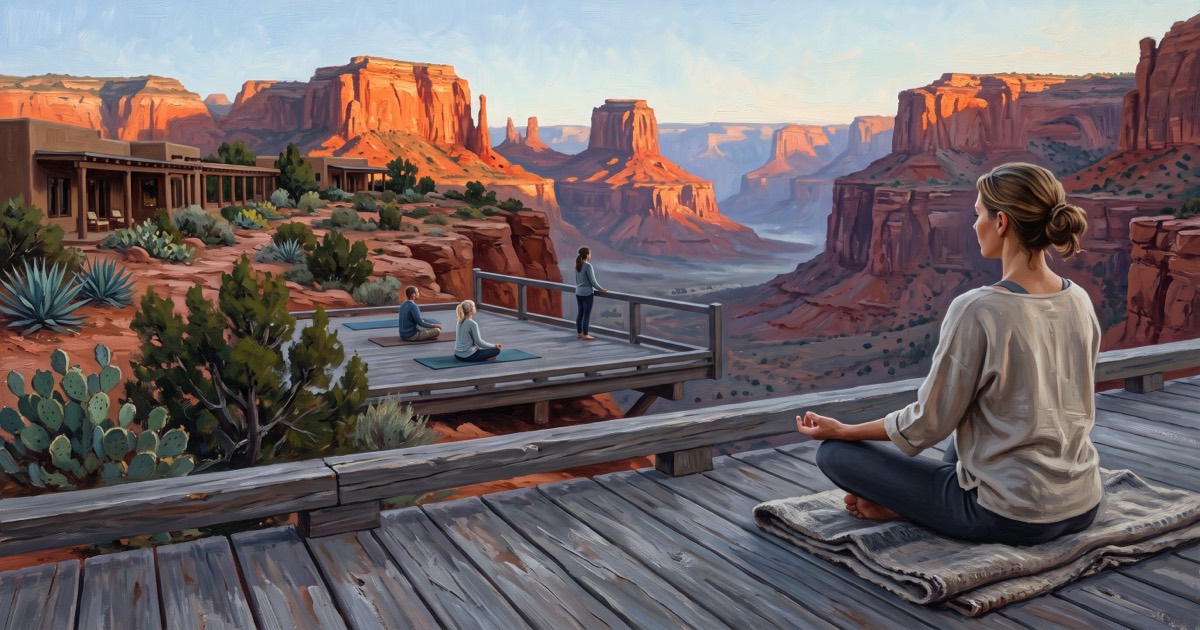
Guests meditating on a canyon-rim deck at a Sedona desert retreat at first light, Arizona

The United States has emerged as a global leader in evidence-based wellness innovation, blending cutting-edge medical science with ancient healing traditions from around the world. From California's Japanese-inspired sanctuaries to Arizona's red-rock energy vortexes and Utah's desert architectural marvels, American wellness resorts offer some of the most diverse and transformative experiences on the planet. The U.S. wellness tourism industry generates over $300 billion annually, reflecting the nation's deep commitment to holistic health and personal transformation.

USA Apex 6 Wellness Resorts 2026 — Comparison at a Glance

ResortLocationTypeStayPrice RangeBest SeasonSignature ExperienceWellness Focus
Golden DoorSan Marcos, CAAll-Inclusive5-7 days$$$$$Year-roundJapanese garden immersionHolistic fitness & mindfulness
Mii amoSedona, AZAll-Inclusive3-10 nights$$$$Mar–NovVortex-inspired ceremonyDestination spa & spiritual renewal
Miraval ArizonaTucson, AZAll-InclusiveFlexible$$$$Oct–AprEquine therapyMindfulness & adventure wellness
Cal-a-Vie Health SpaVista, CAAll-Inclusive3-7 days$$$$Year-roundFrench-inspired hydrotherapyFitness, nutrition & healthy ageing
AmangiriCanyon Point, UTA La CarteFlexible$$$$$Mar–NovMesa journey & Navajo-guided experiencesDesert luxury & grounding
Lake Austin Spa ResortAustin, TXAll-InclusiveFlexible$$$Year-roundLakeside paddleboard yogaOrganic cuisine & relaxation
Before You Book: Worth Asking

The properties on this page are destination spas rather than medical facilities. Most have no resident physician, no diagnostics and no clinical supervision, and none of them presents itself as a substitute for medical care. What they reliably offer is structured movement, good food, sleep and unhurried attention, which is a sufficient reason to go.

  • Ask what is actually included in the quoted rate, and what is billed separately.
  • Ask what the programme involves each day if you are booking for a specific outcome rather than a rest.
  • Note the altitude at several of these properties. Sedona sits at around 4,500 feet and some guests feel it for a day or two.
  • Continue any existing medical treatment, and tell your own doctor what you intend to undertake if you are managing a condition.

Where any property on this page offers something that is a medical procedure rather than a spa treatment, this guide names it plainly in that property's own entry.

Official websites

Golden Door · Mii amo · Miraval Arizona · Cal-a-Vie Health Spa · Amangiri · Lake Austin Spa Resort

USA Wellness Resorts Unique Selection Data Points Are Many

With so many accommodations on the wellness band wagon these days. True independent thorough specialized data is more important the ever when finding the estimated best of the best wellness resorts in the USA.

Frequently Asked Questions — USA Wellness Resorts

What makes a wellness resort different from a luxury hotel with a spa?
A true wellness resort integrates health and well-being into every aspect of the guest experience — from evidence-based treatments and personalized programs to organic cuisine, healing environments, and specialized practitioners. Unlike a luxury hotel that simply offers spa services as an amenity, wellness resorts are purpose-built around transformation, offering structured programs, medical integration, and holistic approaches that address mind, body, and spirit as a unified system.
How are the Apex 6 USA wellness resorts selected?
Our selections are evaluated independently across 14 established criteria including: healing waters and non-chlorine water systems, organic and locally-sourced cuisine, on-site gardens, restaurant quality, yoga and meditation programs, unique mental and physical wellness offerings, medical integration, epic location and nature access, innovation in wellness science, and verified awards from organizations like World Spa Awards, Condé Nast Traveler, and Forbes.
How much do wellness resorts in the USA cost per night?
USA wellness resorts range widely in price depending on the property and program type. All-inclusive destination spas like Golden Door and Cal-a-Vie Health Spa typically range from $1,500 to $3,000+ per night and include meals, treatments, and activities. A la carte luxury properties like Amangiri start around $2,000 per night for accommodations with spa services priced separately. Lake Austin Spa Resort offers more accessible all-inclusive rates starting around $600 per night.
What is the best time of year to visit wellness resorts in the USA?
Most USA wellness resorts operate year-round due to their diverse geographic locations. Arizona properties like Mii amo in Sedona and Miraval in Tucson are ideal from October through April when desert temperatures are comfortable. California properties including Golden Door and Cal-a-Vie enjoy mild Mediterranean climates year-round. Amangiri in Utah is best visited from March through November to avoid cold desert winters, while Lake Austin Spa Resort in Texas is pleasant throughout the year.
Do USA wellness resorts offer medical wellness programs?
Several of the Apex 6 USA resorts incorporate medical wellness to varying degrees. Miraval Arizona offers integrative health consultations and specialized programs guided by wellness counselors. Cal-a-Vie Health Spa provides fitness assessments and nutrition planning with expert staff. Golden Door integrates Japanese-inspired healing practices with modern fitness science. For guests seeking dedicated medical diagnostics and clinical treatments, properties like those in Switzerland and Spain typically offer more advanced medical integration.

WELLNESS RESORTS US BEST 6 CURRENTLY - Equipoise

Wellness Odyssey: A Curated Guide to America's Best Transformational Resorts. The American wellness landscape has evolved dramatically over the past decade, with luxury destinations crafting increasingly sophisticated approaches to holistic health and personal transformation. This comprehensive guide examines six exceptional wellness resorts across the United States, each offering distinctive therapeutic philosophies, architectural environments, and programmatic approaches. From Japanese-inspired fitness sanctuaries in California to desert architectural marvels in Utah, these properties represent the pinnacle of American wellness innovation while drawing inspiration from global healing traditions. The following profiles detail not only the physical amenities and aesthetic qualities of each destination but also their unique culinary philosophies, specialized treatment modalities, and characteristic service approaches. While each property maintains its distinctive regional character and therapeutic focus, all share a common commitment to evidence-based wellness practices delivered through genuinely transformative guest experiences rather than superficial indulgence.

Golden Door

All-inclusive, structured weekly programme
777 Deer Springs Rd, San Marcos, CA 92069, USA
Stay options: 5, 6 or 7 nights, typically Sunday to Sunday; extended stays subject to availability

Golden Door sits in a valley in northern San Diego County, about an hour from the city, and has run as a health retreat since 1958, when Deborah Szekely opened it — originally in Escondido, on old Highway 395, before it moved to its present San Marcos site. She and her husband, Professor Edmund Szekely, had already founded Rancho La Puerta in Tecate, Mexico, in 1940 — widely regarded as the world's first destination health retreat — and Golden Door opened on their twentieth wedding anniversary as its upscale counterpart. It effectively invented the American destination spa. The property took its present form in 1975, when Szekely and architect Robert Mosher modelled it on the Japanese honjin inns that historically existed to receive weary travellers, which is why a Japanese inn and garden sit in the California hills. Rooms open onto private gardens. Guests take a personal schedule set on arrival and adjusted daily: morning hikes on the property's trail network, fitness and movement sessions, treatments, and meals built largely from the on-site organic farm and citrus groves.

The defining feature is scale. Golden Door takes a small number of guests at a time, which is why the programme can be individual rather than grouped, and why many staff have worked here for decades. It is a structured programme rather than a medical facility: there is no physician team, no diagnostics and no clinical supervision. What it delivers is a week of walking, training, good food and rest in unusually complete privacy, at a high price. Since 2013 the company has directed all net profits to charity, much of it addressing child abuse and neglect, which is a matter of corporate structure rather than philanthropy bolted on afterwards, and it is checkable.

One point of clarification: this is the California Golden Door. A separate and unrelated Australian retreat traded under the same name before rebranding as Elysia, so reviews and awards need matching to the right property.

Mii amo

Miraval Arizona Resort & Spa

All-inclusive, mindfulness and wellness focus
5000 E. Via Estancia Miraval, Tucson, AZ 85739, USA
Stay options: 3, 5 or 7 nights, with a three-night minimum

Miraval Arizona sits below the Santa Catalina Mountains north of Tucson, in Sonoran desert of saguaro, ocotillo and adobe-style buildings. It was among the first American resorts to build a programme around mindfulness rather than treatments, and that remains its character: guests choose from a daily schedule of classes, challenge activities and spa sessions rather than following a prescribed plan. The best-known activities are the equine sessions and the ropes and balance challenges, which are used as structured exercises in attention and self-observation rather than as sport.

It is an all-inclusive resort with a strong programme, not a clinic: there is no resident medical team, no diagnostics and no clinical supervision. Treat the challenge activities as what they are — well-facilitated experiences that many guests find genuinely useful — rather than as therapy.

Two practical notes. Tucson in high summer regularly exceeds 40°C, which shapes what is possible outdoors; October to April is the comfortable window and the busiest. And the desert setting is the real draw, so leave time for the walking trails rather than filling every slot.

On the framing: some treatments here draw on Native American imagery and practice. A resort spa using those motifs is not practising an Indigenous healing tradition, and the resort does not publish a partnership with a specific nation. If cultural connection matters to you, seek out experiences run by Native-owned operators in the region.


Cal-a-Vie Health Spa

All-inclusive, European-style programme
29402 Spa Havens Way, Vista, CA 92084, USA
Stay options: 3, 4 or 7 nights, with seven-night programmes running Sunday to Sunday

Cal-a-Vie sits in the hills near Vista, around 40 miles north of San Diego, built in a Provençal style with lavender planting, olive groves and imported European architectural elements including a chapel reassembled from France. It takes a small number of guests at a time, which is the point: the programme is individual rather than grouped, built after an initial assessment, and combines fitness classes, treatments and nutrition consultations across the stay.

Food comes largely from the property's own organic gardens. The register is structured but not austere — this is a fitness-led week in comfortable surroundings rather than a clinical programme, and there is no physician team or diagnostic service.

Worth knowing before booking: the seven-night Sunday-to-Sunday programme is the format the property is built around, and shorter stays give a partial version of it. Guests wanting flexibility rather than a set schedule will find it prescriptive.

Amangiri

A la carte, luxury desert resort with spa
1 Kayenta Rd, Canyon Point, UT 84741, USA
Stay options: flexible, from one night; longer stays recommended given the remoteness

Amangiri sits on a large desert site at Canyon Point in southern Utah, near the Arizona border and close to Lake Powell. The architecture is the reason most guests come: low concrete and stone forms built into the sandstone, with the central pool wrapped around a rock escarpment. The spa offers water therapies, treatments using desert botanicals and clay, and the resort arranges via ferrata climbing, hiking and guided trips into the surrounding canyon country.

This is a luxury resort with a good spa, not a wellness programme: no medical team, no assessment, no structured protocol. Come for the landscape and the building.

On the Indigenous framing, which needs care here. Amangiri sits on the edge of Navajo Nation, and the region is Diné homeland with living cultural significance. A resort spa using sage, clay or desert imagery is not practising an Indigenous healing tradition, and this guide will not describe it as honouring one. Where the resort arranges guided experiences with Navajo operators, those are the genuine cultural offering and worth asking about directly. Visitors to the wider region should note that much nearby land is sovereign Navajo territory with its own rules on access, photography and guiding — check before you travel.

Practical note: the setting is remote and the nearest airport is Page, Arizona, around 25 minutes away; summer daytime heat is severe and spring and autumn are the comfortable seasons.

Lake Austin Spa Resort

All-inclusive, lakeside resort
1705 S Quinlan Park Rd, Austin, TX 78732, USA
Stay options: 3, 5 or 7 nights, with a three-night minimum

Lake Austin Spa Resort sits on Lake Austin, a dammed stretch of the Colorado River in the Texas Hill Country west of the city, and can be reached by boat as well as by road. The site runs to around 19 acres with organic gardens that supply the kitchen. Treatment cabins face the water, and the programme leans on the lake: paddleboarding, paddleboard yoga, kayaking, boat outings and swimming, alongside fitness classes, cooking demonstrations and spa treatments.

It is a comfortable all-inclusive resort with good food and a strong spa, not a clinical programme: there is no medical team, no assessment and no protocol. The register is relaxed rather than austere, which is the main difference between this and the California properties on this page — guests here are not signing up for discipline.

One honest note on the “blue mind” idea, which the resort references: the notion that being near water improves wellbeing is appealing and there is some evidence that time in natural settings, including near water, is associated with lower stress. That is a modest finding, not an established requirement for happiness, and it is worth enjoying the lake on its own terms.

Practical: central Texas summers are hot and humid, with July and August routinely above 35°C; spring and autumn are the comfortable seasons, and spring brings the Hill Country wildflowers.

Golden Door

America's original destination spa, still admitting forty guests a week to 600 Californian acres

Summary

When Golden Door opened in 1958 it effectively invented the American destination spa, and close to seven decades later it has resisted almost every pressure to grow. The week still admits forty guests. The staff still outnumber them four to one. The 600 acres of canyon, garden and trail between San Diego and Los Angeles have not been subdivided into anything. What has changed is the sophistication of the programming, which now spans fitness, nutrition, spa and mindfulness built individually for each guest before arrival. Since 2013 the property's net profits have gone in full to charity, a good deal of it directed at child abuse and neglect, which is a matter of corporate structure rather than philanthropy bolted on afterwards.

History

Golden Door opened in 1958 on old Highway 395 at Escondido, founded by Deborah Szekely. She and her husband had opened Rancho La Puerta at Tecate in 1940, among the first destination health retreats anywhere, when she was still in her teens; Golden Door was conceived as its smaller and more luxurious counterpart. The property describes the 1958 opening as marking the couple's twentieth wedding anniversary.

Szekely bought 125 acres on Deer Springs Road in 1968, and the present property opened in July 1975, about a mile from the original site. After a visit to Japan, she and the architect Robert Mosher modelled it on honjin inns, which existed to receive weary travellers on Japan's official highways. That is the reason a Japanese inn sits in the California hills.

Sources differ on the model: Wikipedia's account of Robert Mosher describes the influence as ryokan. The property's own history, and most coverage, say honjin.

Since 2013, when the property was bought by Joanne Conway, Golden Door has donated 100 percent of its net profits to charity. Named recipients include Rady Children's Hospital, the "I Have a Dream" Foundation, Forensic Health Services in Escondido, and the Whole Planet Foundation. This is a policy dating from 2013 rather than a founding characteristic.

Experience & Spa Treatments

Setting:

Six hundred acres of Southern Californian valley, threaded with better than thirty miles of trail that belong to the property alone. Koi ponds, bamboo, and stone paths laid deliberately to slow the walker down. The gardens are the oldest working part of the estate and among the longest continuously cultivated organic plots in the state, which is why the kitchen can pick in the morning and serve at noon. Hills rise on every side, and the sense of enclosure is the point.

Signature Spa Treatments:

  • A massage every day in your own room, revised as the week progresses and the body changes
  • Shiatsu-derived bodywork, reflecting the property's Japanese lineage
  • Facials built on botanicals, a number of them grown on the estate
  • Herbal wraps, scheduled into the week rather than sold as extras

Water & Wellness Facilities:

  • A trio of pools serving different purposes: laps, classes, and simply lying still
  • The bathhouse, drawn from Japanese practice and present since the property's earliest years
  • Jetted therapy pool for targeted pressure work
  • Soaking tubs scented with oils blended from what the gardens produce
  • Steam and sauna, working with estate-grown herbs
Top Wellness Programs & Activities

Advanced wellness programs include:

  • Training schedules drawn up with the fitness team once you have arrived and been assessed
  • The dawn hike, taken daily across the estate's private trail network
  • Nutrition work covering individual meal planning and time in the demonstration kitchen
  • Meditation, breathwork and stress reduction, threaded through the week rather than blocked into it
  • Sleep protocols, including evening routines designed to survive the return home

Each program incorporates:

  • A consultation before travel, so the week is shaped before you land
  • Individual sessions with trainers and wellness specialists
  • Eastern practice and Western exercise science applied together rather than in rotation
  • A departure plan written for your actual life, not an idealised one
  • Contact after you leave, because the fortnight after matters more than the week itself

Additional Wellness Activities:

  • More than eighty classes across a week: yoga, Pilates, dance, strength
  • Racquet sports with coaching, on the estate's courts
  • Sitting meditation in the gardens
  • Tai Chi among the bamboo, usually early
  • Cooking sessions working with whatever was picked that morning
  • Studio arts, and workshops on carrying the changes home
Dining Experience

Few properties can claim garden-to-table as literally as this one. Produce is cut in the morning and cooked the same day, from plots that have been under cultivation longer than most American restaurants have existed. Meals are planned against each guest's objectives without becoming an exercise in denial, which is the harder trick and the one the kitchen has had seven decades to practise.

  • From the gardens: heirloom vegetables, herbs and fruit, picked the day they are served
  • Proteins: seafood, poultry and plant sources chosen for provenance
  • Grains: heritage varieties, cooked for digestibility rather than fashion
  • Menus by season: what appears depends on what the beds are producing, not on a printed carte
  • Through the day: herbal infusions and pressed juices, available without ceremony

Menu Highlights:

Breakfast comes as a bento of vegetables cut at first light and arranged with unreasonable care, the poached egg standing in for a sauce. Dinner might bring miso-glazed black cod, yielding under the fork, with bok choy from the beds dressed barely at all in sesame and ginger. Nothing on the plate is asking to be admired. The distance from soil to table is short enough that it does not need to.

Accommodations & Service

Accommodations:

  • Forty rooms, each for a single occupant, opening onto a private deck or patio above the gardens
  • Honjin proportions and materials, updated for comfort without losing the reference
  • Muted palettes throughout; the rooms are designed to be slept in rather than photographed
  • Yukata and sandals waiting on arrival, worn for the duration
  • Sliding doors onto the grounds, so the boundary between room and garden stays deliberately soft

Service Approach:

Everything else about the property follows from the staffing. With four employees to every guest, a coordinator can hold your entire week in their head, and the dietitians, trainers, teachers and therapists work from one plan rather than five. Tenure is long here, so the person who took you up the hill on Monday knows what happened in Thursday's session. The Japanese principle the property invokes is omotenashi, care offered before it is requested, and at this scale it stops being a slogan and becomes simply how the week runs.

Pricing & FAQ

Estimated Pricing & Value:

  • The seven-night programme runs to roughly $10,450 per person, all in
  • Shorter stays surface occasionally through the year
  • The rate covers transfers, the room, every meal, all classes, the daily massage and a selection of spa treatments
  • Net profits go in full to charity, a policy in place since 2013

Pricing is indicative and varies by season; confirm current rates directly with the resort.

Included:

The daily in-room massage, a fitness programme built for you, an individual meal plan, cooking and nutrition sessions, a package of spa treatments, workout clothing for the week, every meal and snack, and transport both ways from San Diego or LAX.

FAQ:

Why does Golden Door cost what it does?

Because forty guests are being looked after by four times that number of staff across 600 acres, and the arithmetic of that does not permit a lower price. The programme is assembled from a consultation held before you travel rather than picked from a list on arrival, and adjusted daily thereafter. There is also a second answer that guests tend to find changes how they think about the bill: since 2013 the property's net profits have been donated in full to charity, with named recipients including Rady Children's Hospital and Forensic Health Services in Escondido. What you are paying for is a week of unusually concentrated attention, and where the surplus goes afterwards is not incidental to the proposition.

Why is an American spa built like a Japanese inn?

Because Deborah Szekely and the architect Robert Mosher modelled the present property on the honjin inns of Japan after a visit there, and it has never seen reason to abandon the idea. Honjin stood on Japan's official highways and existed to receive travellers who arrived tired, which is close to the brief of a destination spa. The architecture does therapeutic work: light set against shadow, enclosure against opening, plainness against a single point of richness. Applied across 600 Californian acres, the effect is that the buildings and paths make hurrying feel faintly absurd. Guests slow down before anyone has asked them to, which means the scheduled programme starts from a better baseline than it otherwise would. The yukata and sandals handed over at check-in serve the same function, marking the boundary between ordinary life and the week ahead. Sources differ on the model: Wikipedia's account of Mosher says ryokan, while Golden Door's own history says honjin.

What happens after the week ends?

This is the question the property takes most seriously, because a transformative week that evaporates within a fortnight is a failure however good it felt. Guests leave with a plan covering food, movement and mental practice, written against their real circumstances rather than an aspirational version of them. The specialists remain reachable for follow-up, and recipes, workouts and guided sessions extend the material beyond the property. None of it works without the guest, obviously. But the intent is a set of changes robust enough to survive contact with an ordinary Tuesday, which is a more useful measure than how the week itself felt.

Recent Accolades
2025
  • Worldwide Health & Wellness Destination of the Year, World Spa & Wellness Awards
  • Spa of the Year, North & South America, World Spa & Wellness Awards
  • Best Spa Retreat, North America, The Luxury Spa Edit Awards
2024
  • Winner, Restorative Retreats, Tatler Spa Awards
  • Spa of the Year, North & South America, World Spa & Wellness Awards
  • Featured in Tatler's Spa Guide
2023
  • #1 Luxury Wellness Spa, Top 100 Spas, Spas of America
  • Top 100 USA Spas, Spas of America
  • #4, Readers' 15 Favorite Domestic Destination Spas, Travel + Leisure
Within the United States
  • The country's original destination spa, opened at Escondido in 1958; the present San Marcos property dates from 1975
  • One of very few American properties still capping capacity at forty guests per week
  • Six hundred acres between San Diego and Los Angeles, with over thirty miles of private trail
  • Four staff to every guest
  • Organic gardens among the longest continuously cultivated in California
  • All net profits directed to charity since 2013, much of it addressing child abuse and neglect

Mii amo

A 23-casita destination spa in Boynton Canyon, Sedona, rebuilt in 2023

Summary

Mii amo is a 23-casita destination spa in Boynton Canyon, Sedona, Arizona, which completed a $40 million renovation in February 2023 expanding its spa to 42,000 square feet. Owned by Enchantment Group and a member of Relais & Châteaux, it offers all-inclusive Journeys of three to ten nights built on a philosophy of slow wellbeing. A three-to-one staff ratio, 26 treatment and consultation rooms, and the Crystal Grotto at its centre make it a small, unusually personal property rather than a large resort with a spa attached. It is adults only, from sixteen.

History
Experience & Spa Treatments

Setting:

At around 4,600 feet within Boynton Canyon's horseshoe of red rock, Mii amo occupies a site that matters both scenically and, for many guests, spiritually. Sedona tradition holds that four major vortex sites surround the town, Boynton Canyon among them, and that this canyon carries a balanced rather than a masculine or feminine energy. The Kachina Woman formation is visible from the property and reachable on a twenty to thirty minute hike. The architecture, by Gluckman Tang, works in earthen colour and natural material, oriented to the rock. The renovation expanded the spa to 42,000 square feet and added thermal facilities and a plunge pool.

Signature Spa Treatments:

  • Ancestral Stone Massage, 100 minutes: hot basalt and cold marble, the property's most requested treatment
  • Inner Quest, 60 minutes: a ceremony using braided sweet grass, rawhide drums and cedar and sage oils
  • Chakra Balancing, 80 minutes: oils matched to each chakra with corresponding colours and stones
  • Connection Ceremony, 80 minutes: built individually for guests navigating a life transition
  • Soul Consciousness, 100 minutes: guided imagery, energy work and breath work
  • Healing Sound Bath, 60 minutes: crystal singing bowls placed around the body
  • Also offered: past life regression, astrology readings, tarot, palmistry and numerology

The last group are offered as experiences rather than health services, and this guide does not present them otherwise. Chakra and energy-based treatments are pleasant and often calming; there is no evidence they detect or correct anything physical.

Facilities & Crystal Grotto:

  • 42,000 square foot spa with 26 treatment and consultation rooms, including 14 massage rooms, 3 facial rooms, 2 dry float rooms, a sound lounge and a couples room
  • Crystal Grotto: a circular kiva-like space with an earthen red clay floor and a domed ceiling whose aperture aligns so that summer solstice sunlight strikes a quartz crystal; guided rituals run twice daily
  • Main outdoor pool with canyon views
  • Journey Plunge Pool and garden, for Journey guests
  • 3,300 square foot fitness centre over two storeys, running more than 50 classes weekly
  • Sauna, steam room and whirlpool, added in the 2023 renovation
  • Labyrinth for walking meditation, yoga lawn, hammock grove and a sensory garden with reflexology path

The plunge pool and cold features are not suitable for people with cardiovascular conditions or uncontrolled high blood pressure. Note that Sedona sits at around 4,500 feet; some guests feel the altitude for a day or two on arrival.

Top Wellness Programs & Activities

Journey Paths (all-inclusive programmes):

  • De-Stress Mind, Body and Spirit: massage, meditation and energy work
  • Healthy Body in Balance: movement, nutrition and body therapies
  • Spiritual Exploration: energy work, ceremony and the canyon setting
  • Transformational Wisdom: counselling, ceremony and reflection
  • Soulful Essence: a combination across all of the above

Each Journey includes:

  • Personal Journey Guide consultations to build the itinerary
  • Treatments at 75, 100 or 125 minutes, with no 50-minute options
  • A daily spa credit toward treatments or activities
  • All meals at Hummingbird restaurant plus juice bar access
  • All taxes, gratuities and fees on accommodation, spa and food and beverage

This is a destination spa, not a medical facility: no physician, no diagnostics, no clinical supervision. What it delivers reliably is unhurried treatments, good food, structured quiet and a remarkable setting. Journeys described as transformational or built around a life transition can surface difficult material; they are not therapy, and anyone in active mental health treatment should speak to their own clinician before booking one.

Ceremonial Offerings:

  • Crystal Grotto rituals twice daily, for intention-setting and release
  • Moon ceremonies at full and new moon
  • Medicine Wheel ceremonies working through the four cardinal directions
  • Guided canyon walks to the Kachina Woman formation
  • Labyrinth walking meditation
  • Cacao ceremonies and seasonal sound journeys
  • Stargazing, the dark skies here being genuinely exceptional

On cacao ceremonies: ceremonial cacao is a traditional Mesoamerican practice, and the doses used contain meaningful theobromine and caffeine. Anyone with a heart condition, taking antidepressants — particularly MAOIs — or sensitive to stimulants should check with the practitioners and their own doctor first.

Additional Activities:

  • More than 50 classes weekly across yoga, Pilates, cardio and strength
  • Silent hikes through red rock wilderness
  • Archery and axe throwing introductions
  • Chef's Garden sessions on planting and composting
  • Artist cottage sessions in pottery, watercolour and mixed media

The daily classes and red rock hiking are the best-evidenced parts of a stay here. Sedona sun is strong and trails are exposed — take water and sun protection.

Dining Experience

Dining at Hummingbird follows executive chef Zach Woodworth's stated principle of simplicity perfected: clean ingredients handled with restraint. Woodworth came through Relais & Châteaux kitchens including Blantyre in the Berkshires and Le Bristol in Paris. The on-site Chef's Garden supplies seasonal produce, with tours twice weekly, and local partners include K4 Copper State Beef and Hayden Flour Mills. Chickens and ducks on the property provide eggs.

  • Garden to table: daily harvests supply herbs, vegetables and edible flowers
  • Dietary clarity: menus mark gluten-free, vegan, vegetarian and dairy-free options, including where a dish can be adapted
  • Local sourcing: partnerships with regional beef and heritage grain producers
  • Sustainability: food scraps composted with local farm partners and on-property poultry for eggs
  • Programme fit: recommendations aligned to each guest's Journey and treatment schedule

Menu Highlights:

Menus change with the season and the garden, so specific dishes are not published in advance. Expect southwestern-influenced cooking using regional produce, local beef and heritage grains, with a juice bar working fresh-pressed combinations. Portions are generous rather than restricted — this is not a fasting property — and dietary requirements are accommodated on request.

Accommodations & Service

Accommodations (23 casitas and suites):

  • Casita King or Double Queen, around 475 square feet, with private patio, gas fireplace and heated bathroom floors
  • Junior Suite King, around 813 square feet plus terrace, with living room and soaking tub
  • One Bedroom King Suite, around 800 square feet plus outdoor space, with private courtyard
  • One Bedroom Spa Suite, around 880 square feet, with private massage room and outdoor shower
  • One Bedroom Luxury Suite, with whirlpool, outdoor fireplace and private massage room
  • Two Bedroom Luxury Suite, around 1,340 square feet plus outdoor space
  • All rooms have a private patio or terrace with canyon views, indoor and outdoor gas fireplaces and heated bathroom floors

Service & Team:

What distinguishes Mii amo is the attention made possible by a three-to-one staff ratio across just 23 casitas. Personal Journey Guides act as wellness concierges, building itineraries across the five Paths around what a guest actually wants rather than what the property prefers to sell. Staff are trained in the slow wellbeing principle, which in practice means an unhurried register and a willingness to leave guests alone when that is what is needed. Guests consistently report that the relationships formed with staff, who remember preferences and where someone is in their week, are what separate this from properties where anonymity is structural.

Pricing & FAQ

Estimated Pricing & Value:

  • Per-night rates: around $1,200-1,500+ by season, room category and occupancy
  • Three-night Journey: from around $3,600
  • Four-night Journey: from around $4,800
  • Seven-night Journey: from around $8,400
  • Ten-night Journey: from around $12,000
  • Spring and autumn are the peak seasons

Pricing and booking terms are indicative and change seasonally; confirm current rates and the cancellation policy directly. Note that Sedona summers are hot, which is part of why spring and autumn carry the highest rates.

All-Inclusive Journey Includes:

Casita accommodation, three meals daily at Hummingbird, juices, smoothies, coffees and teas at the juice bar, a daily spa credit toward treatments or activities, all taxes, gratuities and fees on accommodation, spa and food and beverage, Personal Journey Guide consultations, all lectures, fitness classes and programming, and access to all lounges, studios, pools and thermal facilities.

Seven and ten-night Journeys add: dining at the adjacent Enchantment Resort restaurants.

Gratuities are fully included, with no tipping expected.

FAQ:

How should the Native American elements be understood?

Several treatments and ceremonies here draw on Native American imagery, materials and language — sweet grass, rawhide drums, the Medicine Wheel, the four directions, the kiva form of the Crystal Grotto. This guide describes them plainly rather than repeating the marketing. A destination spa using these elements is not practising a Native American healing tradition. Those are living practices belonging to specific nations, with their own custodians and protocols, and the Sedona area is significant to several, including the Yavapai-Apache and Hopi. The property does not publish a partnership with or endorsement by a specific nation. The honest description is that it offers ceremonies influenced by Native American motifs. If cultural authenticity matters to you, ask the resort directly what its relationship with local tribal communities is, and consider experiences run by Native-owned operators in the region.

What is the Boynton Canyon vortex, and does it matter?

Sedona tradition identifies four major vortex sites around the town, places held to concentrate energy, and Boynton Canyon is one. In the local framing Bell Rock carries masculine energy and Cathedral Rock feminine, while Boynton is described as balanced. These are beliefs rather than measured phenomena — no instrument detects them — and the resort presents them as contemplative practice grounded in place rather than as physics. Guests who arrive sceptical generally find the canyon itself does the work regardless, which is probably the more honest account of why the setting matters. Note also that Boynton Canyon and the wider Sedona red rock country hold real significance for the Yavapai-Apache — stay on established trails, take nothing, and photograph nothing ceremonial.

What does slow wellbeing actually mean here?

It is a departure from transactional spa scheduling. All treatments run to 75, 100 or 125 minutes, with no 50-minute options, which changes what a treatment can accomplish. Personal Journey Guides build the week around the guest rather than prescribing. The three-to-one staff ratio and 23-casita capacity make genuine personalisation possible rather than aspirational. It is expensive, and the value depends on whether unhurried attention over several days is what you are actually looking for; if you want facilities, activities and a large resort, this is the wrong property.

Recent Accolades
2025
  • First, Domestic Destination Spa, Travel + Leisure World's Best Awards, fourth consecutive year. A reader-voted ranking
  • First, Best Wellness Destination in the US, Modern Luxury
  • Best Wellness Hotel in Sedona, Forbes
  • Listed among Best Destination Spas in the US, Oprah Daily O-Wards
  • Listed in The Best Spas of 2025, ELLE Magazine
2024
  • First, Spa Resort in the US, USA Today 10Best Readers' Choice, second consecutive year. A public vote
  • Fourth, Destination Spa in the US, Condé Nast Traveler Readers' Choice
  • Second, Best US Wellness Resort, Newsweek Readers' Choice
  • Winner, Best Solo Travel, Organic Spa Magazine
  • Four Diamond Award, AAA/CAA. Assessed by inspectors rather than voted
2023
  • Listed among 7 Best New Wellness Hotels in the World, Travel + Leisure IT List
  • Winner, Spa and Beauty category, Interior Design Magazine Best of Year
  • Winner, Spa category, LIV Hospitality Design Awards
  • Honor Award for Renovation, SARA National Design Awards
  • Inducted as a member property, Relais & Châteaux
Distinctions
  • Travel + Leisure Hall of Fame inductee
  • $40 million renovation completed February 2023, expanding the spa to 42,000 square feet
  • Adults only, guests aged 16 and over

Most of the strongest entries here are reader-voted or editorial rather than judged. That is not a criticism — sustained reader ranking across four years is meaningful — but it measures popularity rather than assessment. The AAA Four Diamond rating is the inspected one.

The last group are offered as experiences rather than health services, and this guide does not present them otherwise. Chakra and energy-based treatments are pleasant and often calming; there is no evidence they detect or correct anything physical. The plunge pool and cold features are not suitable for people with cardiovascular conditions or uncontrolled high blood pressure. Note that Sedona sits at around 4,500 feet; some guests feel the altitude for a day or two on arrival. This is a destination spa, not a medical facility: no physician, no diagnostics, no clinical supervision. What it delivers reliably is unhurried treatments, good food, structured quiet and a remarkable setting.

Journeys described as transformational or built around a life transition can surface difficult material; they are not therapy, and anyone in active mental health treatment should speak to their own clinician before booking one.

On cacao ceremonies: ceremonial cacao is a traditional Mesoamerican practice, and the doses used contain meaningful theobromine and caffeine. Anyone with a heart condition, taking antidepressants — particularly MAOIs — or sensitive to stimulants should check with the practitioners and their own doctor first.

The daily classes and red rock hiking are the best-evidenced parts of a stay here. Sedona sun is strong and trails are exposed — take water and sun protection. Pricing and booking terms are indicative and change seasonally; confirm current rates and the cancellation policy directly. Note that Sedona summers are hot, which is part of why spring and autumn carry the highest rates.

Miraval Arizona Resort & Spa

A transformative desert sanctuary where mindfulness meets luxury in the warm embrace of the Sonoran landscape

Summary

Miraval Arizona opened in 1995 on 400 acres of Sonoran Desert beneath the Santa Catalina Mountains, and largely invented the category of mindfulness-based American wellness resort in doing so. The all-inclusive structure covers meals, activities and a nightly resort credit toward treatments, and the property maintains a device-free policy across public areas that most guests name afterwards as the part that mattered. It is the founding property of a brand that now also operates in Austin and the Berkshires.

History
Experience & Spa Treatments

Setting:

Four hundred acres of Sonoran Desert with the Santa Catalinas rising behind, north of Tucson. The buildings work in native planting, earth tones and organic material, kept low against the landscape. Tucson's climate delivers sunshine on the great majority of days in the year, which is why so much of the programme happens outdoors, on terraces and trails rather than in studios.

Signature Spa Treatments:

  • Treatments built on Sonoran Desert botanicals including prickly pear and mesquite
  • Water therapies combining Thai bodywork with float experience
  • Body renewal treatments drawing on established healing traditions
  • The Life in Balance spa menu, the property's signature range

Water & Wellness Facilities:

  • Desert oasis swimming pools set among native planting
  • Hot tubs and whirlpool baths across the property
  • Watsu pool for aquatic bodywork in body-temperature water
  • Quiet pool areas kept separate from the activity pools, which matters on a property this size
  • Life in Balance Spa, the centre of the treatment programme
Top Wellness Programs & Activities

Advanced wellness programs include:

  • Journeys with Intention, structured around a specific goal set on arrival
  • Mindfulness and meditation courses with resident practitioners
  • Integrative wellness assessment with individual recommendations
  • Sleep programmes addressing environment as well as behaviour
  • Emotional wellbeing workshops covering stress, grief and personal change

Each program incorporates:

  • Intention-setting with a wellness counsellor at the start
  • A deliberate balance of scheduled activity and unstructured time
  • Physical, emotional and reflective work held together
  • Practical tools intended to survive the journey home
  • Both solitary practice and group work, according to preference

Additional Wellness Activities:

  • Equine experiences, worked from the ground rather than ridden
  • The challenge course, including high-wire and zipline elements
  • Conscious cooking classes in the demonstration kitchen
  • Early desert hikes, timed to the light rather than the clock
  • Drumming and sound sessions
  • Climbing and balance work for focus as much as fitness
Dining Experience

Miraval's kitchen works to what it calls conscious cooking: local sourcing, careful preparation, and an emphasis on eating with attention rather than on restriction. All meals, snacks and non-alcoholic drinks are covered by the rate, which removes the running arithmetic that undermines a wellness stay elsewhere.

  • Desert sourcing: ingredients from the on-site organic garden and Sonoran Desert producers
  • Nutritional transparency: menus carry information on what is in a dish and where it came from
  • Considered portions: sized to satisfy without excess, which the kitchen treats as a discipline rather than a limitation
  • Culinary education: cooking workshops turning the principles into something usable at home
  • Dietary accommodation: vegetarian, vegan, gluten-free and allergen-sensitive options prepared as standard rather than as substitution

Menu Highlights:

An ancient grain breakfast bowl arrives in purple amaranth, golden quinoa and green pepitas around a poached egg whose yolk does the work of a dressing. Evening might bring mesquite-grilled quail over wilted desert greens, their bitterness cut by a prickly pear reduction that tastes unmistakably of the ground outside. The desert supplies more to this kitchen than the setting suggests it should.

Accommodations & Service

Accommodations:

  • 118 casita-style rooms and suites with private outdoor space
  • Large windows framing the mountains and the desert floor
  • Architecture kept low and native, working with the site rather than on it
  • Interiors in desert tones and natural material, built for rest
  • Adults-only throughout, which holds the atmosphere the programme depends on

Service Approach:

Miraval operates gratuity-free, which changes the register of every interaction: staff are not working toward a transaction and guests are not calculating one. Experience Planners shape the stay around each guest's stated intentions. Staff are trained in the mindfulness practices the property teaches, so the approach is modelled rather than merely offered, and that consistency is what most distinguishes the place from a resort with a wellness department.

Pricing & FAQ

Estimated Pricing & Value:

  • Nightly rates from around $800 per person on double occupancy
  • Single occupancy from around $1,000 per night
  • Premium rooms and suites from around $1,200 to $2,000 per night
  • Preferential rates on stays of four nights or more
  • Seasonal offers periodically add resort credit or inclusions

Pricing is indicative and varies by season; confirm current rates and the resort credit directly with the property.

Included:

All meals, snacks and non-alcoholic beverages; the daily activity schedule including fitness classes, yoga, meditation and wellness presentations; access to resort facilities; a nightly resort credit applicable to spa services, fee-based activities and private sessions; and gratuities, under the no-tipping policy.

FAQ:

What is the device policy, and why does it exist?

Devices are kept out of public areas, on the reasoning that presence is difficult to practise while holding a phone. Guests are asked to leave them in the room, and the property provides sleeves for the purpose. Use is confined to designated areas. It sounds restrictive described in advance and rarely feels that way in practice: the usual account is a day of low-grade discomfort followed by relief. Many guests name it as the most consequential part of the stay, which says something about how ambient the alternative has become.

How does the desert setting shape the experience?

The Sonoran Desert is worked into the programme rather than merely surrounding it. Buildings open outward, treatment spaces are frequently open-air, and meditation areas are sited for the mountain views. Sunrise hikes tune guests to the desert's actual rhythm, which is early. Spa treatments draw on prickly pear and mesquite growing on the property. Movement classes run on outdoor terraces where the light and dry air do half the work. The resort's water conservation and native landscaping reflect the same relationship: a desert property that behaves like one, rather than a lawn imported into an arid place.

What happens in the equine sessions?

Guests work with horses from the ground, without riding, guided by facilitators trained in the practice. Horses are highly responsive to body language and to the state someone brings into the pen rather than what they say about it, which makes them unusually direct mirrors. Participants often notice something about how they hold authority, set boundaries or approach trust, because the horse responds to the reality rather than the intention. Sessions are offered as reflective and experiential work rather than as clinical therapy, and are not a substitute for treatment; guests addressing a mental health condition should continue working with their own practitioner. Within those limits, they are among the experiences guests most often single out.

Recent Accolades
2025
  • #2 Best Hotels in Tucson, U.S. News & World Report
2024
  • Arizona's Best Resort Spa, World Spa Awards
  • #13 Destination Spa, Condé Nast Traveler Readers' Choice Awards
  • Top 20 Destination Spa Resorts in the United States, Condé Nast Traveler Readers' Choice Awards
  • #18 Favorite Destination Spas, Travel + Leisure World's Best Awards
  • 3rd, Best Spa Retreat North America, The Luxury Spa Edit Awards
  • World's Best Wellness Retreat Brand, World Spa Awards, awarded to the Miraval brand
2023
  • North America's Best Wellness Retreat, World Spa Awards
  • Top 10 Destination Spa Resort in the United States, Condé Nast Traveler Readers' Choice Awards
  • Top 15 Destination Spas, Travel + Leisure World's Best Awards
  • #7, Best Spa category, 10Best Readers' Choice Awards
  • Gold Badge winner, U.S. News Best Hotels, ranked #2 among all-inclusive resorts in both Tucson and Arizona and #5 nationally
Distinctions
  • The original Miraval property, opened in the Sonoran Desert at Tucson in 1995
  • Set beneath the Santa Catalina Mountains on a desert estate
  • All-inclusive structure covering meals, activities and a resort credit toward treatments
  • Adults-only, with a device-free policy across public areas
  • Founding property of a brand that now also operates in Austin and the Berkshires

Cal-a-Vie Health Spa

A French Provençal village rebuilt in Southern California, among vineyards and lavender

Summary

Cal-a-Vie occupies 440 acres at Vista in northern San Diego County, built to resemble a French Provençal village and stocked with the genuine article: a 400-year-old chapel and an Orangerie from Dijon, both dismantled in France and reassembled here. Thirty-two villas, a five-to-one staff ratio, and fixed programmes of three, four or seven nights make it one of the most deliberately structured wellness properties in the United States. European spa tradition meets a Californian emphasis on fitness and nutrition, on an estate that grows its own grapes, lavender and olives.

What this delivers is well founded and modestly claimed. Structured daily exercise, registered dietitians on staff, good food grown on site, and a week of unhurried attention at the highest staff ratio in this guide. There is no clinic, no physician and no diagnostic programme, and the property does not pretend otherwise — which, in this sector, is worth noting in its favour.

History
Experience & Spa Treatments

Setting:

Vineyards and lavender fields across 440 acres of northern San Diego County, arranged as a Provençal village. The European elements are not pastiche: the chapel is four centuries old and the Orangerie came from Dijon, both shipped and rebuilt on the site. The Mediterranean climate of this part of California does the rest, which is why the conceit works rather than grating.

Treatments include:

  • Vinotherapy using grape extracts from the estate's own vineyards
  • Lavender and honey body wraps, both harvested on the property
  • European-style facials with botanical formulations
  • Watsu aquatic massage in the dedicated pool

Vinotherapy is a cosmetic treatment. Grape polyphenols are used as skincare ingredients; applying them does not deliver the effects sometimes attributed to drinking wine, and no topical treatment reverses ageing. Lavender and honey wraps are pleasant and do not draw toxins from the body. Watsu and warm-water bodywork are deeply restful — buoyancy unloads the joints and warmth eases tension, which is a sufficient account of what they do.

Water & Wellness Facilities:

  • Watsu pool for aquatic bodywork, at body temperature
  • European-style thermal pools held at varying temperatures for contrast bathing
  • Swimming pool set among the gardens
  • Reflexology pool with jets positioned for pressure-point work
  • Treatment rooms across a spa built around the European bathing sequence rather than a treatment menu

Pools require chemical treatment and monitoring under bathing regulation. Contrast bathing is enjoyable and there is some evidence it aids perceived recovery; cold features are unsuitable for people with cardiovascular conditions or uncontrolled high blood pressure. Reflexology works within its own tradition — there is no evidence that pressure at specific points affects distant organs — though warm water on the feet is agreeable in its own right.

Top Wellness Programs & Activities

Programmes include:

  • Fitness evaluation with an exercise plan built from it
  • Wellness profiling, including biomarker assessment on longer programmes
  • Nutritional consultation with registered dietitians on staff
  • Mind-body work for stress reduction
  • Packages oriented toward weight management, cleansing or general renewal

Each program incorporates:

  • Structured daily activity balanced against restorative practice
  • Spa treatments chosen against the programme's objective
  • Menus adjusted to individual requirements
  • Education aimed at changes that outlast the stay
  • Movement, nutrition and mindfulness treated as one system

These are fitness and nutrition programmes rather than medical care — no physician, no clinical supervision. Detox and cleansing describe programme categories rather than a physiological process; the liver and kidneys handle that continuously. Biomarker assessment here is a wellness screening rather than a clinical diagnostic: take any result that concerns you to your own doctor for proper testing rather than acting on it. Registered dietitians on staff is a genuine credential — it means a recognised professional qualification, which not every property offering nutrition advice can claim. Anyone with a history of disordered eating should approach the weight programmes with care, and anyone managing a condition should remain under their own doctor's care.

Additional Activities:

  • Guided morning hikes across the estate's trails
  • Yoga and meditation outdoors, frequently in the chapel or gardens
  • Pilates including apparatus work with certified instructors
  • Astronomy sessions at the on-site observatory
  • Tennis and pickleball with coaching
  • Golf on the adjoining 18-hole course, with instruction available

The daily hiking, Pilates, tennis and golf are the best-evidenced parts of a stay here — structured movement, which is among the most reliably beneficial things available to anyone. Southern California sun is strong on the estate trails: take water and sun protection, and tell instructors about any injury or condition.

Dining Experience

The kitchen works from the estate's own gardens and apiary, applying European technique to Californian produce. Meals are planned against each guest's programme and preferences, and the balance the kitchen aims at is nutritional precision that still reads as cooking rather than as compliance. The underlying pattern — vegetable-led, Mediterranean, minimally processed — is among the best-evidenced ways of eating there is.

  • Garden to table: seasonal produce cut daily from the estate's own beds
  • Nutritional focus: meals built to support the programme without abandoning the pleasure of eating
  • Culinary education: cooking demonstrations and nutrition talks from the chef and dietitian
  • Personalisation: menus adjusted to individual requirements and preferences
  • Provençal influence: European technique applied to Californian ingredients, which is the property's whole thesis in miniature

Menu Highlights:

Menus change with the season and the garden, so specific dishes are not published in advance. Expect Provençal technique applied to Californian produce — estate olive oil, heirloom vegetables, lavender and honey from the property's own fields and hives. The distance between the lavender and the plate is a short walk, which is a claim very few properties can make honestly.

A note on the estate wine. The vineyards are genuine and the wine is part of the experience, but wine is not a health food: the World Health Organization's position is that no level of alcohol consumption is established as safe for health, and earlier claims about cardiovascular benefit have not held up well. Enjoy it as wine on a beautiful estate rather than as part of the wellness programme.

Accommodations & Service

Accommodations:

  • Thirty-two villas and suites in Mediterranean style, with European detail throughout
  • Individual spa villas alongside larger suites with expanded living space
  • Private terraces looking onto the vineyards, the lavender fields or the gardens
  • Interiors built from European antiques and materials rather than reproductions
  • Small enough that the staff know each guest by the second day

The estate is spread across 440 acres and walking between buildings is part of the day — worth weighing if mobility is a consideration.

Service Approach:

Five staff to every guest is the highest ratio in this guide, and it shows in how little a guest has to ask for. Dietitians, trainers, therapists and mind-body practitioners work from a shared plan rather than separately, and with a maximum of thirty-two guests the team learns preferences quickly. The schedule is built individually and adjusted through the stay, which on a fixed-length programme is what prevents it feeling like a timetable.

Pricing & FAQ

Estimated Pricing & Value:

  • Three-night programme: from around $4,950 per person
  • Four-night programme: from around $6,600 per person
  • Seven-night programme: from around $10,500 per person
  • Golf-inclusive packages available at a supplement
  • Shared packages periodically offered at reduced rates for a second guest

Pricing is indicative and varies by season and package; confirm current rates directly with the resort. Note that these are genuinely all-inclusive programme prices covering meals, accommodation, treatments, classes and transfers — not a room rate with a programme charged on top, which is the arrangement at several properties in this guide.

Included:

Three meals daily, villa accommodation, the daily fitness class schedule, spa treatments varying by programme, nutrition lectures, cooking demonstrations, fitness evaluation on longer programmes, airport transfers from San Diego International, and access to all facilities.

FAQ:

Is the European theme genuine or decorative?

More genuine than most guests expect. The chapel is four hundred years old and was dismantled in France before being rebuilt here; the Orangerie came from Dijon by the same route. Beyond the structures, the wellness approach itself draws on the European spa tradition, which treats therapeutic benefit and sensory pleasure as equally legitimate goals rather than treating pleasure as a concession. That sits alongside a thoroughly Californian emphasis on fitness and nutrition. The result is a genuine hybrid rather than a French-themed American spa, helped considerably by the fact that this part of California has a Mediterranean climate to begin with.

How personalised is the programme?

The five-to-one staff ratio is what makes personalisation possible rather than nominal. Guests complete health questionnaires at booking and choose a programme orientation. On arrival, assessments covering fitness, nutrition and general wellness refine it further. Daily schedules balance the fixed elements against personal preference, and spa treatments are selected against stated concerns. With no more than thirty-two guests on the property, staff learn individual preferences within a day or two, which is the practical difference between a customised programme and a programme described as customised. Note that the fixed three, four or seven-night structure means arrival days are set — check them before booking flights.

What is unusual here compared with other American destination spas?

A few things do not appear elsewhere. The observatory, with guided astronomy sessions, is genuinely rare at a wellness property. The adjoining golf course is integrated into packages, which suits guests who would otherwise find a week of pure wellness programming too austere. The four-hundred-year-old chapel makes an unusually atmospheric space for meditation and yoga. And the apiary supplies honey to both the kitchen and the spa, so the lavender in the dessert and the lavender in the body wrap come from the same fields. What is also unusual, and worth saying, is what Cal-a-Vie has not added: no diagnostics sold as screening, no infusions, no longevity claims. It offers exercise, food, treatment and rest, and lets those stand on their own.

Recent Accolades
The Property
  • 440 acres at Vista in northern San Diego County, built as a French Provençal village
  • Thirty-two villas only, with a five-to-one staff-to-guest ratio
  • A 400-year-old chapel and L'Orangerie, both brought from France and reassembled on site
  • Estate vineyards, lavender fields and olive groves supplying both kitchen and spa
  • On-site observatory with guided astronomy sessions
  • Adjoining 18-hole golf course, integrated into several packages
The Approach
  • Fixed-length programmes of three, four or seven nights rather than open-ended stays
  • European spa tradition combined with a Californian emphasis on fitness and nutrition
  • Vinotherapy treatments drawing on the estate's own vineyards
  • On-site apiary supplying honey for both the kitchen and the spa
  • Registered dietitians and personal trainers on staff rather than contracted in

Amangiri

Concrete pavilions colour-matched to the rock, in a protected valley on the Utah-Arizona line

Summary

Amangiri sits in a protected valley at Canyon Point in southern Utah, on 600 acres surrounded by mesas, canyons and plateau. Thirty-four suites and pavilions in poured concrete are colour-matched to the surrounding rock, so that the buildings read as an extension of the terrain rather than an imposition on it. The wellness offering draws on the desert itself, its materials, its silence and its scale, and the resort sits within the Grand Circle of national parks and monuments, which makes it as much a basecamp as a retreat.

History
Experience & Spa Treatments

Setting:

Within the Grand Circle of national parks and monuments, Amangiri occupies a desert bowl at Canyon Point. The resort is built around a central swimming pool that curves against an ancient rock escarpment, the single image most people know the property by. Monolithic concrete pavilions sit among stratified rock, wind-carved sandstone and desert scrub, with views running toward the Grand Staircase-Escalante and the mesas of the Colorado Plateau. The effect is of geological time made legible, which is a strange thing for architecture to achieve.

Signature Spa Treatments:

  • Treatments drawing on regional healing traditions and desert materials
  • Therapies built on sage, cedar and warmed stone
  • Flotation therapy in the step-well inspired Water Pavilion
  • Body treatments using local clay and desert botanicals

Water & Wellness Facilities:

  • The main swimming pool, built around a monumental rock escarpment
  • Wellness pools running from cool plunge to hot soaking
  • Step-well terraced reflection pool within the Water Pavilion, the architectural heart of the spa
  • Private soaking baths in selected suites
  • Two spa pavilions with treatment rooms opening onto the desert
Top Wellness Programs & Activities

Advanced wellness programs include:

  • Multi-day wellness immersions combining treatment, movement and time in the landscape
  • Desert-based programmes aimed at rest and recalibration
  • Movement and mindfulness sessions held outdoors
  • Individual wellness pathways combining spa, fitness and nutrition
  • Breathwork and meditation in the canyons and on the mesas

Each program incorporates:

  • Materials and practices drawn from the surrounding region
  • Extended time in a landscape that does much of the work unaided
  • A balance between active exploration and stillness
  • Menus built on local and seasonal sourcing
  • Space, in the most literal sense available anywhere on this list

Additional Wellness Activities:

  • Guided hikes through slot canyons and across the mesas
  • Morning yoga on elevated platforms above the desert floor
  • Via ferrata routes on the surrounding rock
  • Horseback riding across the desert
  • Stargazing, in some of the darkest skies in the continental United States
  • Guided excursions to nearby canyons and monuments, several led by Navajo guides
Dining Experience

The kitchen draws on the culinary heritage of the Southwest alongside contemporary technique, using seasonal and local ingredients including desert botanicals. Dining rooms open through floor-to-ceiling glass or onto terraces, so the landscape remains present throughout a meal, which in this setting is not a minor consideration.

  • Desert ingredients: juniper, prickly pear and pinyon pine among the regional sourcing
  • Regional technique: mesquite grilling and slow cooking drawn from the cooking of the Southwest
  • Seasonality: menus shifting with the desert's subtle seasonal changes
  • Wellness options: lighter dishes built to complement treatment and activity schedules
  • Private dining: arranged in remote locations across the property, from canyon floors to mesa tops

Menu Highlights:

Smoked bison with foraged desert herbs and a juniper reduction, the meat carrying the resinous note of the landscape it grazed. A sunset cocktail layers prickly pear, citrus and local honey into something that mirrors the horizon with more accuracy than it has any need to. The food is regional without being folkloric, which given the setting is a harder line to hold than it sounds.

Accommodations & Service

Accommodations:

  • 34 suites and pavilions in concrete, pale stone and natural material
  • Floor-to-ceiling glass framing unobstructed desert and mesa views
  • Private terraces with outdoor seating, some with private pools or roof terraces
  • Interiors kept deliberately spare, so that the window does the work
  • The four-bedroom Girijaala Suite for larger groups, at the top of the range

Service Approach:

Aman's service register is quiet and anticipatory rather than attentive in the visible sense, and at Amangiri that suits a property whose main proposition is silence. Many staff come from the surrounding communities, and the guides who lead excursions into the canyons bring local knowledge that no external hire could supply. Adventure planning is handled individually, which matters here because the surrounding country is vast and largely unmarked.

Pricing & FAQ

Estimated Pricing & Value:

  • Desert View Suites: from around $3,200 per night
  • Mesa View Suites: from around $3,600 per night
  • Desert Pool Suites: from around $4,500 per night
  • Mesa Pool Suites: from around $5,500 per night
  • Girijaala Suite, four bedrooms: from around $15,000 per night
  • Minimum stays may apply in peak season

Pricing is indicative and varies by season; confirm current rates directly with the resort.

Included:

All meals and non-alcoholic beverages, scheduled group yoga and meditation, guided group hikes, fitness centre access, and selected cultural activities. Transfers from Page Municipal Airport are included on longer stays.

FAQ:

How does the desert setting shape the wellness offering?

More than at any other property on this list, the landscape is the offering. The buildings are oriented to capture the changing desert light and to frame particular rock formations, so that stillness is encouraged architecturally rather than instructed. Treatments use clay, sage and desert salt drawn from the surrounding country. Activities happen where the terrain suggests: yoga on warmed slickrock at dawn, walking in slot canyons whose acoustics are genuinely extraordinary. What guests most often describe afterwards is not a treatment but the silence, which in a valley this size is close to absolute and is something most people have never actually experienced.

What cultural experiences are available?

The resort sits close to Navajo Nation land, and several excursions are led by Navajo guides who interpret the landscape, its rock art and its history. These are offered as guided experiences with local knowledge rather than as ceremonial access, and the distinction matters: some sites and practices are not open to visitors, and the resort works within those limits. Guests interested in the region's Indigenous history will find the guided excursions substantially more informative than the equivalent elsewhere, precisely because they are led by people whose families have lived here. Current availability is best confirmed directly with the resort, as the programme changes with the season and with the communities involved.

What makes the architecture significant?

Amangiri was designed by Marwan Al-Sayed, Wendell Burnette and Rick Joy, and departs from resort convention by attempting to disappear rather than to announce itself. The concrete is colour-matched to the surrounding rock, so the pavilions appear to have emerged from the terrain rather than been placed on it. The central pool wraps around a sandstone escarpment laid down in the Jurassic, incorporating the obstacle rather than clearing it, which is the design philosophy in a single gesture. Inside, floor-to-ceiling glass turns each view into a composition that changes through the day. The psychological effect is unusual: enclosed and exposed simultaneously, sheltered within something enormous, which is a good deal of why guests describe the place as restorative rather than merely beautiful.

Recent Accolades
Inspected ratings
  • Forbes Travel Guide Four Stars, 2025, 2024 and 2023. Assessed by inspectors against published standards rather than voted — the most substantive credential here
Judged awards
  • Utah's Leading Hotel Suite, World Travel Awards, 2024 and 2023
  • World's Best Desert Spa, World Spa Awards, 2023
Nominations and finalist placings
  • Utah's Leading Resort, World Travel Awards, 2025
  • World's Best Desert Spa, World Spa Awards, 2024
  • Finalist, Hotel of the Year, Destination Deluxe Awards, 2024; nominee 2023
Editorial listings
  • Condé Nast Traveller Gold List, twenty best hotels in the world, 2023
Distinctions
  • Six hundred acres at Canyon Point, southern Utah, built around a rock escarpment
  • Architecture by Wendell Burnette, Marwan Al-Sayed and Rick Joy, using board-formed concrete cast to match the surrounding rock
  • Thirty-four suites, with a central pool built around a stone outcrop
  • Within reach of Grand Staircase-Escalante, Lake Powell, Bryce Canyon and Zion

Entries have been regrouped by type rather than by year. As originally listed, an inspected Forbes rating, judged wins, nominations and a finalist placing appeared interleaved, which made the record read as more decorated than it is. Note in particular that World's Best Desert Spa was won in 2023 but was a nomination in 2024 — a distinction the year-based grouping obscured.

On the Navajo elements. Amangiri sits beside the Navajo Nation, and experiences described as Navajo are led by Navajo guides rather than performed by resort staff — which is the right arrangement and better than most properties manage. Understand what it is: a luxury resort offering respectful access to a living culture, not participation in that culture on its own terms. Navajo ceremony belongs to specific communities with their own custodians. If this matters to you, ask who is leading a given experience and what their relationship to the Nation is; a property doing it properly will answer readily. Much of the surrounding land is sacred to the Navajo and to other Puebloan peoples — stay on established trails, take nothing, and photograph nothing ceremonial.

Lake Austin Spa Resort

Nineteen acres and two thousand feet of private waterfront, half an hour from downtown Austin

Summary

Lake Austin Spa Resort occupies nineteen acres on the shore of Lake Austin in the Texas Hill Country, with forty lakeside rooms and two thousand feet of private waterfront. The LakeHouse Spa runs a treatment menu past a hundred options, the kitchen works from the property's own organic gardens, and the activity schedule moves between land and water. Being thirty minutes from downtown Austin makes it unusually accessible for a destination spa, which is part of why it has held top rankings for two decades rather than briefly.

History
Experience & Spa Treatments

Setting:

On the shore of Lake Austin, a reservoir on the Colorado River, with the Hill Country rolling away behind. The nineteen-acre property holds gardens, shaded paths and two thousand feet of private waterfront, yet sits half an hour from downtown Austin. The architecture is Texas ranch translated into something more comfortable: limestone buildings, porches with rocking chairs, and pavilions turned toward the water for the breeze as much as the view.

Signature Spa Treatments:

  • Tour of Texas, built on regional botanicals and technique
  • Floating massage in the spa's dedicated water treatment rooms
  • Quench body wrap using prickly pear and aloe from the property
  • Lavender treatments drawing on the resort's own gardens

Water & Wellness Facilities:

  • Three swimming pools across the property
  • The Palm Pool, an outdoor lap pool running toward the lake
  • Indoor Pool Barn with a junior Olympic-length pool for year-round swimming
  • Hot tubs and water features throughout the grounds
  • Dedicated water treatment rooms within the LakeHouse Spa for aquatic bodywork
  • Private lake access with kayaks, paddleboards and hydro-bikes included in the rate
Top Wellness Programs & Activities

Advanced wellness programs include:

  • Individual wellness journeys built from a fitness assessment on arrival
  • Mindfulness programmes combining meditation, yoga and time outdoors
  • Culinary wellness with cooking demonstrations and nutrition education
  • Sleep programmes covering environment and habit as well as technique
  • Stress relief immersions drawing on several modalities at once

Each program incorporates:

  • One-to-one consultation with a wellness specialist
  • A deliberate mix of indoor and outdoor sessions
  • Active and restorative practice in balance
  • Meals built around nutrient density rather than restriction
  • Education aimed at what happens after departure

Additional Wellness Activities:

  • More than twenty fitness classes daily across cardio, strength and mind-body work
  • Water activities including hydro-biking, paddleboarding, kayaking and water yoga
  • Lakeside yoga and meditation at sunrise and sunset
  • Gardening workshops in the herb and vegetable beds
  • Walks and hikes through the surrounding Hill Country
  • Creative sessions including art and journaling workshops
Dining Experience

The kitchen calls its approach Conscientious Cuisine: organic and seasonal ingredients, much of it from the property's own gardens, cooked with a Texan accent. The intent is food that supports the programme without reading as a sacrifice, which in this part of the country means regional cooking handled thoughtfully rather than replaced.

  • Garden to table: daily harvests from the resort's gardens supply herbs, vegetables and edible flowers
  • Texas influence: regional flavours and techniques reworked with a health-conscious approach
  • Nutritional transparency: ingredient and nutritional information available across the menu
  • Dietary customisation: requirements accommodated to the same standard as the standard menu
  • Education: cooking demonstrations and nutrition workshops for continuing at home

Menu Highlights:

A lakeview breakfast tostada arrives with black beans, garden pico de gallo and a poached egg over crisp corn tortilla. Evening brings grilled Hill Country quail glazed with local honey and kitchen-garden herbs, alongside heirloom vegetables cut hours earlier and roasted simply enough to concentrate rather than mask them. The cooking is recognisably Texan, which is the point: this is not spa cuisine imported into Texas.

Accommodations & Service

Accommodations:

  • Forty lakeside rooms and suites, each with a private porch or patio over the water
  • Hill Country interiors, rustic in reference but comfortable in execution
  • Sitting areas, generous bathrooms and abundant natural light
  • Lavender sachets from the resort garden, a small touch that guests reliably mention
  • Small enough that staff learn preferences within a day

Service Approach:

The register here is Texan rather than formal, which suits the property: expertise delivered without ceremony. The team spans fitness instructors, registered dietitians, massage therapists and mindfulness coaches, working together on each guest's schedule. At forty rooms the personalisation is real rather than claimed, and returning guests are recognised, which over two decades of top rankings has become much of the proposition.

Pricing & FAQ

Estimated Pricing & Value:

  • Signature Rooms: from around $595 per night on double occupancy
  • Luxury Lakeview Rooms: from around $795 per night
  • Premier Hot Tub Suites: from around $995 per night
  • Lady Bird Suite: from around $1,495 per night
  • Package rates for three, five or seven-night wellness stays
  • Spa day passes occasionally available to non-resident guests

Pricing is indicative and varies by season; confirm current rates and availability directly with the resort.

Included:

Three meals daily, morning coffee and juice service, snacks through the day, unlimited fitness classes and activities, use of all facilities including the pools and lakefront, water sports equipment including kayaks, paddleboards and hydro-bikes, and transport to and from downtown Austin.

FAQ:

How is the lake used in the programming?

Two thousand feet of private waterfront gives this property something most destination spas cannot offer, and the schedule makes full use of it. Water fitness classes work with the resistance and buoyancy of water for low-impact training suitable at any level. Paddleboarding and hydro-biking put guests on the lake itself, which tends to do more for attention than a studio does. The spa's water treatment rooms allow floating massage and aquatic bodywork. The pools are programmed too, from aqua yoga to quiet swimming. Time near water is widely associated with lower stress and easier rest, and whatever the mechanism, the effect on a schedule built around it is noticeable.

What distinguishes the food?

Mainly that it does not behave like spa food. Much of the produce is cut from the resort's gardens hours before service, and the chefs plan plantings with the garden team so the menu follows what is actually ready. The emphasis falls on nutrient density and satiety rather than calorie reduction, with attention to plant variety. The cooking is rooted in Texas rather than apologising for it: regional dishes reworked with better technique and lighter hands, not replaced with something from elsewhere. Garden tours, demonstrations and workshops fill in the reasoning, and servers can tell you where a given ingredient came from, which changes how people eat more than a printed calorie count does.

Is this a serious wellness programme or a comfortable break?

It is deliberately both, and unusually honest about it. Rooms carry good linens and spa amenities alongside blackout curtains and lighting chosen to support sleep. The food is genuinely pleasurable and genuinely nutritious. Treatments use premium products while remaining therapeutic rather than merely pleasant. Guests who want a rigorous programme can build one from the twenty-plus daily classes and individual consultations; guests who want to sit on a porch and look at the lake can do that instead, without anyone making them feel they have failed. For many people that flexibility is precisely why the changes survive the journey home.

Recent Accolades
2024
  • #1 Destination Spa in the United States and #3 globally, Condé Nast Traveler Readers' Choice Awards
  • #4 Readers' Favorite Destination Spas in the World, Travel + Leisure World's Best Awards
  • Super Hall of Fame, Travel + Leisure, for more than twenty years of recognition
  • Top 10 Best Spa Resort, USA Today 10Best Readers' Choice
  • Best Spas in the World to Visit, ELLE Magazine
2023
  • #2 Destination Spa in the World, Condé Nast Traveler Readers' Choice Awards
  • #1 Best Destination Spa in the World, Women's Health Healthy Travel Awards
  • #3 Best Spa Resort in the US, USA Today 10Best
  • #11, Readers' 15 Favorite Domestic Destination Spas, Travel + Leisure
  • Best Spas for a Weekend of R&R, ELLE Magazine
Distinctions
  • Established in its current form in 1997, when Michael McAdams and William Rucks acquired the lakeside lodge
  • Nineteen acres on the shore of Lake Austin, with 2,000 feet of private waterfront
  • Forty lakeside rooms and suites, all with porches or patios over the water
  • The LakeHouse Spa, running to 25,000 square feet
  • Organic gardens supplying the kitchen directly
  • Thirty minutes from downtown Austin, unusually close for a destination spa
  • A limited number of day spa reservations available without an overnight stay
  • Rates covering all meals, classes and use of the water sports equipment