Jordan Wellness Resorts: Dead Sea Spas, Hot Springs & Desert Retreats

Jordan holds the best-evidenced wellness claim of any country in this guide, and the least marketing to go with it. The Dead Sea sits about 430 metres below sea level, where the extra atmosphere filters ultraviolet light and forty years of published dermatology has studied what that does for psoriasis. Ma'in's waterfalls fall hot into a desert canyon. Wadi Rum is a UNESCO landscape where Bedouin families run the camps. Ajloun protects one of the last Eastern Mediterranean oak forests, and the income funds the reserve. What Jordan does not have is a developed medical spa industry, which sits on the Israeli shore, and this page says so rather than blurring it. None of these runs a fixed residential programme, so Jordan's wellness retreats are landscape and hosting rather than protocol: what you get is the Dead Sea, the desert and the forest, and what you do with them is yours to decide.

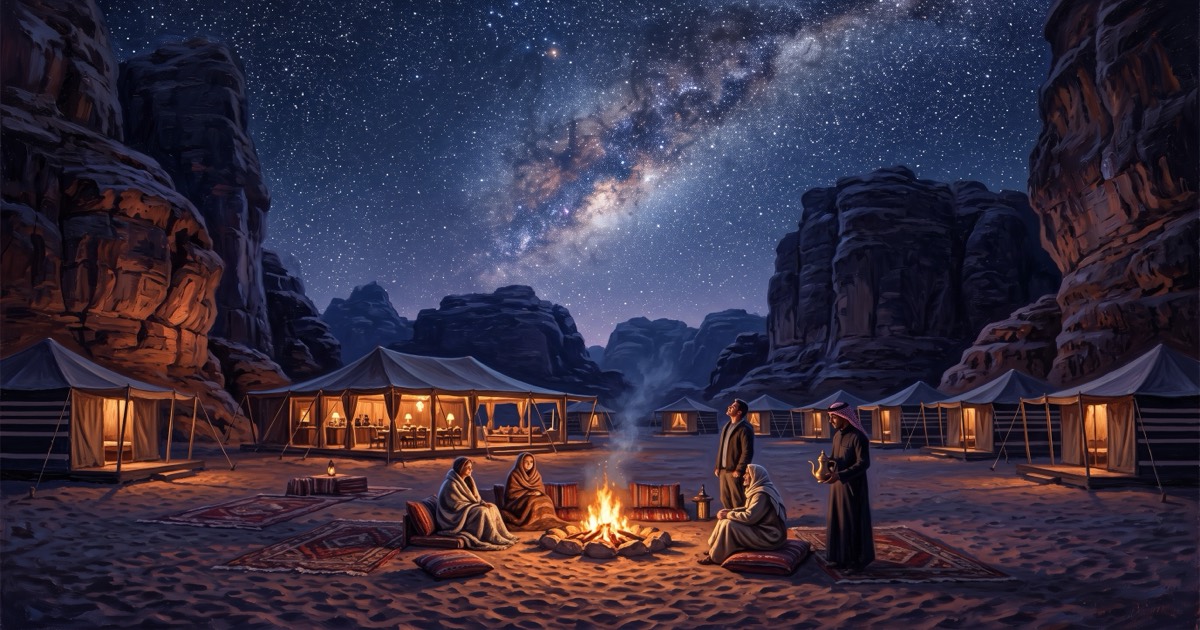
Desert camp under the Milky Way in Wadi Rum, guests around a fire between sandstone cliffs, Jordan

Jordan Apex 6 Wellness Resorts 2026 - Comparison at a Glance

ResortLocationTypeStayPrice RangeBest SeasonSignature ExperienceWellness Focus
Kempinski Hotel IshtarSweimeh, Dead SeaA La CarteFlexible$$$$Oct-AprTerraced pools descending to the Dead SeaDead Sea bathing & large-scale spa
Ma'in Hot SpringsMa'in, MadabaA La CarteFlexible$$Oct-AprBathing beneath hot waterfalls in a desert canyonThermal bathing & mineral springs
Memories Aicha Luxury CampWadi RumA La Carte1-3 nights$$Oct-AprSleeping under desert sky in a UNESCO landscapeSilence, dark skies & Bedouin hospitality
Mövenpick Resort PetraWadi MusaA La CarteFlexible$$$Mar-May, Sep-NovWalking to the Petra gate in under five minutesRest between long days on foot
Kempinski Hotel AqabaAqaba, Red SeaA La CarteFlexible$$$Oct-MaySoft coral reefs a short boat ride offshoreDiving, sea air & recovery
Ajloun Forest ReserveAjlounA La Carte1-3 nights$Mar-Jun, Sep-NovCooking a meal in a local family's homeForest walking & conservation stays
Before You Go: Dead Sea Safety
On Treatment Claims

Dead Sea climatotherapy for psoriasis is genuinely well studied, with supervised courses of three to four weeks reporting high response rates. Two things matter: the studied protocols run far longer than most holidays, and the developed clinical infrastructure sits on the Israeli shore rather than the Jordanian one. A third point is worth knowing if you are comparing the two shores, because it runs counter to what you might assume: the Israeli hotel beaches at Ein Bokek front a managed evaporation pond kept at a fixed level by the potash industry, while the Jordanian shore at Sweimeh faces the surviving natural lake. Both are dense brine and you float identically in either. But Jordan's shoreline is the one that is genuinely moving. If you are seeking treatment rather than a holiday, discuss it with your dermatologist first, particularly if you take systemic medication that interacts with sustained sun exposure.

One claim repeated constantly about the Dead Sea is that its air is ozone-rich. It is not. What is documented is higher atmospheric pressure at depth and the resulting filtering of UV-B. Ground-level ozone is a pollutant, not a therapeutic feature.

Best Jordan Wellness Resorts - Top 6 Currently

Kempinski Hotel Ishtar, Dead Sea

Jordan's largest five-star Dead Sea property, 345 rooms across terraced levels descending to the water, with the longest private beach in Jordan and nine...
Summary

Jordan's largest five-star Dead Sea property, 345 rooms across terraced levels descending to the water, with the longest private beach in Jordan and nine freshwater pools. Its spa, around 10,000 m², is commonly cited as the largest in the Middle East. The flagship Dead Sea resort on the Jordanian side, best suited to a multi-night stay where everything happens on the property, and to wellness rather than supervised medical treatment.

Experience & Spa Treatments

Setting: Sweimeh, the Dead Sea resort corridor, about an hour from Amman and 75 minutes from Queen Alia International Airport. The corridor is quiet with limited dining outside the hotels, which is why the property's own restaurant range matters.

What is offered
  • Ishtar Spa by Resense, around 10,000 m²
  • 20 treatment rooms with private showers
  • Six outdoor treatment and relaxation areas
  • Hydro-facilities: steam room, sauna, whirlpool, Tepidarium heated lounges
  • A dedicated Dead Sea pool and the largest hydro-pool in the Sweimeh cluster
  • Nine freshwater pools: four infinity, two secluded, a children's pool and a lazy river
  • The longest private beach in Jordan — but ASK HOW FAR THE WATER IS BEFORE YOU BOOK. Unlike the Israeli hotel strip at Ein Bokek, which fronts a managed industrial evaporation pond held at a constant level, the Jordanian resort coast at Sweimeh faces the real northern lake, which is falling by roughly a metre a year. The surface was recorded at about 441 metres below sea level in August 2026, some 45 metres lower than fifty years ago. Resorts here have repeatedly extended paths and moved beach infrastructure to follow the retreating water, and the walk from the pool terraces down to the actual shoreline now varies considerably between properties. Several run shuttles. If mobility matters to you, or you are picturing a short stroll into the water, confirm the current distance with the hotel rather than assuming, with direct sea access

The resort holds EarthCheck certification, which measures environmental, community and local-economy impact and is audited rather than voted.

Dead Sea bathing and mud have genuine published support for psoriasis and several rheumatologic conditions. But that evidence comes from supervised four-week climatotherapy protocols, not from spa treatments during a short stay. This is a luxury resort with an outstanding spa, not a medical facility, and there is no dermatology clinic on site.
One honest disclosure: the private beach, the longest in Jordan, has been built up with fine sand imported from the Red Sea. A visitor picturing a natural Dead Sea shore should know, and it quietly illustrates how far the water has receded.
Programmes & Activities
  • Floating in the Dead Sea, following the page safety guidance above
  • Mud application on the beach, the classic and genuinely pleasant
  • Mount Nebo, around 30 minutes, where Moses is said to have viewed the promised land, with a Byzantine church and mosaics
  • Dead Sea Panoramic Complex, 17 minutes, with a museum on the sea's geology and decline
  • Bethany Beyond the Jordan, a UNESCO World Heritage Site and the traditional site of Jesus's baptism, around 30 minutes
  • Madaba, for the sixth-century mosaic map of the Holy Land
  • Amman, an hour, for the Citadel and Roman theatre
Dining Experience

Several restaurants across the resort, which matters more here than usual because dining outside the hotels in Sweimeh is limited.

  • Obelisk, international and Levantine, overlooking the sea
  • Ashur, poolside pizza and grill
  • Jordanian cooking is excellent and under-rated: mansaf, the national dish of lamb and fermented dried yoghurt, maqluba, and outstanding mezze
Accommodations & Service

345 rooms and suites across terraced levels, most with sea views, plus Ishtar Villas with greater privacy. The scale is the point: nine pools and multiple restaurants mean a multi-night stay does not repeat itself. It is a large resort, and busy in peak season.

Pricing & FAQ
Estimated pricing
  • From around JOD 150 to 250 / US$210 to 350 per night, rates observed 2026
  • Day pass around JOD 65 per adult, JOD 35 per child, the premium tier in the Sweimeh cluster, typically including pool, beach, towels and mud access
Will a stay here treat my psoriasis?

Be precise about this. Dead Sea climatotherapy has genuine published support, including a study recording an 81.5% PASI reduction and complete clearance in 48% of patients. But that was a supervised 28-day protocol with prescribed, graduated sun exposure. A few days at a resort spa is not the same intervention, and there is no dermatology clinic here. If you are travelling specifically for treatment, arrange supervised care and decide with your dermatologist.

Is the sea still at the hotel?

Worth asking directly before booking. The Dead Sea has been shrinking for decades through water diversion and mineral extraction, and several resorts have had to extend walkways or shuttle guests to reach the shoreline. Kempinski Ishtar has the longest private beach in Jordan, but confirm current walking distance to the water. It is a fair question and a good property will answer it plainly.

Ma'in Hot Springs Resort & Spa

Hot waterfalls falling down a canyon wall, 264 metres below sea level
Summary

The valley holds around 109 hot and cold springs, at 264 metres below sea level, 74km south of Amman and 30km from Madaba. The falls are fed by winter rainfall on Jordan's highland plains, which percolates deep enough to be heated before rising, the same non-volcanic mechanism found at Caldas Novas in Brazil. Known in antiquity as Baaras, and Herod the Great is traditionally said to have bathed here.

Waterfalls at 30 to 65°C dropping into a desert canyon, which is genuinely extraordinary and unlike anything else in this guide.

Experience & Spa Treatments

Setting: A gorge in the hills above the Dead Sea, reached by a steep descending road — narrow, winding and a demanding drive if you are not used to mountain roads, which visitors mention often. The springs emerge hot from the rock face and fall directly onto bathing terraces. The resort holds around 97 rooms and ran for years as an Evason property with a Six Senses spa; it now operates independently. SET EXPECTATIONS ACCORDINGLY: the setting is extraordinary and nobody disputes that, but recent guest reports are consistent that the buildings and some facilities are tired and would benefit from investment. Come for the canyon and the water.

What is offered
  • Six waterfalls at different temperatures. The hottest, at around 65 degrees, is too hot to stand under and is not for contact — treat it as something to look at, not bathe in. Others run far cooler, including one at roughly 35 degrees reserved for women. Check which fall you are approaching before you step under it, and supervise children closely ranging from around 30°C to 65°C
  • Thermal pools fed directly by the springs
  • A hammam and treatment rooms in the Cascade Spa — a standalone building modelled on the desert palace at Qusayr Amra, holding around ten treatment rooms and a natural steam cave, with its own 34-degree waterfall falling into a pool. Note it sits roughly a kilometre from the main hotel, with a shuttle
  • Roman-era bathing history, with the site named in classical sources
The hottest falls, at around 65°C, cannot be entered. That is well above safe bathing temperature and would cause scalding. Bathing takes place at the cooler falls and in the fed pools. Standard thermal cautions apply: limit sessions, come out to cool, hydrate, and take medical advice first with cardiac conditions, uncontrolled blood pressure or in pregnancy.
Reviews consistently describe the hotel itself as dated. The waterfalls are the reason to come, and the accommodation is where you sleep.
Programmes & Activities
  • Bathing beneath the falls, the reason the site exists
  • The hammam and thermal pools
  • Mukawir (Machaerus), the hilltop fortress traditionally associated with the death of John the Baptist, around 30 minutes
  • Madaba, 30km, for the mosaic map
  • The Dead Sea, a short drive down to the shore
Dining Experience

Hotel dining, with limited alternatives nearby given the location in a gorge. Jordanian mezze and grills are the mainstay.

  • Buffet and à la carte at the resort
  • Dietary requirements should be advised in advance, as the site is remote
Accommodations & Service

A single resort property serving the springs. Comfortable rather than luxurious, and guest accounts are consistent that the setting outclasses the rooms. The property previously traded as Evason Ma'in and later as a Six Senses resort; older coverage under those names refers to the same place.

Pricing & FAQ
Estimated pricing
  • From around JOD 90 to 160 per night, rates observed 2026
  • Day pass around JOD 10 for the public section
Do I need to stay at the hotel?

No, and this is the single most useful thing to know about Ma'in. The site is split between a resort section and a public section, and the public area holds four of the six waterfalls. A day pass of around JOD 10 gets you in. The best of Ma'in therefore does not require staying at the hotel, which matters given that reviews describe the accommodation as dated.

Why is the water hot?

Winter rainfall on Jordan's highland plains percolates deep into the rock, is warmed by the Earth's natural temperature gradient at depth, and rises back to the surface under pressure. No volcanic activity is involved. It is the same mechanism that heats the springs at Caldas Novas in Brazil, and it is more interesting than the volcanic explanation people assume.

Memories Aicha Luxury Camp, Wadi Rum

Fifty-five tents and domes inside a UNESCO World Heritage desert
Summary

Wadi Rum is a UNESCO World Heritage Site of roughly 740 km², Jordan's largest wadi, inhabited since Neolithic times, and carrying petroglyphs, inscriptions and carvings left by successive cultures over thousands of years. Sandstone and granite mountains rise straight from red sand, and the silence at night is genuinely total.

Wadi Rum has dozens of camps at wildly varying standards, and the name on a booking site tells you very little. This one is named specifically because it is Bedouin-run, has its own site and takes direct bookings, and is consistent enough across hundreds of reviews to recommend without hedging. The wider guidance below still applies to choosing any camp here.

Experience & Spa Treatments

Setting: Southern Jordan, an hour from Aqaba, two hours from Petra, four from Amman. A Bedouin village sits at the centre of the reserve with a school, shops and a police post; many families own a house there and still live in tents outside for much of the year.

What a stay involves
  • Fifty-five units in all: canvas luxury tents, dome tents, and panoramic bubble tents with transparent roofs for sleeping under the stars. Every unit is air-conditioned with a private bathroom and shower — not the shared facilities common at cheaper camps. Larger tents add living and dining space for families. Communal life happens in a traditional Bedouin dining tent, a low-lit coffee and shisha lounge, and around an outdoor fire; dinner is often zarb, cooked in a covered pit in the sand and lifted out in front of guests. The camp is smoke-free indoors, roughly five to ten minutes' drive from the visitor centre, and jeep, camel and guided stargazing trips run from it
  • 4x4 desert tours to the main sites
  • Hiking and scrambling, including Jabal Umm ad Dami, Jordan's highest mountain
  • Stargazing, with effectively no light pollution, and the single best reason to stay overnight rather than visit for a day
  • Zarb, meat and vegetables cooked in an underground sand oven, the genuine Bedouin method
The desert is the risk, not the accommodation. Daytime summer temperatures regularly exceed 40°C, and night temperatures in winter fall near or below freezing. The swing between them is larger than most visitors expect, so bring layers whatever the season. Carry and drink far more water than feels necessary; heat exhaustion is the most common problem here.
Scrambling routes to the rock arches are unroped and exposed. Um Frouth and Burdah in particular involve real drops. Do not attempt them if you are uncomfortable with heights, and go with a guide. There is no mobile signal in much of the reserve and no rapid medical access. Tell your camp where you are going.
Programmes & Activities
  • Stargazing, the reason to stay the night
  • Sunset from a high dune, the standard closing of a day tour, and it earns its reputation
  • Khazali Canyon, with Thamudic and Nabataean inscriptions cut into the walls
  • Lawrence Spring and Lawrence's House, where the attributions are traditional rather than documented
  • Um Frouth and Burdah rock arches, both exposed scrambles
  • Jabal Umm ad Dami, Jordan's highest peak, a guided day
Dining Experience

Zarb is the thing to have: meat and vegetables buried in a sand oven and cooked for hours, uncovered at dinner. A genuine Bedouin method, though it is performed for guests at every camp.

  • Zarb, sweet sage tea and Bedouin bread
  • Mezze, grilled meats and vegetables
  • Alcohol is not served at most camps. The region is conservative and many operators are observant. Do not assume it is available
Accommodations & Service

Standards vary enormously, and price is not a reliable guide. The best camps are small, family-run, deep inside the Protected Area and quiet; the worst are large, close to the village and noisy. Ask about location within the reserve, not just the room type. Bubble and dome tents are climate-controlled; traditional tents are not.

Pricing & FAQ
Estimated pricing
  • Traditional Bedouin camps from around JOD 30 to 60 per person per night, usually with dinner and breakfast
  • Luxury domes and bubble tents from around JOD 120 to 250
  • Protected Area entry fee applies, covered by the Jordan Pass. Rates observed 2026
How do I choose a camp?

Three questions. Is it Bedouin-owned, and by which family? Where is it inside the Protected Area, deep or near the village? And what kind of tent? Traditional goat-hair tents are not heated or cooled; domes and bubbles are. In summer and winter that matters a great deal. Price alone tells you very little.

Is it worth staying overnight?

Yes, and it is the whole point. Wadi Rum by day is a landscape; Wadi Rum at night is a different experience entirely, with effectively no light pollution, total silence, and a sky that genuinely startles people. Day visitors miss it completely. One night is enough to understand it; two is better. WHY THIS ENTRY LINKS TO UNESCO RATHER THAN A CAMP: this is a category, not a property. The protected area covers around 74,000 hectares, was designated a reserve in 1997 and inscribed by UNESCO in 2011 as a mixed natural and cultural site, and is administered by the Aqaba Special Economic Zone Authority. Development inside it is restricted to native Bedouin, camps are regulated to keep traditional Bedouin elements, and an environmental fee is charged on vehicles entering from outside. Dozens of families run separate camps under those rules, so naming one would be a recommendation rather than a link, and this guide is not in a position to rank them. Choose on the operator's own reputation and on how they handle vehicles — off-road traffic, with visitor numbers estimated above 200,000 a year, is the single biggest pressure on the landscape and the one the IUCN has flagged.

Mövenpick Resort Petra

Fifty metres from the gate of Petra, a three-minute walk to the Visitor Centre
Summary

Fifty metres from the Visitor Centre and the Petra gate, which is the entire proposition. A three-minute walk to the Centre and about ten to the entrance of the Siq. Petra is a UNESCO World Heritage Site inscribed in 1985 and among the most significant archaeological sites in the world.

Somewhere to rest between long days on foot, and the location is worth more here than any spa facility. UNDERSTAND WHAT PETRA ASKS OF YOUR BODY, because it is the real reason a bed fifty metres from the gate is worth paying for. The full circuit — gate, Siq, Treasury, colonnaded street, then the climb to the Monastery and back — runs to roughly 14 to 15 kilometres with around 550 metres of ascent, and the Monastery alone is a gorge staircase of some 800 to 900 uneven rock-cut steps, commonly 45 to 60 minutes up. Visitors regularly log over 20,000 steps in a day. Add desert heat from late spring to early autumn and it becomes a serious day out rather than a stroll round a ruin. Start early, carry far more water than feels necessary, and if you only have the legs for one thing beyond the Treasury, make it the Monastery.

Experience & Spa Treatments

Setting: Wadi Musa, the town serving Petra, about three hours and 220km from Queen Alia International Airport. One thing this guide asks you to consider at Petra: horses, donkeys, mules and camels are offered constantly inside the site, including donkey rides up the Monastery steps. Animal welfare organisations have documented sustained mistreatment of the roughly 1,300 working animals there — beating, overloading, and work in extreme heat without shade or water — and have called publicly for rides to be banned. Authorities have introduced electric vehicles and pledged reform, but animal rides continue. This guide does not recommend them, consistent with its position at Hamat Gader and Aqaba. If you cannot walk the distance, the electric buggies exist for exactly that reason. It is also worth saying plainly that the handlers are largely local Bedouin for whom this is a livelihood, and the answer is better regulation and alternative work rather than blaming individuals.

What is offered
  • A spa with treatment rooms, hammam and sauna
  • Al Ghadeer Roof Garden, the leading rooftop restaurant in Petra, with views over the valley toward the entrance to the ruins
  • A complimentary chocolate hour each afternoon, a Mövenpick signature
  • Recently refurbished throughout

The interiors are the property's genuine distinction. The Al Maqa'ad Bar and Al Multaqa Lounge carry antique hand-carved wall and ceiling decoration, Damascus-style detailing and a five-metre handmade brass chandelier.

Two things the hotel states plainly in its own FAQ, and almost no guide mentions: it does not organise tours, and it does not offer transportation. The Petra Visitor Centre across the street provides guides in most languages, and operators in Wadi Musa arrange transport. Guests booking a five-star resort at a World Heritage site routinely assume both are included.
Programmes & Activities
  • Petra, a UNESCO World Heritage Site and the Nabataean capital, carved from rose sandstone
  • The Monastery (Ad Deir), reached by more than 800 steps. Start early and carry water
  • Petra by Night, the candlelit Siq walk, on set evenings
  • Little Petra (Siq al-Barid), quieter and often overlooked
  • Wadi Rum, two hours south
Two safety points. Flash flooding in the Siq is a real hazard, and the site closes when rain is forecast. Heed closures without argument. Animal rides within Petra are offered persistently; this guide does not encourage them, and welfare standards have been a longstanding concern.
Dining Experience

Several outlets across the property, with the rooftop the one to book.

  • Al Ghadeer Roof Garden, with valley views
  • Buffet and à la carte dining
  • Jordanian mezze, grills and mansaf
Accommodations & Service

Around 180 bedrooms in a stone building matched to the town. Comfortable and well run, and the location does the heavy lifting. After eight hours walking Petra, being able to reach a room in three minutes is worth a great deal.

Pricing & FAQ
Estimated pricing
  • From around JOD 110 to 200 per night, rates observed 2026
  • Petra entry is separate and is covered by the Jordan Pass, which is worth buying before arrival
Does the hotel arrange guides and transport?

No, and it says so plainly. The Visitor Centre across the street provides licensed guides in most languages, and operators in Wadi Musa arrange transport. It is worth knowing before you arrive expecting a concierge to handle it.

How many days do I need at Petra?

Two, ideally. One day covers the Siq, the Treasury and the main street; the second gets you to the Monastery, the High Place of Sacrifice and Little Petra without rushing. The site is far larger than photographs suggest, and the walking is substantial.

Kempinski Hotel Aqaba Red Sea

Jordan's only coastline is 27km long, and this is the best-sited hotel on it
Summary

200 rooms and suites, all with Red Sea views, and a two-floor spa overlooking the water. Ten minutes from King Hussein International in Aqaba, but roughly three hours from Queen Alia International in Amman by the desert road, which visitors routinely misjudge.

Listed in the MICHELIN Guide's hotel selection, which describes the building as a retro monument to 1970s modernism. Aqaba is Jordan's only coastal city, historically known as Ayla, and sits in what Jordan calls its golden triangle of tourism with Petra and Wadi Rum.

Experience & Spa Treatments

Setting: King Hussein Street, on the Aqaba shore, with the mountains of Sinai visible across the gulf on clear days.

What is offered
  • A two-floor spa with panoramic Red Sea views
  • A private white sand beach and an infinity-edge pool
  • Hammam, sauna and treatment rooms
  • Direct access to the reef for snorkelling and diving — a reef of real scientific significance rather than simply a pretty one

The reef is what makes Aqaba worth the journey, and the reason is more interesting than most people realise. The corals of the Gulf of Aqaba are among the most heat-tolerant on earth. The accepted explanation is that they recolonised northward through the Red Sea after the last ice age, passing through the very warm waters of the Bab el-Mandab strait, which selected for thermal resistance before their descendants settled in this cooler northern gulf. Common species here have withstood water several degrees above their summer maximum without bleaching, temperatures that would kill reefs almost anywhere else, and the gulf came through four consecutive intensifying marine heatwaves including the extreme event of 2024. Researchers describe it as one of the last natural refuges for reef survival at a time when something like 44 per cent of reef-building corals are considered at risk of extinction. THE HONEST QUALIFIER: shallow bleaching was recorded during the 2024 heatwave, and the scientists studying it say plainly that the refuge may be approaching its limit and that local pollution matters alongside global warming. Snorkel it gently, use reef-safe sunscreen, touch nothing, and choose operators who brief properly. Around 110 species of soft coral are recorded in the Gulf of Aqaba, and the diving is widely regarded as the best in Jordan.

The hotel does not run its own dive centre. Use an established operator and ask about instructor certification and group sizes before booking. Reef etiquette matters here: do not touch or stand on coral, do not wear chemical sunscreen in the water, and keep well clear of the seabed.
Programmes & Activities
  • Diving and snorkelling on the Gulf of Aqaba reefs
  • Aqaba's old town and souk
  • Wadi Rum, an hour inland
  • Petra, around two hours north
  • Ayla, the early Islamic city excavation, in Aqaba itself
Among Aqaba's attractions is a captive dolphin facility. This guide does not recommend captive-cetacean attractions anywhere. It is a city attraction rather than a hotel amenity, and the reef offers far better wildlife encounters on the animals' own terms.
Dining Experience

Several restaurants on site, and Aqaba town has a genuine local dining scene, which is not true of the Dead Sea corridor.

  • Seafood, unsurprisingly, and it is good
  • Sayadieh, the Levantine spiced fish and rice dish
  • Jordanian mezze and grills
Accommodations & Service

200 rooms and suites, every one with a guaranteed sea view. The architecture is bold and dated in a way that has come back around. It is not a discreet boutique property and does not pretend to be.

Pricing & FAQ
Estimated pricing
  • From around JOD 120 to 220 per night, rates observed 2026
Is the diving really worth it?

Yes. The Gulf of Aqaba holds around 110 species of soft coral, and because Jordan's coastline is only 27km long the reefs have had far less pressure than comparable sites. Visibility is generally excellent. Use a certified operator, ask about group size, and do not touch anything.

How far is Amman really?

About three hours by the desert highway, and this catches people out. Aqaba's own airport is ten minutes from the hotel, so flying in directly is much easier than driving down from Queen Alia. If you are combining Aqaba with Petra and Wadi Rum, the geography works well; combining it with the Dead Sea in a short trip does not.

Ajloun Forest Reserve Cabins

Twenty-three cabins among oak, carob and wild pistachio, the last substantial forest in northern Jordan
Summary

Twenty-three cabins in a clearing among oak, carob, wild pistachio and strawberry trees, protecting one of Jordan's last tracts of Eastern Mediterranean oak forest. Established 1987, around 13 km², at elevations of 700 to 1,000 metres, which creates a cool, moist microclimate quite unlike the rest of the country.

Operated by the Royal Society for the Conservation of Nature, founded 1966, through its Wild Jordan ecotourism arm. Income from the cabins funds reserve management and local employment.

Experience & Spa Treatments

Setting: Around 75km north of Amman, about 90 minutes. Green, forested Jordan surprises visitors who assume the country is uniformly desert.

What a stay involves
  • Twenty-three cabins, plus bungalows with shared facilities
  • Two restaurants: the Roe Deer Restaurant at the cabins, and Al-Ballout at the Royal Academy for Nature Conservation, both serving homemade local food
  • Guided trails including the Prophet's Trail and the full-day Orjan to Ajloun Trail
  • Guided night walks for bats and mammals
  • Wildlife includes striped hyena, crested porcupine and stone marten; spring brings anemones and rockroses

This is a conservation reserve with accommodation, not a spa. There are no treatments, and the entry does not pretend otherwise. What it offers is forest, quiet and a genuinely funded conservation model.

Programmes & Activities

The programme worth booking: RSCN runs a cooking with local residents experience, where guests cook and then share a traditional meal in a local family's home. That is community tourism with the income reaching the community, and it illustrates the reserve's model better than any facility list.

  • Forest walking on marked trails
  • Ajloun Castle (Qal'at ar-Rabad), a twelfth-century Ayyubid fortress nearby
  • Local craft workshops supported by the reserve
  • Jerash, one of the best-preserved Roman provincial cities anywhere, around an hour
The reserve runs one of Jordan's most successful deer reintroduction programmes. Sources differ on the species, so this guide does not name it. Confirm with RSCN if the detail matters to you.
Dining Experience

Simple, local and genuinely good. Both restaurants serve homemade Jordanian food, and the produce is regional.

  • Roe Deer Restaurant at the cabins
  • Al-Ballout at the Royal Academy for Nature Conservation
  • Dietary requirements should be advised in advance
Accommodations & Service

Twenty-three cabins, plain and comfortable, sited among the trees. Bungalows with shared facilities are also available. Expect a nature-reserve standard rather than a hotel one, staffed by people from the surrounding villages.

Pricing & FAQ
Estimated pricing
  • Cabins from around JOD 60 to 110 per night, rates observed 2026
  • The most affordable entry on this page, and among the most affordable in this guide
Is Jordan really forested?

In the north, yes, and it surprises people. Ajloun protects one of the last substantial tracts of Eastern Mediterranean oak forest, a woodland type once widespread across the Levantine highlands. At 700 to 1,000 metres it is cool and moist, and in spring the ground cover is dense with wildflowers. It is the one place in Jordan that stays comfortable in summer.

Why stay here rather than a hotel?

Because the money does something. RSCN is a national conservation body and the cabins fund reserve management and local employment. The cooking programme puts income directly into a local household. If you want a spa, this is the wrong entry on this page. If you want a forest, a good meal and a stay that funds the thing you came to see, it is the right one.

Jordan Wellness Resorts: Unique Selection Data Points

Six properties, selected on evidence rather than marketing. Two are internationally significant for reasons that have nothing to do with hospitality: the Dead Sea for four decades of published psoriasis research, and Wadi Rum for a UNESCO inscription covering roughly 740 square kilometres. One is run by a national conservation body. One holds an audited environmental certification. Two carry claims this guide declined to repeat, and says which and why. Prices run from about ten Jordanian dinars for a day at the hot springs to several hundred for a Dead Sea suite, which is a wider span than any other page in this guide.

Frequently Asked Questions: Jordan Wellness Resorts

Is Dead Sea treatment actually proven for psoriasis?

This is the strongest evidence base in the guide, and it is genuinely good. Published dermatology going back forty years describes high response rates for supervised climatotherapy, a combination of graduated sun exposure, bathing and rest over three to four weeks. Two things matter. It is a supervised course, not a spa weekend, and the studied protocols run far longer than most holidays. And the developed clinical infrastructure sits on the Israeli shore, not the Jordanian one. If you are seeking treatment rather than a holiday, discuss it with your dermatologist first, particularly if you take systemic medication, since some interact badly with sustained sun exposure.

How do I float in the Dead Sea safely?

Never put your head under, and never swallow the water. The salinity is high enough to cause serious harm if aspirated. Do not shave that day, and keep it out of your eyes. Enter slowly, float on your back, and rinse thoroughly in fresh water afterwards. Twenty minutes is plenty. Wear something on your feet: the salt crystallises into sharp formations along the shore.

When should I visit Jordan?

October to April for the Dead Sea, Wadi Rum and Aqaba, when the heat is manageable. March to May and September to November for Petra and Ajloun, when walking is comfortable. Summer at the Dead Sea regularly exceeds 40 degrees, and Wadi Rum swings from very hot days to genuinely cold nights year-round. The forest at Ajloun is the one place in Jordan that stays cool.

Is the Dead Sea really disappearing?

Yes, and visibly. The water level has been falling for decades, largely through diversion of the Jordan River and mineral extraction. Hotels that once stood at the shoreline now run shuttles down to the water. Sinkholes have opened along both shores as the retreating water leaves unstable ground behind. Stay on marked paths and use hotel beach access rather than walking out across open ground.

Can I visit Wadi Rum responsibly?

Book with Bedouin-owned camps rather than operators headquartered elsewhere, and ask directly who owns and staffs the camp. Wadi Rum is a protected area and a living community, not a film set. Take your litter out with you, do not climb on or touch rock art, and expect no mobile signal in much of the area.