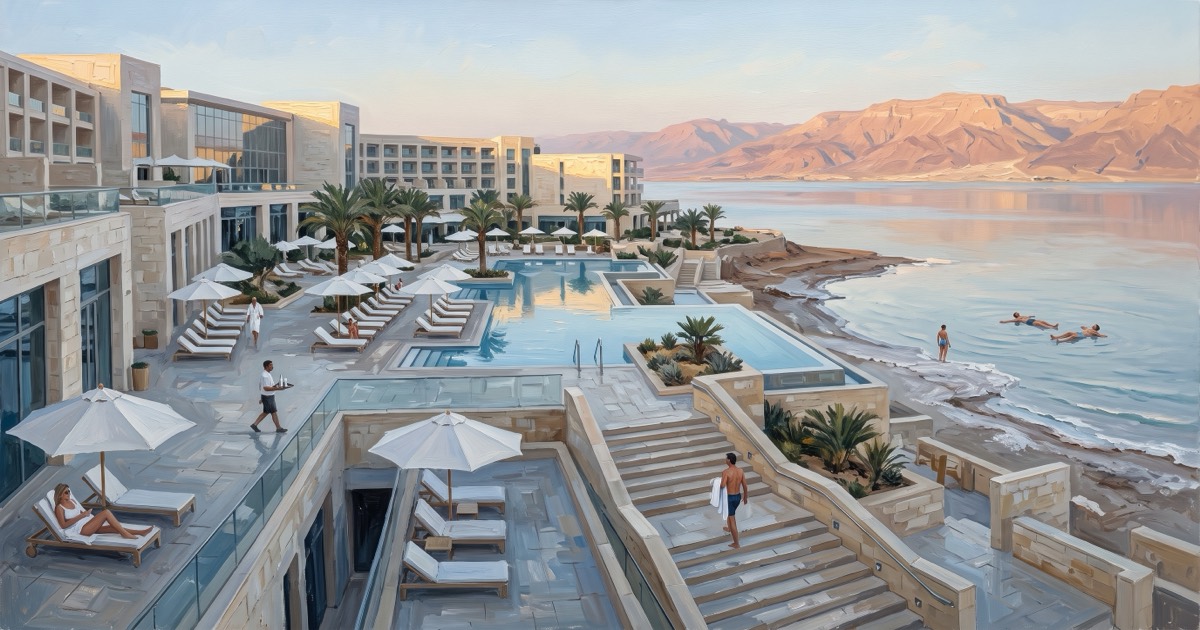
Israel holds the best-evidenced wellness claim in this guide, and the most consequential safety material to go with it. Four decades of published dermatology have studied Dead Sea climatotherapy for psoriasis, with supervised courses reporting high response rates. But the studied protocol is three to four weeks under medical supervision, not a spa weekend, and one claim repeated constantly about the Dead Sea is simply wrong. Beyond the shore there is Roman bathing at Hamat Gader, springs at Tiberias named in the Talmud, the country's largest health spa in a forest reserve, and a desert landform found almost nowhere else on Earth. One property runs supervised climatotherapy that functions as a medical wellness retreat measured in weeks; the others are wellness resorts and day bathing sites where the water is available and the schedule is your own.

| Resort | Location | Type | Stay | Price Range | Best Season | Signature Experience | Wellness Focus |
|---|---|---|---|---|---|---|---|
| Lot Spa Hotel / DMZ Medical Center | Ein Bokek, Dead Sea | All-Inclusive | 3-4 weeks | $$$ | Oct-Apr | Physician-supervised climatotherapy | Dermatology, rheumatology, respiratory |
| Herbert Samuel Hod (formerly Hod HaMidbar) | Ein Bokek, Dead Sea | A La Carte | Flexible | $$$ | Oct-Apr | Mineral pools graded by concentration | Treatment-oriented Dead Sea hotel |
| Hamat Gader | Golan foothills | Day Visit | Day sessions | $ | Oct-Apr | Roman baths built by the Tenth Legion | Thermal bathing at 42C |
| Lakehouse Kinneret | Tiberias, Galilee | Day Visit | Day sessions | $ | Oct-Apr | Springs named in the Talmud, inside the hotel | Ancient mineral bathing |
| Carmel Forest Spa Resort | Carmel Forest, Haifa | All-Inclusive | Flexible | $$$$ | Mar-Nov | Israel's largest health spa, adults 16+ | Destination spa & programme |
| Beresheet | Mitzpe Ramon, Negev | A La Carte | Flexible | $$$$ | Oct-Apr | Villas on the rim of the Makhtesh Ramon | Desert luxury & dark skies |
Dead Sea climatotherapy for psoriasis is genuinely well studied. A 2024 review authored from Hadassah Medical Center and the Hebrew University of Jerusalem summarised forty years of clinical work, with supervised courses reporting high response rates, up to around 88% of patients achieving PASI 75.
Why it works is understood and unremarkable. The shore sits roughly 430 metres below sea level, and the additional atmosphere filters UV-B while admitting UV-A, allowing longer, gentler sun exposure than at sea level. The water carries roughly 34% dissolved minerals, around ten times Mediterranean salinity. The studied protocol is a supervised course of three to four weeks, not a spa weekend.
The correction that matters most: ozone-rich air is repeated constantly about the Dead Sea, including in hotel marketing. It is wrong. What is documented is higher atmospheric pressure and UV-B filtering. Ground-level ozone is a pollutant, not a therapeutic feature.
Systemic steroids and sustained sun phototherapy are incompatible, and clinics advise reviewing medication well before travel. But abrupt withdrawal of steroid medication carries its own serious risk.
Any change is a decision for your prescribing doctor, made months ahead, never on arrival and never on a clinic's advice alone. A family history of melanoma, or numerous atypical naevi, requires dermatologist consultation before booking sun-based treatment.
Documented course lengths: around one week general, two to three weeks musculoskeletal, three to four weeks dermatological.
The Dead Sea is shared with Jordan, which has its own page in this guide. The Israeli side has the more developed clinical infrastructure; the Jordanian side has fewer medical clinics and a quieter shore. Both pages state this.
The DMZ Medical Center employs dermatologists, rheumatologists and pulmonologists, and its clinical work has been documented in peer-reviewed literature over four decades. It sits within the Lot Spa Hotel on the Ein Bokek strip.
This is a supervised medical facility rather than a spa, and it is the reason this country page exists.
Setting: Ein Bokek, the Dead Sea hotel strip, around 90 minutes from Jerusalem and two hours from Tel Aviv. DMZ stands for Deutsches Medizinisches Zentrum, the German Medical Centre, and the German connection is not incidental: German and Scandinavian national health insurers have historically subsidised courses here for patients with documented psoriasis, which is about as strong an external validation as a facility of this kind can have. The mechanism is geographic. At roughly 430 metres below sea level this is the lowest exposed land on earth, and the extra atmospheric depth scatters a disproportionate share of the shorter, burning UVB wavelengths while letting longer wavelengths through. Patients can therefore accumulate a therapeutic ultraviolet dose with less burn risk than the same exposure at sea level.
Hotel board, typically half or full, with treatment guests often eating on a set schedule.
Functional rather than luxurious, and the page says so. The clinical provision is the reason to come. The Ein Bokek strip has a wide range of hotels within walking distance if you want more comfort nearby.
Sometimes. German and Scandinavian insurers have historically subsidised supervised Dead Sea courses for psoriasis. Arrangements vary by country and change, so check with your own provider and your dermatologist before booking.
Supervision. A physician assesses you, sets exposure times and monitors response. A hotel spa sells mud and a beach. Both can be pleasant; only one is a treatment course, and only one has forty years of published literature behind it.
The most treatment-oriented of the Ein Bokek hotels, with mineral pools classified by temperature and concentration to match therapeutic protocols, and dermatology consultation available on site.
More structured than a resort spa, less clinical than the DMZ. Useful for anyone who wants supervision without committing to a full medical course.
Setting: Ein Bokek, on the Dead Sea shore, with direct beach access; around 203 rooms, recently renovated under Herbert Samuel Hotels. One thing worth understanding about all of Ein Bokek, not just this hotel: the water you bathe in here is not the open Dead Sea. The natural lake's northern basin has been falling for decades — the surface was around 441 metres below sea level in August 2026, some 45 metres lower than fifty years ago — and its shoreline has retreated well away from the hotels. The Ein Bokek strip now fronts a large evaporation pond maintained as part of the Dead Sea Works potash operation, which is why the water level here stays constant while the sea itself shrinks, and why more than six thousand sinkholes have formed along the abandoned natural shoreline since the 1980s. The brine is genuine, you float exactly as you would in the lake, and the therapeutic properties are unaffected. There is even a practical upside: because the pond is held at a fixed level, the walk to the water here does not lengthen year by year, which it does on the Jordanian shore opposite. But the postcard is managed, and a guide that did not say so would be selling you a picture rather than a place.
Half or full board, with Israeli hotel breakfast a genuine highlight.
Comfortable four-star standard, with a clientele weighted toward treatment guests and returning European visitors, on the Ein Bokek strip at the southern end of the Dead Sea. The conditions here are genuinely unusual and worth understanding correctly: this is the lowest land on earth, the water runs roughly ten times saltier than the ocean, and the extra atmosphere overhead filters UV-B more heavily than anywhere else, which is why supervised sun exposure forms part of the dermatological protocols. What is not true, despite appearing constantly in local hotel marketing, is that the air is ozone-rich; that claim is addressed in full elsewhere on this page. The practical caution is the heat, which is extreme from May to September, and the sinkholes that have opened along parts of the shoreline, which is why bathing should be at the maintained hotel beaches rather than wherever the water looks accessible. The register is quieter and more purposeful than a general resort hotel.
The evidence is strongest for psoriasis. There is reasonable support for atopic dermatitis and for some musculoskeletal conditions, and much weaker support for most other claims made about it. Warm mineral bathing eases stiffness, which is uncontroversial and does not require any additional framing.
If you are travelling for a supervised medical course, the DMZ. If you want a comfortable Dead Sea stay with graded mineral pools and a dermatologist available, this. The two are minutes apart on the same strip, so it is a question of intent rather than location.
Israel's largest and oldest spa complex, on the site of the ancient Greek city of Gadara. The Romans built here, with the baths established by the Tenth Legion and recorded as among the largest in the entire Empire. The water rises at a steady 42 degrees, flowing at 500 to 700 cubic metres per hour.
Forty acres of thermal pools and genuine archaeology, and one thing this guide does not endorse. The archaeology is the real draw and deserves more than a passing mention. The bath complex was begun in the second century by the Tenth Legion, garrisoned at nearby Gadara, and grew into a series of decorated pools in interconnected halls fed from the hottest spring. A Roman theatre seating around 2,000 followed in the third century, and a large synagogue with mosaics and inscriptions in the fifth — a section of its mosaic pavement now sits in the entrance hall of Israel's Supreme Court. More than forty inscriptions have been recovered, showing the baths were used by pagans, Christians, Jews and Muslims in turn. Earthquakes damaged the complex in the seventh and eighth centuries; it was rebuilt under the Umayyads, abandoned by the ninth, and buried under silt from its own springs until systematic excavation between 1979 and 1982.
Hamat Gader operates a crocodile farm of around 200 animals, a petting zoo and parrot shows. This guide does not recommend captive-animal attractions anywhere, and the position applies here as it does at Aqaba and across the South Africa page.
The thermal pools and the Roman ruins are the reason to come, and can be visited without engaging with the animal facilities. It is stated plainly rather than omitted.
Setting: The Golan foothills in the Yarmouk valley on the southeastern side of the Sea of Galilee, a short drive from Tiberias. Five springs rise here, four mineral and one fresh, the hottest reaching around 50 to 52 degrees at source. The site sat within the demilitarised zone between Israel and Syria from 1949 until 1967 and was abandoned throughout that period, which is part of why the archaeology survived as well as it did.
Two restaurants on site, and reviewers commonly suggest bringing your own food. Galilee cooking nearby is excellent.
Spa Village Hamat Gader is on site. Tiberias, 20 to 30 minutes away, has the full range, typically ILS 400 to 900 a night, rates observed 2026.
Roman, and significant. The complex was developed by the Tenth Legion and is recorded as among the largest bathhouses in the Roman Empire. The site is ancient Gadara, and the ruins are genuine rather than reconstructed. That archaeology is the reason to come.
Yes. The thermal pools and the Roman ruins are in a separate part of the complex and can be visited without engaging with the crocodile farm, petting zoo or parrot shows. This guide states their existence plainly rather than hiding it, and recommends the bathing and the archaeology on their own terms.
Seventeen separate hot springs feed the complex, rising from more than 180 metres below sea level, beside Hamat Tiberias National Park. The springs are named in the Talmud, which makes this among the oldest continuously used bathing sites anywhere in this guide.
The Hamei Tiberias springs complex is housed within the hotel itself, so the bathing is not an excursion but part of the stay: indoor and outdoor thermo-mineral pools, a cold pool, a full gym and a spa complex, with the Kinneret beach across the road. The water rises at around 60 degrees and is cooled to roughly 37 to 38 for the pools. Hot pools stay open until 9pm from Tuesday to Thursday, later than most Israeli spa hotels. Two points to know before booking: the spa areas admit guests aged 16 and over only, so this is not a family wellness stay despite the beach; and the complex is a working public bathing facility as well as a hotel amenity, which means day visitors share it — entry runs around 75 shekels for adults. Come for the springs and the history rather than for resort polish.
Setting: Tiberias, on the western shore of the Sea of Galilee, around two hours from Tel Aviv.
Tiberias has good, plain Galilee cooking, and facilities at the springs themselves are limited.
The springs are a day facility, and the antiquity here is documented rather than claimed. Seventeen natural hot springs rise on this stretch of the Kinneret shore at around 60 degrees, carrying sulphur, sodium, calcium, magnesium, bromide and sulphate, and they were channelled and bathed in under Rome; Herod Antipas founded the city in 20 AD and Pliny the Elder wrote about the baths. The Talmud discusses them, and the sages permitted bathing here even on Shabbat. The adjacent Hamat Tiberias National Park holds the excavated Roman baths and a fourth-century synagogue with a mosaic floor combining a menorah and shofar with a zodiac wheel and a depiction of Helios, which is worth seeing whether or not you bathe. The modern facility cools the water into graded pools; at source it is hot enough to scald, so bathing is in the cooled channels rather than at the spring itself. Tiberias has a wide range, typically ILS 350 to 900 a night, rates observed 2026, and lakefront rooms are worth the premium.
The older one for the bathing tradition and separate-sex sessions; the newer for families and the Kinneret beach. They are across the road from each other and priced separately, so check which your ticket covers before you arrive.
The springs are named in the Talmud, which places recorded use at close to two thousand years. Hamat Tiberias National Park next door holds a synagogue mosaic from the same broad period. Bathing here is genuinely continuous with antiquity, and that is the entry's real substance.
Israel's largest health spa, on roughly 7.5 hectares inside the Carmel Forest Reserve. 126 rooms and suites, and a spa building of around 2,500 square metres with more than 70 treatments, workshop spaces, wet and dry saunas, a Turkish bath and a solarium.
Officially rated 5-star superior by the Israeli Ministry of Tourism, which is a state classification rather than an award. Adults only, 16 and over.
Part of Isrotel Exclusive, which also operates Beresheet on this page. Herbert Samuel Hod, formerly Hod HaMidbar, now sits under the Herbert Samuel brand rather than Isrotel. Three of six properties share an operator. All three are retained because each is genuinely apex for its landscape, Dead Sea, forest and desert, but the concentration is disclosed so readers can weigh it.
Setting: Inside the Carmel Forest Reserve above Haifa near Beit Oren, Mediterranean woodland and the greenest setting on this page — around 15km from central Haifa and about an hour and a half from Ben Gurion airport. It is part of the Isrotel Exclusive Collection, rated five-plus stars by the Israeli Ministry of Tourism, with 126 rooms and suites. THREE HOUSE RULES SHAPE THE ATMOSPHERE AND ARE WORTH KNOWING BEFORE YOU BOOK: guests must be 16 or over, those aged 16 to 18 must be accompanied by an adult over 21, and MOBILE PHONES AND SMOKING ARE BOTH PROHIBITED IN PUBLIC AREAS. The phone rule in particular is unusual and is much of why the place is as quiet as it is. IF YOU ARE TRAVELLING WITH YOUNGER CHILDREN, you are not out of options: Isrotel runs a large portfolio across Israel including properties built for families, and Beresheet at Mitzpe Ramon, further down this page, takes children — so a family group can stay within the same group rather than abandon the idea.
Full board is standard, with a spa-oriented menu alongside conventional dining, and a cocktail bar.
126 rooms and suites, all facing forest, recently renovated, plus three villas. Service is consistently the most-praised element in guest accounts.
Closer to a programme than most. The workshops, lectures and classes are real, and the property was built as a health resort rather than retrofitted. But there is no physician assessment and no clinical supervision. For that, the Dead Sea properties on this page are the ones with medical staffing.
The property is explicit that guests must be 16 or over. It is built around quiet, and the policy is the reason it stays quiet. Families should look elsewhere on this page.
On the rim of the Makhtesh Ramon, with 111 rooms and villas across 50,000 square metres of desert. Thirty-nine ground-level rooms have private pools. Built from local stone, low against the rim, and genuinely admired as architecture.
The desert apex of this page, and the most striking property on it.
The Makhtesh Ramon is not a crater. It is an erosion landform, a makhtesh, created by water eroding softer rock beneath a harder surface layer and then draining away. It is around 40km long and up to 500m deep, and makhteshim are found almost nowhere else on Earth.
Most coverage calls it a crater. It is not one, and the real explanation is more interesting.
Setting: Derech Beresheet 1, Mitzpe Ramon, in the Negev, around three hours from Tel Aviv.
Rosemary Restaurant, using produce from local farms. Negev agriculture is genuinely interesting, with desert viticulture and goat dairies along the Ramon and Arava routes.
111 rooms and villas across 50,000 square metres, 39 with private pools and the rest with large balconies. Bookings are accepted only from adults over 18, though under-18s may stay accompanied.
A luxury desert hotel with a very good spa, and the page says so rather than dressing it up. What is genuinely restorative here is the silence, the scale and the dark skies, which is a well-founded reason to go and needs no treatment menu attached.
October to April. Summer in the Negev is extreme, and while the hotel is comfortable, the landscape that justifies the journey becomes unusable in the middle of the day. Winter nights are genuinely cold, which surprises people.
Six properties on a page carrying the best-evidenced wellness claim in this guide and the most consequential safety material. One is a physician-staffed medical centre documented in peer-reviewed literature over four decades. One holds a state 5-star superior classification from the Ministry of Tourism, which outranks any voted award. One sits on Roman baths built by the Tenth Legion; another on springs named in the Talmud. Three of the six share an operator, and the concentration is disclosed rather than hidden. Two awards are typed as reader-voted or editorial rather than repeated as inspected. One captive-animal facility is stated plainly rather than omitted.
For psoriasis, the evidence is genuinely good and is the strongest in this guide. A 2024 review from Hadassah Medical Center and the Hebrew University summarised forty years of clinical work, with supervised courses reporting up to around 88% of patients achieving PASI 75. The mechanism is understood: the shore sits roughly 430 metres below sea level, and the extra atmosphere filters UV-B while admitting UV-A, allowing longer, gentler exposure. The critical caveat is that the studied protocol runs three to four weeks under supervision, not a spa weekend.
It is wrong, and it is repeated constantly including in hotel marketing. What is documented is higher atmospheric pressure at depth and the resulting filtering of UV-B. Ground-level ozone is a pollutant, not a therapeutic feature. This guide does not carry the claim anywhere.
Systemic steroids and sustained sun phototherapy are incompatible, and clinics advise reviewing medication well before travel. But abrupt withdrawal of steroid medication carries its own serious risk. Any change is a decision for your prescribing doctor, made months ahead, never on arrival and never on a clinic's advice alone. A family history of melanoma or numerous atypical naevi requires dermatologist consultation before booking sun-based treatment.
Never put your head under and never swallow the water, since aspiration causes serious harm. Do not shave that day, keep it out of your eyes, and rinse thoroughly afterwards. Twenty minutes is plenty, and wear something on your feet because salt crystallises into sharp formations. The sea is shrinking and sinkholes have opened along both shores, so stay on marked paths and use hotel beach access.
The sea is shared with Jordan, which has its own page in this guide. The Israeli side has the more developed clinical infrastructure, with physician-staffed centres at Ein Bokek. The Jordanian side has fewer medical clinics and a quieter shore. If you are travelling for supervised treatment, that difference is decisive; if you want a quiet stay by the water, it is not.